Lessons You Learn At University Go Way Beyond the Academic

If you need any further explanation that university can help you experience all sorts of things beyond your degree study, a University of Glamorgan student gives a bit more perspective in a list.

Student Ambassador, Aisling Galligan, has listed just some of the things she has been learning so far at university.

Aisling is currently in her second year at Glamorgan

Aisling is currently in her second year, studying Drama at Glamorgan

First on the list, Aisling now knows how to make ‘a wicked chilli-con-carne’. Her list is clearly not limited to academic learning.

Finding good deals, designing and painting, presenting videos, harmonising in a choir, effective reading of academic journals, and smiling more… the list covers all sorts. I’m sure it is just the tip of the iceberg, since Aisling calls her list a ‘selection’. And given she’s only in her second year, there will be many more learning opportunities to come.

That’s how it should be. A wealth of new discoveries is a big part of why you’re at uni. It’s hard to work out a true value to higher education because it’s an individual thing and it’s not entirely visible without hindsight. However, a simple list like Aisling has produced can help uncover the diversity of what’s available.

If you could list the things you’ve learned at uni, what things have (so far) been most valuable to you?

Trust Yourself: You’re More Effective Than You Think

Can you trust yourself to be effective? Can you trust yourself to succeed where it matters? Can you trust yourself to keep on learning?

The answers should be yes, Yes, and YES.

Nobody can achieve everything on their own. But unless you trust yourself to push forward and keep exploring what works for you, everyone else’s help will go to waste.
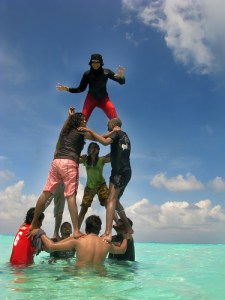
photo by notsogoodphotography

What’s the use in listening to others if you don’t listen to yourself? As the title of this post says, you are more effective than you think. Just trust yourself and get ready to shine.

The one way to write effectively – YOUR way

Top writing takes practice, takes mistakes, and takes guts. As you progress, your depth and breadth of knowledge will increase. Plus, you’ll learn tips along the way and discover loads of techniques to make an impact and save time.

Learn from others, but don’t try to imitate a style or write the way you *think* is expected of you.

At uni, your first year grades rarely count toward your final degree result (but do check first!). Instead of using this as an opportunity to take it easy, take each assignment as an experiment to find what works for you.

Be prepared to make mistakes and learn from them. That’s why draft essay attempts are better than pulling off a single all-nighter. Tutors can check where you’re headed and give you advice and feedback before you’ve even handed in the piece of work.

The more you attempt and explore, the more likely your own styles of writing will become apparent. This is massively powerful.

Don’t think unique. Think U-know!

Undergraduate learning is mostly about understanding, exploring, reaching conclusions, assessing other conclusions, and so on. There’s a difference between undergraduate and postgraduate work. Your job is not to find an unexplored angle of the universe and claim it as your own.

If you stumble upon something amazing, it’s either been done before or you’ve managed a massively rare fluke. Either way, you’re still learning and discovering, so it’s no bad thing.

I could say it’s better to ‘know’ you know than to ‘think’ you know. But there’s no room for arrogance in academic writing. Well, there shouldn’t be room anyway… Build up as much confidence as you can and continue to seek help from tutors and your network as necessary.

The key is to be confident in your choices and actions, rather than be adamant that there’s no other way. Learning should be about openness; open to opposing views and open to trusting your own.

A fine balance, but one you’ll be thankful for once you’ve found it. 🙂

Your methods are personal to you. Your achievements are ready to share.

It doesn’t matter how you write it. The fact is, you’ve written it.

Do you hate staring at a monitor with a blank white screen waiting for you to type away some amazing critical analysis?

No problem. Why not start writing inside a Facebook message? Or tapping out a few paragraphs in the form of text messages? Or getting good, old-fashioned, pen and paper to see where it’ll take you? Or dictating into a sound-recording device? Or blogging a bit of content?

Yes, even blogging could help you trust yourself more. If people can turn blog posts into books, nothing is stopping you from using the same method to get started on your assignments!

Like I’ve said above, writing is suited to drafts. Writers don’t sit down one day and resolve to write an entire book in a single sitting.

Imagine a writer getting loads of blog posts finished in private. None of the posts are published until such a time that a publisher asks to put them in book form.

Trust yourself to choose when it’s time to publish. Use the methods and practices that work for you and bring it together however you like. It may be a weird and wonderful technique, but nobody cares. If that’s what it takes to be amazing, then do it. The finished article is what everyone else appreciates.

Your life is a jigsaw. Put it together.

Bring your achievements together and find what makes you tick.

At first, this patchwork may look like a mish-mash of random events. But within the randomness there are all sorts of links.

Some of your individual achievements will look great, even in isolation. And there are many more under the surface that aren’t apparent at first, but which suddenly look amazing when presented as a package.

So keep track of all those successes, no matter how small they may be. They may come in more useful than you think.

You need you just like you need others. Trust in that.

The world is full of amazing opportunities, and fascinating possibilities. Reach out to them. The more you reach out, the more likely you’ll get stuff handed to you.

You can trust yourself.

photo by Jinto!
photo by Jinto!

Will Science and Art Get Together (Again)?

Back in early 2008, I wrote a short piece about science and art. I said they should just get along.

photo by MuseumWales

The post still gets a lot of traffic from people searching ‘science vs art’ in search engines. The debate is clearly on a lot of people’s minds.

I was being light-hearted, but I still meant it. Science and art are not opposites or adversaries. Nevertheless, the two are separated as if there is a need to stay apart much of the time.

So it was interesting to see Björk’s take on the matter when answering questions on the Guardian website. When asked if science and art will ever be combined successfully, her response was:

“seems like science and art were pretty much the same thing for thousands of years until the industrial revolution and the enlightenment separated them . i feel the 21st century is going to be the one where not only they can unite again but they have to …”

What might the future hold? Have needs changed? Will science and art get along better in coming years due to necessity?

Taking the Essay Journey

Is life one big journey? Or is life a lot of smaller journeys?

Whatever way you look at it, your journey belongs to you. And the same should be said of your coursework.

photo by Matthias Rhomberg

Whether you see your assignments as a long journey, or a range of shorter journeys brought together, the finished piece should also take the reader on a journey.

The journey analogy helps to show that while introductions are different to conclusions, the two still need to be related to make the most of the adventure.

An introduction is an invitation for the reader to come on a journey with you.

You outline where you’re headed and why you’ve decided to take this path. You may even suggest a couple of stop off points along the way so the reader is ready to take some mental photographs of the best views.

A conclusion allows you to sum up what you’ve explored and how you feel about it.

Now is your chance to evaluate the situation, discuss the destination you’ve chosen, and allow readers to either go home or press on and explore further.

Views are subjective.

Not everyone likes looking out to sea. Some are more interested in mountains before them.

Your introduction won’t suggest that the sea is better than the mountains. Your conclusion won’t suggest that you’ve proved how mountain-loving idiots are just plain wrong.

Your introduction will point out the amazing range of views to be had and that you’re about to explore some of them. Your conclusion will point out why, given the adventure you’ve just had, you feel the sea is pretty darn awesome and why it may give mountains a run for their money.

Map our the journey clearly

Make sure your introduction and conclusion are headed in the same direction. The last thing you want is to tell everyone that you’re about to take a journey to the sea and send everyone off to the mountains instead. It’ll only end in tears and confusion.

Don’t be afraid to make the journey your own

Steve Jobs sadly passed away on October 5 2011. As co-founder, CEO and Chairman of Apple, Jobs had a thing or three to say about setting out your own path:

“The system is that there is no system. That doesn’t mean we don’t have process.” – Steve Jobs [Source]

Creating your own journey doesn’t have to exclude others from understanding the relevance of the path you have travelled. Neither does it mean you’ll ignore everyone else along the way. If Jobs had done either of these things, Apple and its products wouldn’t have enjoyed the success they have.

“Remembering that you are going to die is the best way I know to avoid the trap of thinking you have something to lose. You are already naked. There is no reason not to follow your heart.” – Steve Jobs [2005 Stanford Commencement Address]

Journeys aren’t just for essays. I hope every journey you take is special. You can make each and every pathway your own. You don’t need to be another Steve Jobs or another anyone else. You need to be YOU.

As Jobs said, “Your time is limited, so don’t waste it living someone else’s life”.