personal development

Find and Highlight Your Transferable Skills

You develop at uni in so many ways. It just happens. You won’t notice it the whole time.

Not being aware of all the skills you’re acquiring makes it difficult to talk about those skills. But these are important for the future, especially when you’re looking for work. As Prospects explains, “Every vacancy requires a unique set of competencies but some transferable skills are commonly requested”.

Paintbrushes (photo by Viewminder) CC BY-NC-ND 2.0

So much potential, so much choice, so many stories to tell. (photo by Viewminder)

To get you thinking about what you have already achieved and what else you might achieve over these years, here are a few thoughts on those common transferable skills and how you can point them out:

Willingness to learn

You’re working off your own back. The more you put in, the more you’re likely to get out. There’s more to uni than grades. What other activities did you invest time in to learn and develop from? How did you go about discovering new things?

Initiative

University offers so much in one place. But it doesn’t come to you. Think of it as a bunch of opt-in stuff, not opt-out. No matter what some people might say, students aren’t spoon-fed. That’s nonsense. The most successful students are generally the ones who take their actions into their own hands and seek out new things. Take time to point out what you opted in for at uni, what drove you to it, and how you achieved in that guise. This required initiative.

Communication

Words, gestures, and listening. Yes, even listening is communication.

Words: Your coursework, presentations, and exams improve your relationship with words. Blog posts and articles in the student newspaper are useful too. The more you read and write, the better you will communicate.

Gestures: How you present yourself at uni (and on social networks) is important. How people see you interact with others makes a difference.

Listening: The world doesn’t revolve around you. University is a place of debate, discovery, getting involved, and having fun. That requires a population of more than one. Be ready to ask questions, and also to stay quiet and let others do the talking. Your voice needs to be heard, so long as you show an interest in hearing other voices in the mix.

Self-awareness

Spending all that time on study off your own back requires a teeny tiny bit of self-awareness. You need to understand what makes you tick, how to push yourself harder, and where you fit in within the grand scheme of things. A lack of self-awareness means you can’t separate your ‘super powers’ from your ‘kryptonite’.

Teamwork

The big bad ‘real world’ requires a lot of working with other people. And, believe it or not, people are brilliant and helpful and kind and necessary. When you gel with people, from a simple smile to some complicated coursework, you go places. Positive places. Whenever you have worked with other people and achieved something, highlight how your team was awesome and how you were awesome within the team.

Leadership

A successful leader does not act like a leader. Your uni years aren’t about managing people, but you have many opportunities to lead the way through teamwork, as mentioned above, and through the projects you get involved with. Be proud of this; it’s not boastful, it’s identifying your ability to follow and be followed. A useful two-way process.

Interpersonal skills

Living with others, communicating with others, involving yourself in the plans of others, welcoming others into your own plans… It’s hard to go through uni without dealing with other people. If you ignore everyone else as you study, you’re missing out on a lot, even if you come out with a shiny First Class Honours. A degree isn’t personal. People are.

Customer service

All this working with other people means you get to know what other people want and how other people act. Hopefully!

We’re all different. We all like to be treated in a particular way and to be listened to in an appropriate way. Give people the feeling that you have their interests at heart and not just your own.

Trampling over others may show a type of strength. But holding them up with you is a sign of both strength and support. Again, make it two-way. Show that you’re looking for win/win situations.

Flexibility

Things don’t always go our way. That shouldn’t be the end of the world. Hectic plans and last minute changes require a willingness to adapt. University is a great place to find out just how much you need to adapt, because you don’t know what’s coming around the corner.

Housemate problems, low grades, conflicting schedules, surprise tests, illness, too much partying… There’s no end to the stuff that can bite you on the bum. You can take charge of difficult situations, but you cannot control them.

When you take charge, you take change in your stride. Not because you know what happens next, but because you’re being flexible. Think of a time when you were faced with a dilemma that altered the direction you thought you were headed. How did you deal with it? What helped you shine, despite the problems you faced?

Commitment/motivation

Three or more years of study shouldn’t be taken lightly. Your involvement in clubs and societies should be taken seriously (even the fun groups!). The links you make within Students’ Union activities and with university staff need constant nurturing. Your part-time job can be more than just a way of making a few quid.

When you’re not motivated by what you do, it shows. Enthusiasm is hard to fake.

Most of the stuff you do at uni should be because you want to do it. That way, even the tough stuff has a purpose. You’re willing to see it through. This level of commitment will put a spring in your step and a sparkle in your eyes. When people see that you take pride in what you do, your value shines through too.

When it comes to careers, your commitment will be clear by what you have done in the run up to your applications and introductions. Don’t just say you love what you do, prove it!

Problem solving

Where do I begin with this one? How much of your life at uni DOESN’T require problem solving? Lateral thinking is a big deal. Creative ways of getting from one place to another are just as helpful as the practical ways. Check out these links for more information:

You can highlight your strengths and transferable skills in numerous ways. You have so many stories to tell. Which stories are you telling?

11 Things You Should Be Every Day

You can be lots of things. What will you be today?

photo by It's Holly

photo by It's Holly

Some days I like to plan every minute. Other days I choose what I want to be and see where it takes me. It all depends on my mood and what’s already on my to-do list.

There are some things you can be any time. Whether you’re a Fresher or in your final year, fill your day by trying to be these things:

1. Be Seen

Make yourself visible. If nobody can see you, how do they know what you’re up to? Socially, academically, professionally…get on the radar! Speak to people, write a blog, get involved in something you feel strongly about, ask questions, create a portfolio, find somewhere or something new to explore.

2. Be Emotional

Robots don’t (currently) possess genuine feelings. You do. Make your strengths real by explaining how and why you feel the way you do. Emotions are nothing to be afraid of. Expressing yourself isn’t a problem, so long as you consider your response. You can be honest and clear and open without resorting to spontaneity.

photo by Camdiluv

photo by Camdiluv

3. Be Interested

When you’re interested, it brings out the best in people. My Dad used to go to jazz clubs and he saw some awful bands. So bad that it wouldn’t be a surprise if everyone just left or even started throwing things. But my Dad and his friends did something different. They showed increasing interest. They cheered the bands on. They gave time and attention to these acts and egged them on. And you know what? The majority of the time this allowed the band members to relax a little and improve their playing, or at least give a more hearty performance. Not everything works out at first glance, but a little time and interest can take you places you never imagined possible.

4. Be Helpful

Everyone has to start somewhere. If you see someone else trying to get over a hurdle you had to jump in the past, why not offer some advice or talk strategies with them? Your offer of help may benefit another, and you may just find that they’re able to help you in return. Even if nothing is obvious at the time, you’ve used an opportunity to make contact with someone who you may end up working with (or even competing with) further down the line.  A little bit of help can go a long way.

5. Be Sociable

Even when you can’t be directly helpful, it pays to get out there and enjoy those around you, even when you’re ‘on business’. Every meeting is an opportunity. Just as it’s important to be seen, it’s equally important to reach out and be social. Showing your face is one thing, holding out a welcoming hand is another.

6. Be Selective

The more you make yourself visible, the more that will become available to you. But it’s not all amazing. You need to be a filter to everything that comes your way. You are your own personal curator. You hold the key to what gets consumed and what gets thrown out. Being selective is harder than you think, because it can be hard to say no. It’s like when you get rid of clutter. There’s so much you want to keep for sentimental reasons or because it looks good or it might be useful later or…on goes the list of reasons. Being selective is a challenge, but it becomes easier the more you practice. Flex your selective muscle if you want to remain in control.

7. Be Prepared

On one side of prepared, you have pathetic. No preparation whatsoever. No attempt to engage or make the most of what you’ve got. On the other side of prepared, you have perfected. Every last detail scrutinised to within an inch of its life. Every moment of time spent getting something just right, even when time could have been spent better elsewhere. Try not to move too far away from prepared, because danger lies either side. To be prepared is to have an idea of what lies ahead, without obsessing about it or worrying that you’ve missed a minor detail. Without preparation, you have no idea at all and you risk things unnecessarily falling apart.

8. Be Individual

You may hold a view of something that nobody else agrees with. So be it. When you’ve got a hunch, don’t let opinions put you off. Research further. Even if it’s a long shot, give yourself a chance to explore what grabs you before you throw in the towel. Otherwise, you’ll always wonder.

9. Be a Team Player

Together we’re stronger. For all the work you’ll do alone, there are many times when you’ll need a helping hand. For all the specialisms you have, there are others with specialities you need that only they can provide. Don’t just be in the game for you alone; cast your net a bit wider and reap the benefits. You help others and others help you. Geddit?

photo by atomicShed

photo by atomicShed

10. Be Imaginative

Children want to be so many things every day. They want to be a teacher, an astronaut, a racing driver, a princess, a musician, a runner, a dancer, a builder, a shop-keeper, a statue, an animal, a friend, an explorer…

Have you still got a vivid imagination? I hope so!

11. Be Yourself

Of course you’re yourself. Who else would you be?

And that’s the point. The advice to ‘be yourself’ can be frustrating, because it doesn’t mean much in itself. My take is that it’s not worth comparing yourself to others, it’s not worth trying to copy someone else’s success routine, it’s not worth hiding behind an act because you think it’s what people want to see. You need others, but you don’t need to *be* others. To be yourself is to believe in yourself and what you have to offer.

photo by Will Foster

photo by Will Foster

By being the things above, you’ll bring yourself closer to being whatever you want. So I’ll ask the question again: What will you be today?

Focus On New Experiences If You Want Change To Stick

Change is easier if you don’t call it change. I found that out when I changed my diet started eating differently.

photo by QuintanaRoo

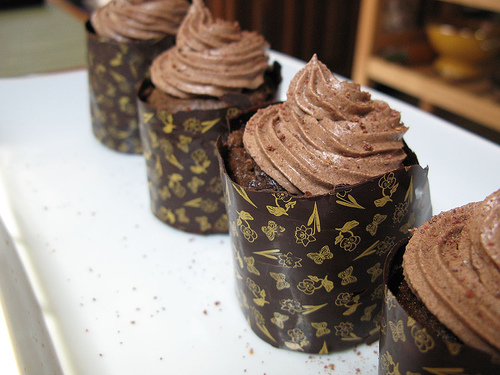
Vegan cupcakes (photo by QuintanaRoo)

We all have to eat. Without food, we wouldn’t get far. But when you’re able to choose whatever you want to eat, could you make handle trying something new?

Two Imperial College students did just that and went vegan for a month to raise money for the Multiple Sclerosis Trust.

In that month, Clare Cheng and Hannah Cox found plenty to enjoy, even if it was a challenge.

And that was just a month. If their goal was to become vegan on a permanent basis, they would have found plenty plenty more to explore and discover.

But this was no ethical choice or health-related change. From meat-eating, dairy-loving and egg-devouring human beings, the change to a vegan diet seemed pretty hardcore to them:

“Our preconception of the vegan lifestyle was that of tasteless and unfulfilling meals that satisfied your body, but not your mind. So it was a surprise when we found that actually some parts of being vegan were pretty good.”

I live with a vegan, so I get to eat a lot of vegan meals. Days go by (maybe weeks) and only then I realise that I haven’t eaten any meat in ages. Even dairy products and eggs don’t get a look in for a while. And I’m fine with that, so long as the diet is healthy and doesn’t miss out on any nutrients that are hard to find in a vegan diet. Fortunately, that’s covered too.

But while I’m going so long without the food I was so used to in the past, I don’t feel like much has changed. I’m living differently, but I acknowledge the final choice is still my own. I don’t actively class myself as vegetarian or vegan, even though I’m close to being that anyway.

When I’ve spoken to people who made a choice to go veggie or vegan with an ‘all-or-nothing’ approach, cravings can be an issue. Many vegetarians admit that they miss bacon more than anything else. For vegans, the craving for an occasional egg can be pretty strong at times. Yet I haven’t particularly felt that.

Some thoughts why:

  • I don’t have the stress of feeling it’s a hardcore change – At no stage have I labelled myself with the description ‘vegetarian’ or ‘vegan’. I simply explored what was available and allowed myself to eat anything I wanted. Meat and dairy products have never been off the menu. All that’s changed is that I picked a different meal from the menu. It’s all about my attitude toward change.
  • The more time I put in to new recipes and combinations opens the doors for more, not less – I was asked to bake a cake recently. I have never baked a cake before. And this had to be a vegan cake too!
    One quick flick through a vegan recipe book gave me the confidence to make a chocolate cake. And it was yummy. Like a chocolate brownie. Then I made another, in an attempt to improve the consistency a bit. Two tablespoons of apple sauce later and the second cake was even more presentable. In no time I’d gone from never having baked a cake to finding ways of improving a recipe. [I enjoyed another slice in the middle of writing this. Win!]
  • I’m going in search of new food I haven’t tried, and food I’ve never heard of – Limitations in one area move you to explore other areas for alternatives and workarounds. Cheng and Cox had a lot of soya milk, although my favourite is oat milk. I’ve tried hemp milk, rice milk, and various other concoctions. Some weren’t even on my radar until recently!
  • I’m still learning more about myself – Big changes get you thinking about your current circumstances as well as your future ones. Questions come flying. Why am I doing this? How can I do things better? What are the implications? What are the differences between Point A and Point B?

One of the uncomfortable things about change is that it forces us out of the comfort zone and into new territory. But once you’re there, it’s usually just as comfy, if not better than before.

What can you do when change is afoot?

Firstly, try not to label the change and don’t take an all-or-nothing approach if you want this to be long-term. New Year resolutions and giving stuff up for Lent give an artificial totality to what you’re doing. Altering your lifestyle in such a complete and sudden way is hard to do successfully and happily.

Second, not doing something in the past doesn’t automatically mean you cannot do it at all. It’s easy to say “I can’t” when you really mean “I’ve never tried”. Give yourself a chance, make a few mistakes, and build up the confidence to build bigger and better things.

Third, there is so much choice out there that you have made thousands of unconscious limitations and automatic choices for the sake of ease. That’s fine in itself much of the time. But when you want to change, those limitations and choices seem practically hard-wired! Next time you’re faced with a challenge, sit down and think about what’s limiting you. Then seek out alternatives to help move you along. It’s not always easy, but sometimes all you need to do is to search around.

Finally, all these big questions help your critical thinking, as well as open up your attitudes to change. If the challenge is big enough, you may come out the other side thinking you could do almost anything. The world is out there, waiting for you to make your next move!

Going back to the start of this post, change does require huge effort. Even when everything is in place and you want to rise to the challenge, there’s the question of willpower. As Cheng and Cox explain of going vegan:

“It makes everyday life that little more difficult when you walk down the aisles of delicious Easter Eggs or pass a good ol’ burger bar with that smell of meaty goodness.”

And they are right. When you make such an extreme change, missing out on so much that you’re used to is a threat to your intention. I used to love Creme Eggs and I ate all sorts of meat. But the less I have these things and the more I enjoy the wealth of food that’s still available to me without these options, I realise that I don’t particularly miss the choc and the meat. Not to mention the eggs and dairy products.

My once favourite Creme Eggs are now viewed with hardly any emotion at all. When they went on sale again in January, I didn’t play my usual hand of buying several dozen straight away. I purchased 12 eggs and enjoyed two a day. They were gone in less than a week, but my craving was satisfied. And I haven’t bought any since. Even writing about them here isn’t upping any desire to munch on one.

Why? Because I stepped out of my comfort zone and kept going. It’s certainly easier with someone else by your side who is taking their lifestyle seriously. I’m lucky there. However, if I wasn’t actively embracing the change, nothing could have put me in the right mindset to take on the challenge.

For me, the mindset necessary was to focus less on the change (the hard part) and more on the new experiences (the fun part). The key was not to label myself as ‘vegetarian’ or ‘vegan’. By not formally recognising any barriers around my eating, I’ve found it easier to keep the barriers up.

The next time change is afoot, see how far you can take things without actively calling it ‘change’.

Are you ready to rise to the next challenge?

photo by floridecires

photo by floridecires

How To Make the Most of YOUR Student Experience

Q: What is ‘the student experience’?
A: It’s what you make it!

This week, I held a workshop at the University of Glamorgan about ‘the student experience’.

I’ve mentioned Glamorgan in the past for their brilliant Glam Insight, where students write about their time at the university and their experiences while they study.

The students make clear how different their lives are, how varied their experiences are, and how wide-ranging their opportunities are.

In the workshop, I asked four questions. They are covered in the presentation below. But if I could sum things up as briefly as possible, here’s what I’d say in a nutshell:

  1. What IS ‘the student experience’?
    Nothing in particular. Reclaim it as your own. Ask what you want and why you want it.
  2. What should young people consider when applying?
    The bigger picture first, and only then the fact that they would like to live in nice halls.
  3. Why do students leave?
    Not enough subject research and not enough knowledge of what’s on offer.
  4. How do students make ‘the student experience’ work for them?
    Be selfish, open up to change, and be prepared to fail.

Question 4 is the big one here. If you want to skip the Prezi presentation itself and get straight to the good stuff in the archives, I’ve got the top 10 tips on making the most of your experience underneath.

“The Student Experience” on Prezi

How do you make the most of
‘the student experience’? 10 Tips

  1. Don’t compare yourself to others. The Student Experience is YOUR experience.
    https://theuniversityblog.co.uk/2010/03/30/you-or-everyone-else/
  2. Be involved!
    https://theuniversityblog.co.uk/2011/08/11/why-being-involved-is-so-important-to-learning/
  3. Seek out new opportunities and experiences rather than waiting for them to come to you.
    https://theuniversityblog.co.uk/2010/05/28/act-on-ideas-or-fade-away/
  4. Embrace failure.
    https://theuniversityblog.co.uk/2011/05/03/how-to-fail-brilliantly/
  5. Pick yourself up, dust yourself down, keep going.
    https://theuniversityblog.co.uk/2008/02/25/10-tips-to-pick-yourself-up-after-a-fall/
  6. Take your experience seriously, even when you’re having fun.
    https://theuniversityblog.co.uk/2010/02/04/get-serious-about-university/
  7. Enjoy the benefits, but do remember you can have too much of a good thing…
    https://theuniversityblog.co.uk/2008/01/11/10-reasons-why-the-benefits-of-university-can-lead-to-downfall/
  8. Embrace the unknown. Prepare for the unknown. But don’t fear the unknown.
    https://theuniversityblog.co.uk/2011/06/02/fearing-the-unknown/
  9. Look beyond employability. Look beyond the piece of paper you get at the end of those years.
    https://theuniversityblog.co.uk/2011/05/17/looking-beyond-employability/
  10. Focus more on yourself, less on the degree. “Your degree isn’t the source of awesome. You are.”
    https://theuniversityblog.co.uk/2011/10/27/grad-employability/