Writing

How 750 Words Can Help Your Productivity

Sometimes, you just want to write. But it’s not always that easy.

You sit down with the best intentions, but it’s so intimidating when you start a potential masterpiece.

Your internal editor chips away at your confidence before you have even touched the keyboard.

You have no sense of the goal you’re aiming to achieve.

And that’s where 750words comes in.

For a while now, I’ve heard some academic peeps raving about 750words.com as a fantastic way to write without distraction and other concerns. These are academic peeps I trust. So I’ve given the service a go.

And I give it a thumbs up.

When you want something a little more inviting than an empty document and a flashing cursor, 750words may be the trick. It doesn’t offer much more than a blank page and it still features a flashing cursor —Hey, stick with me!— However, there are other reasons why the service may help you write more than other methods:

  1. Free-writing: Instead of carefully thinking about what you have to say, you may prefer to riff and find your voice by bashing out a load of words. Even if you find 95% of the words come out as irrelevant rubbish, the remaining 35–40 words may be exactly what you wanted. That may not sound like much, but it could be enough to spark something amazing.
  2. Challenges: 750words gives you the option to sign up to a monthly writing challenge, where you promise to write 750 words every single day in the month. If you do, you make the Hall of Fame. If you don’t, you make the Hall of Shame. If you thrive on that type of thing, the monthly challenge is for you!
  3. A blank page: Distractions aren’t welcome. If you want a blank screen, free from other goodies, you’ve come to the right place. 750words is pretty limited in terms of features. All on offer is a place to type some plain text. No fancy fonts, no bold and italics, no special layout features. Just type away until you reach the magical number of words required.
  4. No need to check word counts: Just keep on writing until you get to 750 words. When you do, you’re congratulated. And if you’re on a roll, great! Just keep writing until you’re done. You can see how many words you’ve written by looking at the bottom of the screen. No procrastination or interruption necessary by checking the ‘Word Count’ option. It’s all there for you already.
  5. Statistics: Want to know how long it takes you to write those words? 750words will tell you. Concerned about how many times you’ve moved away from your writing with other distractions on the computer? 750words will tell you. Wondering what types of words you tend to use most? 750words will tell you.

I’ve tried the service for over a week now and I enjoy the simplicity of the service. I’m not bothered about writing a particular number of words every day and I doubt I’ll sign up for the monthly challenges any time soon. I’ve already missed a day on purpose.

Still, there is certainly something satisfying about writing until you reach the number of words allotted. You cannot change the number of words set in the challenge, but nobody is forcing you to stick to that specific number of words. You can write a single sentence and stop, or you can keep going until you’ve written a whole book in a day. It’s up to you.

The user average each day is just over 900 words. I think 750 is a pretty good number to work with for most situations, though. That works out as a pretty good length for a blog post, and it’s half a 1500-word essay. You’re being challenged, but not made to bust a gut.

Here’s one more thing for you to consider: This post was written using 750words on one of my days. It took about 12 minutes to write. And I spent about ten minutes editing after that; so the post wasn’t originally a complete mess, even though I blasted it out quickly.

Remember, even if you have no use for 95% of what you write, the 5% of awesome you can use is worthwhile. And, in the case of this blog post, I only took out a few words. More like 95% used, 5% chucked out. Win!

Next time you want to get your write on, give 750words a whirl. Take up the challenge. You may just surprise yourself!

On Writing

Today I welcome Rod Pitcher to TheUniversityBlog. Rod has written a piece on the writing process.

Rod is a PhD student in Education at The Centre for Educational Development and Academic Methods at the Australian National University, Canberra, Australia. The focus of his study is the metaphors that doctoral students use when describing their research and other matters related to their studies. He uses metaphor analysis to arrive at an understanding the students’ conceptions.
Rod Pitcher’s profile is at http://cedam.anu.edu.au/people/rod-pitcher and you can contact Rod at Rod.Pitcher@anu.edu.au

photo by chic.geek

photo by chic.geek

On Writing

Writing is not a simple process. It depends on a number of factors, three important ones of which are knowledge, incentive and the ability to write. I have never had any problems with the last one. I enjoy writing and do it well according to my supervisors. The others are not so easy.

Knowledge
It seems a truism to say that good writing depends on knowledge, but it is true, none the less. If you don’t know what you are going to write about it will be difficult if not impossible to produce anything sensible. You need knowledge to frame the paper, give an account of what it is intended to illustrate and to provide information to the potential reader. A knowledge of others’ work on your topic is necessary to provide the references that put your work into its context.

If you don’t know what you are writing about, how can you expect to make sense? Whether the paper is factual, biographical or speculative you need to know the background to it. You must be familiar with the topic, the background and anything previously written on the topic so that you can place your work in the context of other’s work on similar topics.

Incentive
Having gained the knowledge about your topic you must then have an incentive to write. Common incentives include finishing your thesis to gain your PhD, writing a journal paper to improve your publication list, or writing an application for a job that you would like after completing your doctorate. Note that the reward for doing the writing should be important to you, personally. The personal incentives are by far the best. Working to someone else’s incentive is a recipe for disaster.

It is sometimes difficult to find an incentive to write, but it is important that you do so. The more important the incentive is to you the more incentive you have to write. Writing without a good incentive can be soul-destroying as you try to imbue some interest you do not have into the work.

Ability
Lastly, you need the ability to write. If you have that ability without being taught then you are lucky. If not, you can be taught to at least produce good quality prose. Your university probably runs courses on it. Take all the courses you can. They can’t do you any harm and you might find the spark that brings out the creative writer in you. Join a writers’ group to get feedback on your work – and LISTEN to the comments, don’t just let them pass you by. Take advantage of other writers’ experience. Finally, practice writing. The more you write the better you will get.

Writing is not easy for most of us. We need help to produce our best. Even the best writers can use constructive feedback and comments about their writing. Use all the resources available to you to develop your writing skills. You will gain from it in your writing – and so will your audience.

Last-minute Essays: Should you REALLY be pulling an all-nighter?

In the early days of TheUniversityBlog, I wrote a popular piece about pulling all-nighters and writing essays at the last possible minute. And I wasn’t very complimentary about the process.

To see my friends in a fiddle and my peers in a panic was frustrating, because some of them clearly didn’t respond well to this regular ritual.

The one time I didn’t focus enough until it was too late…was my dissertation. Yes, I know, it annoyed me at the time too. Even worse, I’d been enjoying the research and writing at first and then simply stopped doing enough to make the project as scholarly (and awesome) as I could have done. Sucked to be me. 😉

So I knew that the last-minute wasn’t for me. By all means get close, but never get TOO close.

But can the all-nighter essay work for some students? Is it really the best way to get the right words flowing?

Rachel Toor, an assistant professor of creative writing, says this:

“What I’ve learned about writing and intellectual work is that there’s no right way to get things done, no ritual or routine that is effective unless it’s effective for you…If the products are coming out in ways that you’re not happy with, by all means, try to make a change in your work style. But…if you need the guillotine hanging over you to get that paper done, let it dangle. There’s no “right” way.”

My personal preference is to use the time given and aim to finish with time to spare if necessary. More often than not, it’s not necessary. I’ll set my own deadline in advance of the actual requirement, so I’m not tempted to run over for some reason.

I do it this way because I prefer to work when it suits me, often in small doses. It depends what I’m working on, but I generally feel comfortable, so see no reason to change.

And that’s the big deal. I see no reason to change.

Just as Rachel Toor explains, pulling an all-nighter is fine if that’s what makes you tick.

Unfortunately, I get the impression that it’s not what makes many last-minuters tick. It’s just what they’ve got used to.

I recommend you to do a little experiment to find out whether or not there’s another way for you. A better way. Take the time to work on a few assignments earlier than usual. Mix things up and see what happens when you spend more time on an essay.

If the slow approach doesn’t work for you, I have another thought. Pull an all-nighter and finish your assignment the way you normally would. But do it a week or two before the real deadline. Treat it seriously and do it as if there will be no more time left after this night. That may be hard to believe, but give it a go.

Because once you’ve got your last-minute attempt, you’ll still have time to revisit it in a couple of days and see if you truly think it’s the best darn paper you could possibly hand in.

Make an effort to explore new ways, rather than doing it once and not bothering again. Toor suggests three months of working differently, but you may be comfortable with something else. Just so long as you take it seriously, otherwise it’s not worth trying in the first place.

After that, if you’re still not convinced, maybe the all-nighter approach is the best way for you after all. The stress, the adrenalin, the pressure…I doubt it works for all the people that experience it, but a few will still find it’s the only way to greatness. In Toor’s words:

“See if it makes your life better. If it doesn’t, then I would say there isn’t a problem. Accept that you are a last-minute person and realize this: Writing is hard, no matter when you do it. Thinking that there’s a better, easier way is just silly.”

The difference will be that you tried and you understood. For others, the difference will be that they tried and they realised the wonders of a somewhat calmer approach. What works for you?

No matter which direction you take, at least you can now be certain!

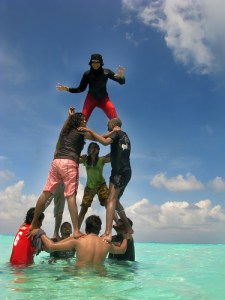
Trust Yourself: You’re More Effective Than You Think

Can you trust yourself to be effective? Can you trust yourself to succeed where it matters? Can you trust yourself to keep on learning?

The answers should be yes, Yes, and YES.

Nobody can achieve everything on their own. But unless you trust yourself to push forward and keep exploring what works for you, everyone else’s help will go to waste.

photo by notsogoodphotography

What’s the use in listening to others if you don’t listen to yourself? As the title of this post says, you are more effective than you think. Just trust yourself and get ready to shine.

The one way to write effectively – YOUR way

Top writing takes practice, takes mistakes, and takes guts. As you progress, your depth and breadth of knowledge will increase. Plus, you’ll learn tips along the way and discover loads of techniques to make an impact and save time.

Learn from others, but don’t try to imitate a style or write the way you *think* is expected of you.

At uni, your first year grades rarely count toward your final degree result (but do check first!). Instead of using this as an opportunity to take it easy, take each assignment as an experiment to find what works for you.

Be prepared to make mistakes and learn from them. That’s why draft essay attempts are better than pulling off a single all-nighter. Tutors can check where you’re headed and give you advice and feedback before you’ve even handed in the piece of work.

The more you attempt and explore, the more likely your own styles of writing will become apparent. This is massively powerful.

Don’t think unique. Think U-know!

Undergraduate learning is mostly about understanding, exploring, reaching conclusions, assessing other conclusions, and so on. There’s a difference between undergraduate and postgraduate work. Your job is not to find an unexplored angle of the universe and claim it as your own.

If you stumble upon something amazing, it’s either been done before or you’ve managed a massively rare fluke. Either way, you’re still learning and discovering, so it’s no bad thing.

I could say it’s better to ‘know’ you know than to ‘think’ you know. But there’s no room for arrogance in academic writing. Well, there shouldn’t be room anyway… Build up as much confidence as you can and continue to seek help from tutors and your network as necessary.

The key is to be confident in your choices and actions, rather than be adamant that there’s no other way. Learning should be about openness; open to opposing views and open to trusting your own.

A fine balance, but one you’ll be thankful for once you’ve found it. 🙂

Your methods are personal to you. Your achievements are ready to share.

It doesn’t matter how you write it. The fact is, you’ve written it.

Do you hate staring at a monitor with a blank white screen waiting for you to type away some amazing critical analysis?

No problem. Why not start writing inside a Facebook message? Or tapping out a few paragraphs in the form of text messages? Or getting good, old-fashioned, pen and paper to see where it’ll take you? Or dictating into a sound-recording device? Or blogging a bit of content?

Yes, even blogging could help you trust yourself more. If people can turn blog posts into books, nothing is stopping you from using the same method to get started on your assignments!

Like I’ve said above, writing is suited to drafts. Writers don’t sit down one day and resolve to write an entire book in a single sitting.

Imagine a writer getting loads of blog posts finished in private. None of the posts are published until such a time that a publisher asks to put them in book form.

Trust yourself to choose when it’s time to publish. Use the methods and practices that work for you and bring it together however you like. It may be a weird and wonderful technique, but nobody cares. If that’s what it takes to be amazing, then do it. The finished article is what everyone else appreciates.

Your life is a jigsaw. Put it together.

Bring your achievements together and find what makes you tick.

At first, this patchwork may look like a mish-mash of random events. But within the randomness there are all sorts of links.

Some of your individual achievements will look great, even in isolation. And there are many more under the surface that aren’t apparent at first, but which suddenly look amazing when presented as a package.

So keep track of all those successes, no matter how small they may be. They may come in more useful than you think.

You need you just like you need others. Trust in that.

The world is full of amazing opportunities, and fascinating possibilities. Reach out to them. The more you reach out, the more likely you’ll get stuff handed to you.

You can trust yourself.

photo by Jinto!
photo by Jinto!