Dissertation

Taking the Essay Journey

Is life one big journey? Or is life a lot of smaller journeys?

Whatever way you look at it, your journey belongs to you. And the same should be said of your coursework.

photo by Matthias Rhomberg

Whether you see your assignments as a long journey, or a range of shorter journeys brought together, the finished piece should also take the reader on a journey.

The journey analogy helps to show that while introductions are different to conclusions, the two still need to be related to make the most of the adventure.

An introduction is an invitation for the reader to come on a journey with you.

You outline where you’re headed and why you’ve decided to take this path. You may even suggest a couple of stop off points along the way so the reader is ready to take some mental photographs of the best views.

A conclusion allows you to sum up what you’ve explored and how you feel about it.

Now is your chance to evaluate the situation, discuss the destination you’ve chosen, and allow readers to either go home or press on and explore further.

Views are subjective.

Not everyone likes looking out to sea. Some are more interested in mountains before them.

Your introduction won’t suggest that the sea is better than the mountains. Your conclusion won’t suggest that you’ve proved how mountain-loving idiots are just plain wrong.

Your introduction will point out the amazing range of views to be had and that you’re about to explore some of them. Your conclusion will point out why, given the adventure you’ve just had, you feel the sea is pretty darn awesome and why it may give mountains a run for their money.

Map our the journey clearly

Make sure your introduction and conclusion are headed in the same direction. The last thing you want is to tell everyone that you’re about to take a journey to the sea and send everyone off to the mountains instead. It’ll only end in tears and confusion.

Don’t be afraid to make the journey your own

Steve Jobs sadly passed away on October 5 2011. As co-founder, CEO and Chairman of Apple, Jobs had a thing or three to say about setting out your own path:

“The system is that there is no system. That doesn’t mean we don’t have process.” – Steve Jobs [Source]

Creating your own journey doesn’t have to exclude others from understanding the relevance of the path you have travelled. Neither does it mean you’ll ignore everyone else along the way. If Jobs had done either of these things, Apple and its products wouldn’t have enjoyed the success they have.

“Remembering that you are going to die is the best way I know to avoid the trap of thinking you have something to lose. You are already naked. There is no reason not to follow your heart.” – Steve Jobs [2005 Stanford Commencement Address]

Journeys aren’t just for essays. I hope every journey you take is special. You can make each and every pathway your own. You don’t need to be another Steve Jobs or another anyone else. You need to be YOU.

As Jobs said, “Your time is limited, so don’t waste it living someone else’s life”.
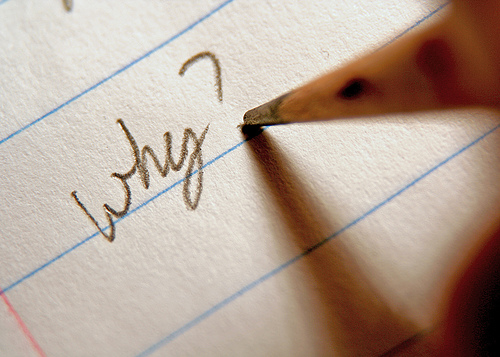
Are you asking enough questions?

Last week, I talked about understanding questions as a whole and then breaking them down into parts. Both stages are in order for you to get as much meaning from a question as possible.

Questions are important. You need to understand questions, answer questions, and ask questions.

photo by e-magic
photo by e-magic

Assignments go beyond asking how much information you can remember on a topic. Assignment questions also require you to:

  • create an argument;
  • weigh up different views;
  • provide examples and workings, as opposed to regurgitations;
  • demonstrate understanding of the topics under discussion.

It’s easy to get stuck on key topic words that you have a lot of knowledge on. But dig deeper and you’ll notice more to the question. The closer you come to answering the question clearly, deeply, and effectively, the more likely your grade (and enjoyment!) will benefit.

Look for:

  • What’s being asked of you – Does the question ask you to discuss, compare, analyse, argue, evaluate…? The question is probably worded so that you should talk about what you know, but relate to why that’s the case and explain how it could be different or why people have different theories on the matter.
  • Specific focus points – Some questions can be vague, but many ask you to concentrate on a particular feature to base your answer on. You may also notice the question is guiding you to frame your answer in a certain context, such as a single culture, time period, object, opinion, text, and so on.
  • Leading words and phrases – For example, you may be asked to analyse the benefits of something. This is not an invitation to lavish praise upon the subject. To analyse the benefits means to weigh up, to argue whether they really are benefits, and to discuss alternatives. You aren’t being asked a trick question, but you do need to show awareness that there is more than one side to any story. You are welcome to have an opinion on the matter, so long as you explain why you have reached that conclusion and show why you don’t share the same enthusiasm for the alternatives. You’re not stating right/wrong, yes/no, good/bad answers. Instead, you’re reaching a conclusion after exploring the topic.

You also need to ask a lot of questions. Unanswered questions, questions that arise from your study, and questioning assumptions.

Even after you’ve written up a good draft of an essay and you’re happy with it, read through the draft again. Ask yourself — and try to answer — these 15 questions throughout your draft:

  1. How did I come to say that?
  2. Have I backed this up?
  3. Can I say this any clearer?
  4. Does this point follow on?
  5. Should I give more detail here?
  6. Does this assume something I haven’t mentioned?
  7. Does this need referencing?
  8. Will a relevant quotation and/or summary help before I move on?
  9. Is this relevant to the question/title?
  10. Could my main point be made more prominently?
  11. Am I making sense here?
  12. Am I being critical or opinionated?
  13. Does this require an example or demonstration?
  14. Has there been a more recent development?
  15. Is something missing?

These questions are simple enough to make you think, and challenging enough to make you respond. If you’re not asking these questions about your writing, answer this question: Why not?

Why You Are Better Than Robotic Willpower

There are many tools around that make sure you’re only doing what you’re meant to be doing. Let’s say you’re supposed to be writing. To help you stay writing, there’s software that cripples your Internet connection, that removes your social network access, and that generally takes control of what you can and can’t do.

photo by jakedobkin

photo by jakedobkin

Instead of willpower, you can set tools to force you away from temptation.

But this is damaging.

Doug Belshaw asked via Twitter:

http://twitter.com/dajbelshaw/statuses/60691447883632641

I responded:

While software like Quiet Hours will automatically switch off email and social apps for you to get on with more important tasks, it’s not all roses and butterflies:

  1. You stop working naturally – The forced nature of your work can scupper creative thinking. There’s nowhere else to go, but you’re made very aware of the fact. Choice is more open than force, so aim for that as often as possible.
  2. It feels like a punishment – Where’s the fun in removing all distractions so clinically? There’s a fine line between giving yourself a bit of peace and pissing yourself off.
  3. A ‘no ifs, no buts’ approach is restrictive – Need to quickly look something up for a reference? Well you can’t. I tried a ‘no ifs, no buts’ practice in the past, but quickly stopped. When you’re busy working and find your restrictions stop you working, it’s a bigger distraction than everything else put together. I didn’t end up screaming, but it was a close thing…
  4. Tools can’t eliminate the problem of forgetting what you were meant to be doing – I’ve walked away from writing something in order to find a quotation in a book. Half an hour later, I’m still looking through books and I suddenly remember what my initial purpose was. A five minute job took much longer than necessary. An automated shut-down tool will remove a couple of these problem points. However, it won’t stop the problem itself.
  5. You may end up believing that you cannot rectify these problems manually (i.e. yourself) – The more you rely on tools to kick you into shape, the less you’ll be in touch with your own talent and power to push on.

There’s nothing wrong with using software to help eliminate distractions. But reliance on software is dangerous. You have the power to do it yourself:

  1. Keep a to-do/task list – An easy way to train yourself to concentrate on what you’ve set yourself.
  2. Leave plenty of time for important tasks – Left until the last minute results in panic. You may be totally focused on the task, but the deadline hovering over you like a guillotine blade will be more than enough distraction.
  3. Do things in small chunks – Rather than commit to an hour on an essay, try to work for just ten minutes. Then take a minute or two off to check social networks and other distractions. Multitasking doesn’t work, so try ‘minitasking’ as an alternative.
  4. Keep ‘valid disruptions’ in check – I’ve said before, “disruptions aren’t always unwelcome, even if they are disruptive”. Be aware of this and you can work more effectively. Give yourself time to spend on the good stuff and mix it up with your other work. There’s nothing like a bit of variation!

What do you think? Would you rather automate the process of removing distractions? Do you feel better when you have control yourself? What tips do you have to stay focused?

How to study a book before you have it

The wait for a crucial book to become available in the library is frustrating.  Even worse when the library doesn’t have the book at all.

Aside from inter-library loans, buying the book yourself, and other costly or time-heavy options, what other options do you have in the meantime?

photo by Newton Free Library

photo by Newton Free Library

To Do: Dissertation has some great tips on what to do while you wait for that book to become available.

But it got me thinking about others ways to the book that may work in your favour.  Here are a few ideas that might land you more access to a book than you think you have:

  • Check publisher’s website for excerpts and sample chapters – Some publishers are great at making PDF samples available to download.  You may get instant access to the Introduction, first chapter, possibly more.  Even a simple table of contents or index is a helpful head start on your research.
  • Check library online databases for books in electronic format – Don’t just check the library shelves.  An increasing number of books are now available online.  Services such as Cambridge Books Online provide a huge range of books at your fingertips.  Find out if your library has access.  If not, ask if they can get a trial.
  • Use Google Books – It’s not just Google Scholar that can help your research.  With Google Books, you can look through the pages of many books as a preview.  And the previews can be extensive.  Combine that with the ability to search for specific terms within each book and you may not even need to track down the physical copy of the book at all!
  • Use Amazon “Look Inside” – An alternative to Google Books, Amazon have their own preview function for a large number of books.  Again, you can search within the book and get busy with the research straight away.  However, it looks like Amazon may start charging for this feature soon.
  • Play Google and Amazon off with each other – Online previews are limited and don’t display all pages.  Rightly so.  You’re not meant to read entire books with the services.  However, when researching, you may find a specific page is excluded.  If both Google and Amazon have a preview available, that missing page on one resource may be there to view on the other.
  • YouTube talks – Why wait to read what the author wants to say when they may have said a lot of it in a talk or lecture?  By searching for the author (and maybe even book title) in YouTube, you may stumble upon directly relevant content for your research.  It’s another worthwhile reference to add to your bibliography too!
  • Read reviews – All sorts of texts get reviewed, not just bestsellers.  Reviews can give a breakdown of a book’s main ideas, flaws and coverage.  A Google search for book title and author and the word ‘review‘ should bring up newspaper reviews.  You can also check Times Higher Education.  It’s worth checking Google Scholar or journal databases for the title and author too, which should point you toward scholarly reviews and even related papers by the same authors.
  • Search for author details – Personal websites, university web pages, Google Scholar, JSTOR, etc…  All these can give further detail on the individual and their background, as well as other literature they have produced.  You may not have the book, but you may uncover key opinions and similar texts to chew on.

Don’t let the wait for a book stop you from getting on with your reading and research.  In the unlikely event that you find absolutely nothing after these searches, you can still go back to those helpful tips from To Do: Dissertation.