Month: June 2010

Why fiction is necessary

Fiction is as necessary and important as non-fiction.  Just the facts m’am?  Nope.  Step beyond reality and reap the rewards.

photo by kevindooley

photo by kevindooley

Facts without fiction won’t work.  In most instances, fiction has elements of truth in it and non-fiction can still be crammed with stories (and even fabrications!).

Make the most of all angles.  For a few months, I hadn’t been reading any novels or short stories.  Big mistake.  I really missed the ride and I won’t make the same mistake again quickly.  I felt my own imagination flagging.

Imagination was recently discussed in the Chronicle of Higher Education:

“Surely we would be better off pursuing more adaptive activities—eating and drinking and fornicating, establishing relationships, building shelter, and teaching our children. Instead, 2-year-olds pretend to be lions, graduate students stay up all night playing video games, young parents hide from their offspring to read novels, and many men spend more time viewing Internet pornography than interacting with real women. One psychologist gets the puzzle exactly right when she states on her Web site: ‘I am interested in when and why individuals might choose to watch the television show Friends rather than spending time with actual friends.'”

We love stories.  Even when looking for truth or reading a textbook, some of the best lessons come from stories.  As I’ve said before, storytelling is powerful.  Just as we can inspire by telling stories, we’re suckers for the things ourselves!

Hard facts and dry recounting of events are enough to put casual readers off.  This is probably why “many people seek out certain types of fiction (historical novels, for example) because they want a painless way of learning about reality”.

Yet it goes further than learning.  Amazing philosophical thoughts and questions come out in fiction.  Your life can change for the better when you’re inspired by a character that doesn’t even exist.  A fictional success may be an advantage in the real world…In your world:

“Often we experience ourselves as the agent, the main character, of an imaginary event. To use a term favored by psychologists who work in this area, we get transported. This is how daydreams and fantasies typically work; you imagine winning the prize, not watching yourself winning the prize.”

The drama and the condensed nature of fictional situations give us a more intense excitement.  No wonder we revel in the activities of imaginary characters and put ourselves in their place.  The fiction is necessary to inspire, to open our eyes, to discover heroes to aspire to.

We all need heroes in order to get our own chance at saving the world.  Who says our heroes have to be physical beings?
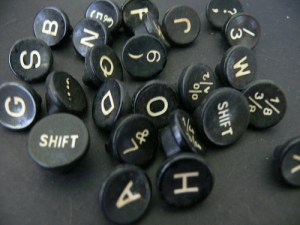
Monkeys and typewriters

Stick loads of monkeys in a room and give them a typewriter.  Assuming they do as you say and hit away at the typewriter forever more, it’s only a matter of time before one of those monkeys will have written the works of Shakespeare.

photo by Laineys Repertoire

photo by Laineys Repertoire

Or so the theory goes.  If every attempt was a unique effort, then one day the attempts would reduce in size until you’re only left with the works of Shakespeare.  But monkeys on typewriters wouldn’t be typing with the insight that we do.  In essence, all the monkeys forever working on typing would also, feasibly, write the works of Shakespeare with many spelling mistakes and errors.  And some will get halfway through the correct text and veer off into nonsense.

Even if one monkey managed it, I don’t imagine the follow-up would win any prizes.

The monkeys and typewriters analogy doesn’t work outside of mathematics.  A lot of life is random and much of what happens is by chance.  If you’re chosen out of 10,000 contestants to win a talent contest, you don’t need to be the best performer to win.  You won’t be the worst person either.  However, a lot is down to luck, subjectivity, who’s aware of and following the contest, the amount of backing you already have, and so on.

You do need skill to achieve, but you need more than skill to achieve many goals.  There’s drive and determination to get you working each day.  There’s your attitude and a network that appreciates it.  There are many elements in play; some are in your control and some are not.

You do your best and still nothing is certain.  But it’s a start.  You’re not a monkey randomly bashing at a typewriter.  You have insight and you have a choice.

Choice plus chance equals luck.  Don’t be afraid to create your own luck!

How real is the graduate earning premium?

As we approach summer, there will soon be another group of graduates looking for jobs.  Soon after, another set of students will hit campuses around the country for their Fresher year.  Two very different starts, full of very different hopes and fears.

One of the reasons touted for going to university is that you’ll be better off.  Statistics suggest that graduates earn more over their lifetime than those without a degree.

Is the vague term of ‘graduate premium’ a good enough reason to spend three or more years of your life in Higher Education?

Also, is the earning premium all it’s cracked up to be?  What will it end up meaning for you?  Do you expect to earn more than non-graduates over your working lifetime?  If so, how much more?

photo by James Cridland

photo by James Cridland

I’m sceptical about the overall relevance of a graduate earning premium. We are currently in a time of change, both economically and educationally.  More people than ever are applying to universities.  With huge intakes of students, there are still not enough places to allow everyone in, even if they’ve got good grades.

With so many people doing undergraduate study and collecting degrees, will the term ‘graduate premium’ mean as much in a couple of years?  And a few years after that?  And in 20 years?

I’m sure some people end up earning a lot more off their studies than if they’d taken a different route, but it’s not guaranteed.  Far from it.  Many students will graduate into more humble circumstances and may not achieve the dizzy heights they were hoping.

Indeed, students aren’t convinced about their future career prospects.  According to a report by High Fliers Research:

  • 45% of those leaving uni believe their prospects are ‘very limited’;
  • A third of those polled think most entry-level jobs will be taken by last year’s graduates;
  • 1 in 6 students would have questioned university study had they realised how tough the graduate job market is.

If student numbers stay as they are, any premium is likely to slow to the point where it becomes misleading.  Even if graduates remain, on average, better off than non-graduates, it won’t mean much if most of the population needs a degree.  Any ‘premium’ would become a ‘norm’.

The High Fliers report suggests that students don’t expect to make as much money as they used to.  Expectations are now an average of £22,000 for their first job.  That’s down 3.1% on last year’s expectations.

Nevertheless, university is not about commanding a higher salary.  It can certainly help you toward that goal, but using study in a vague attempt to make more money in nonsensical.  Chasing a big pay packet is a time-consuming and pointless exercise when taken in isolation.

Uni Choices

The student experience can’t be judged based on future situations and perks that aren’t guaranteed.  If money is the only thing driving a person, degree study may well be a mistake.

Personal choices over the institution you study at are often based on small points, uni facilities, and various random attractions. No matter, because they’re still based on what you see and what’s actually on offer.  While you can check tables for suggested future earnings based on subject, it’s still a shot in the dark that’s frayed with uncertainty.

Your future is important.  So important that you need to rely on yourself to push for the best employment terms.  As a student or graduate, you’re in a great position.  While the job market is tough, you are the most important piece of the jigsaw.  The key isn’t where you did your degree or what you studied.  That won’t help you command a huge earnings premium.  You’re better off showing how you made use of and continue to make use of your learning and experiences.

A dedicated student who effectively pieces together their experience at one of the lowest ranked unis can easily sweep the floor with a half-hearted, uncertain student from a top ranked uni.  Graduate premium doesn’t count for anything if the person doesn’t push their achievements and seek to do better with each new day.  Your degree award doesn’t command a premium by itself.  The piece of paper you get is more a sign of the skills you’re building up personally.  Don’t let your achievement stop at that piece of paper…let it be the true start.

What does ‘graduate premium’ mean for you?

WikipediaWictionaryChambers (UK)Google imagesGoogle defineThe Free DictionaryJoin exampleWordNetGoogleUrban DictionaryAnswers.comrhymezone.comMerriam-Webster

Take life seriously for more fun

The only way you can get the most from life is when you take it seriously.  The laughs, the fun, the success…everything is serious.

Don’t get me wrong, your outward character can be as eccentric and crazily happy as you want.  You can get a lot through seeking contentment, following passions, and enjoying yourself as much as possible.  But the way in which you approach life needs to be taken seriously.

photo by poolski

photo by poolski

If you’re determined to take flight every which way, without giving your actions proper thought and time, your enjoyment suffers.  A more determined, less casual approach will help you shine.

As soon as you shrug your shoulders at something, it becomes less serious and you suffer as a consequence. We all do it from time to time, because it’s another way for that dreaded ‘comfort zone’ to come along and lull you into a false sense of security.

When you find yourself going off the boil, ignoring the importance of every second of your life, don’t let yourself off.  Take the matter  seriously, before everything blurs and you forget how serious you need to be before you can convince at casual:

  • Take seriously the need to do some things you don’t want in order to get what you do want;
  • Take seriously the fact that your leisure time is usually more fun when you plan activities ahead;
  • Take other people seriously, even if you don’t agree with them;
  • Take yourself seriously, acknowledging your worth and the importance of your own ideas;
  • Seriously commit to changing the aspects of your life you want to change;
  • Seriously commit to achieving more of what you love and being who you want to be.

When you take the world seriously, you can still have larger-than-life ideas and great ambitions.  In many ways, a serious attitude makes it all the more possible.

There’s a book called “When Wishing Comes True”, which has a great message about taking life seriously no matter how imaginative you are and how much your wishes seem unlikely to come true.  Even better, it’s a book for children.

We all know how children don’t let the world get in the way of their bizarre plans.  Those plans may seem ridiculous to us, but the children are deadly serious about them!

I’ll leave you with the simple, yet strong message that “When Wishing Comes True” ends on.  And I hope you have a good time wishing…and taking it all seriously:

“First wish,
Then do.
That’s when wishing comes true.”