Is life one big journey? Or is life a lot of smaller journeys?
Whatever way you look at it, your journey belongs to you. And the same should be said of your coursework.
photo by Matthias Rhomberg
Whether you see your assignments as a long journey, or a range of shorter journeys brought together, the finished piece should also take the reader on a journey.
The journey analogy helps to show that while introductions are different to conclusions, the two still need to be related to make the most of the adventure.
An introduction is an invitation for the reader to come on a journey with you.
You outline where you’re headed and why you’ve decided to take this path. You may even suggest a couple of stop off points along the way so the reader is ready to take some mental photographs of the best views.
A conclusion allows you to sum up what you’ve explored and how you feel about it.
Now is your chance to evaluate the situation, discuss the destination you’ve chosen, and allow readers to either go home or press on and explore further.
Views are subjective.
Not everyone likes looking out to sea. Some are more interested in mountains before them.
Your introduction won’t suggest that the sea is better than the mountains. Your conclusion won’t suggest that you’ve proved how mountain-loving idiots are just plain wrong.
Your introduction will point out the amazing range of views to be had and that you’re about to explore some of them. Your conclusion will point out why, given the adventure you’ve just had, you feel the sea is pretty darn awesome and why it may give mountains a run for their money.
Map our the journey clearly
Make sure your introduction and conclusion are headed in the same direction. The last thing you want is to tell everyone that you’re about to take a journey to the sea and send everyone off to the mountains instead. It’ll only end in tears and confusion.
“The system is that there is no system. That doesn’t mean we don’t have process.” – Steve Jobs [Source]
Creating your own journey doesn’t have to exclude others from understanding the relevance of the path you have travelled. Neither does it mean you’ll ignore everyone else along the way. If Jobs had done either of these things, Apple and its products wouldn’t have enjoyed the success they have.
“Remembering that you are going to die is the best way I know to avoid the trap of thinking you have something to lose. You are already naked. There is no reason not to follow your heart.” – Steve Jobs [2005 Stanford Commencement Address]
Journeys aren’t just for essays. I hope every journey you take is special. You can make each and every pathway your own. You don’t need to be another Steve Jobs or another anyone else. You need to be YOU.
As Jobs said, “Your time is limited, so don’t waste it living someone else’s life”.
Books are tools. Visiting a library doesn’t turn someone into a scholar. Digital platforms for information and engagement can be viewed similarly. We have an increasing range of digital tools at our disposal. Free access to those tools doesn’t turn everyone into digital scholars.
So is the term ‘digital scholarship’ useful? To an extent, I would argue it is, even though no single definition is clear.
Research is affected because scholarly access is altered. At its most basic level, anyone with access to the Internet can indulge in research. It is often quick and painless and routinely involves Google.
Can a basic Google search constitute research? Has the term ‘research’ been tainted by digital means of accessing information more freely? Must research involve new discovery and/or the remixing of materials into something new?
How about teaching? I am pleased to see an increasing push toward tackling misunderstandings of ‘digital natives’. Just because young people (myself included) have generally been granted access to the Internet from an early age, that doesn’t mean all young people have mastered online access as a matter of course. Neither does it mean young people should be expected to know how to best use digital tools to their advantage. Access to the tools is different to mastering them. And even an advanced grasp of Facebook and other social platforms is not enough to assume someone can take that savvy and apply it to anything remotely ‘digital’ in nature.
Martin Weller, author of ‘The Digital Scholar‘ is hosting this week of the Change MOOC and he asks that we address the question: “what impact has digital scholarship had on your practice and what difficulties have you encountered?”
When I was an undergraduate, I recognised that most of my peers were not taking to the Internet as enthusiastically as myself. I’d been telling school friends as early as 1995 how the Internet was going to change the world. My friends thought I was crazy. They didn’t even know what I was talking about at the time.
By the time I was at university, people were beginning to get the hang of this Internet beast and technologies were moving quickly. Nevertheless, I didn’t notice many people getting excited about finding a new online journal dedicated to exactly the topic I was looking into at the time. I was one of the few. Far more popular at the time was Napster. Change wasn’t limited to the strictly academic.
The difficulties with referencing online material were even greater back in the late ’90s. And it wasn’t unusual to have anything related to the Internet be frowned upon as if it was automatically unreliable and suspect. Happily, those times have changed, yet issues remain. And while hurdles are slowly jumped, several more pop up and any type of catch-up is not reasonable. An element of openness to newness is required otherwise there’s little point making a realistic embrace of digital scholarship, whether a student or an academic.
Weller states that there is moderate evidence for differences in expectations of net generation learners. This is more acceptable than suggesting that net generation learners are more capable and/or ready to learn differently. Expectations can change, but that doesn’t automatically alter ability. Familiarity and access are improved for many, but again I go back to saying that possessing the tools does not equate to using them efficiently, if at all.
Digital scholarship must be learned, the same as any scholarly activity. As technology changes and generations start from different points, it may seem likely that expectations will change and tools will be taken for granted. What’s less likely, however, is automatic understanding and full perception of these tools. That takes time, effort, and a desire to get to grips with those tools to a greater extent.
Weller explores the myths of a genuinely savvy generation and I recently wrote about an Illinois study that discovered the extent to which even Google isn’t used very well for research. This is concerning when you consider how ingrained Google is to the general public psyche. Google is a recognised verb and there’s plenty of jokes suggesting that you can “Google it with Bing” and other search engines. Google the term and you’ll see what I mean…
I was lucky enough to be given a computer when I was only two years of age. This was a time when computers weren’t a norm in the home. At school, I was regularly frustrated by the lack of depth within IT lessons. As the years went by, dedicated IT teachers continued to be low in number and curriculum often covered only the basics. Into my teens, some of my peers also grew frustrated at the limitations imposed upon them. Looking back, it appears that while students gained increasing familiarity with computers and their capabilities, learning resources were not growing in conjunction with that familiarity.
Weller asks that we should look to maintain relevance during cultural change. He also urges that these changes should be seen as a series of opportunities rather than threats. I agree with this. Culture changes, tools change, our lives change. It’s difficult to adapt to changes when faced with uncertainty, but our lives are exposed to an ongoing series of challenges. Jonathan Fields suggests that uncertainty and fear need to be dealt with differently, rather than moving away from uncertainty itself. Without those scary moments where it’s hard to ascertain what to do next, life becomes a safe haven and…shudder…a long stay in the comfort zone.
Times change and it’s wise to be alert to what’s changing around us. Does that mean specific digital tools are now a requirement to continue along a scholarly path?
Not exactly. Turning to a tool because it looks like an ‘answer’ to something is dangerous. It’s better to turn to a tool and learn about its relevance to you as an individual. If you can use the tool to your advantage, use it, and keep learning so that you truly master the tool. If the tool doesn’t work for you, make sure you’re not just suffering teething troubles. When you’re satisfied the tool isn’t providing any intrinsic benefit to you and those you’re affiliated with, feel free to drop it. There is likely to be another tool out there that you CAN use to your advantage:
“…scholars shouldn’t be using wikis because they believe there is a Wikipedia generation and it will make them look relevant but rather because they allow them to achieve certain goals in teaching.” (Weller, 2011)
This sums up how I’ve been feeling for many years. Our relationship with tools can be turned the wrong way at times. I was recently quoted in the Guardian:
“Social media tools are only tools. Rely on them & you let tools rule you. Learn to use them, don’t seek their help.”
Is digital scholarship a way to define scholarship when using these digital tools?
“The attainments of a scholar; learning, erudition; esp. proficiency in the Greek and Latin languages and their literature. Also, the collective attainments of scholars; the sphere of polite learning.”
The definition of ‘scholar’ gives even greater range of meaning. I return to this question: is a search on Google digital scholarship?
Tools don’t necessarily need to be scholarly, but perhaps our practice does. Since the term ‘scholarly’ itself is subjective, we’re left in a potential muddle. However, consider Twitter for a moment. Twitter is valued by many academics around the world and it wasn’t initially recognised as a tool to grow scholarly and interested networks. There wasn’t a group of people using the service to exchange links on numerous topics. People learned to use the Twitter in ways that hadn’t been suggested at the outset. Scholarly moves can be made with tools bearing no visible scholarly use. Perhaps this is digital scholarship in action. In realtime.
What about this MOOC? Is this a real stab at digital scholarship, or a distant cousin? Weller writes in a blog post that he hasn’t had much time to put together the exciting and radical package he’d hoped for this week. Why? In Weller’s own words, “Innovation takes time”.
“I view MOOCs in a different way to conventional courses. I see them more as a focal point for bringing people together to discuss the topics. They are not there to teach. It is a shame though because the point of doing a MOOC for me as an educator is that they provide a space to experiment in a way that may not be acceptable with paying students, so I don’t feel as though I used this opportunity to its full potential.”
In between reading, typing, and searching for the occasional link, I kept returning to this question: is my participation in a MOOC, by writing this very post, meant to be built up using scholarly language, accurate referencing, removing vague statements, and backing up every last point?
I still haven’t reached a comfortable answer to this. Here lies the biggest difficulty I have encountered. In my opinion, this is a type of scholarship. It uses digital platforms. It is part of a bigger thing, but it can be encountered (to an extent) in isolation. However, it doesn’t act as an academic paper. It isn’t traditionally academic. It isn’t relying directly on a lot of research (though it comes about after a lot of general research).
Digital scholarship suffers due to an uncertainty surrounding context. And, as I state above, the fact that the term is highly subjective hardly helps.
My ability to research and connect and engage is greatly improved with the use of digital platforms. Perhaps digital scholarship wins on this basis alone. Everything else is a bonus.
I have made the conscious decision to keep this post rough and a bit ’round the houses’ in order to make this as far removed from hardcore academic scholarship as possible. Are academics uncomfortable with the rough and raw output of a blog post? Does it feel unnatural to hit ‘publish’ and have a post published online without previous peer-review?
What academics achieve online can be a part of their work offline, as well as something separate. Digital scholarship is necessarily complementary and different at the same time. I conclude this because what we do as individuals cannot feasibly be placed into isolated boxes. Online personas may or may not appear different to those offline, but they still belong to us. They still cross over at times and meet when we least (and most) expect it.
“…people on both sides of the digital scholarship argument portray it as an either/or scenario, so you may hear detractors saying ‘I don’t want everything to be reduced to a tweet, I think books are still important’, or evangelists proclaiming that ‘publishing is dead, video is king now.’ I would suggest that what digital scholarship provides us with is a richer set of alternatives, where previously we may have had no choice.”
Tools don’t make us different people, but we can use tools to explore further and in new directions. Giving up on books or any other tool is utterly pointless unless there has been a total replacement that allows complete conversion. That’s a pretty difficult feat for most things.
So whenever I hear someone declare anything as ‘dead’, I shrug and move along quickly. There’s no point in arguing because the author is either being deliberately provocative or they have already made up their mind. Their loss.
I’m going to make use of what I need to get the job done. Digital scholarship has opened things up. I’m thankful for that.
This seems a good place to stop. Because I need to get the job done. And, as I’m sure a lot of you will agree, the job is never done!
Last week, I talked about understanding questions as a whole and then breaking them down into parts. Both stages are in order for you to get as much meaning from a question as possible.
Questions are important. You need to understand questions, answer questions, and ask questions.
photo by e-magic
Assignments go beyond asking how much information you can remember on a topic. Assignment questions also require you to:
create an argument;
weigh up different views;
provide examples and workings, as opposed to regurgitations;
demonstrate understanding of the topics under discussion.
It’s easy to get stuck on key topic words that you have a lot of knowledge on. But dig deeper and you’ll notice more to the question. The closer you come to answering the question clearly, deeply, and effectively, the more likely your grade (and enjoyment!) will benefit.
Look for:
What’s being asked of you – Does the question ask you to discuss, compare, analyse, argue, evaluate…? The question is probably worded so that you should talk about what you know, but relate to why that’s the case and explain how it could be different or why people have different theories on the matter.
Specific focus points – Some questions can be vague, but many ask you to concentrate on a particular feature to base your answer on. You may also notice the question is guiding you to frame your answer in a certain context, such as a single culture, time period, object, opinion, text, and so on.
Leading words and phrases – For example, you may be asked to analyse the benefits of something. This is not an invitation to lavish praise upon the subject. To analyse the benefits means to weigh up, to argue whether they really are benefits, and to discuss alternatives. You aren’t being asked a trick question, but you do need to show awareness that there is more than one side to any story. You are welcome to have an opinion on the matter, so long as you explain why you have reached that conclusion and show why you don’t share the same enthusiasm for the alternatives. You’re not stating right/wrong, yes/no, good/bad answers. Instead, you’re reaching a conclusion after exploring the topic.
You also need to ask a lot of questions. Unanswered questions, questions that arise from your study, and questioning assumptions.
Even after you’ve written up a good draft of an essay and you’re happy with it, read through the draft again. Ask yourself — and try to answer — these 15 questions throughout your draft:
How did I come to say that?
Have I backed this up?
Can I say this any clearer?
Does this point follow on?
Should I give more detail here?
Does this assume something I haven’t mentioned?
Does this need referencing?
Will a relevant quotation and/or summary help before I move on?
Is this relevant to the question/title?
Could my main point be made more prominently?
Am I making sense here?
Am I being critical or opinionated?
Does this require an example or demonstration?
Has there been a more recent development?
Is something missing?
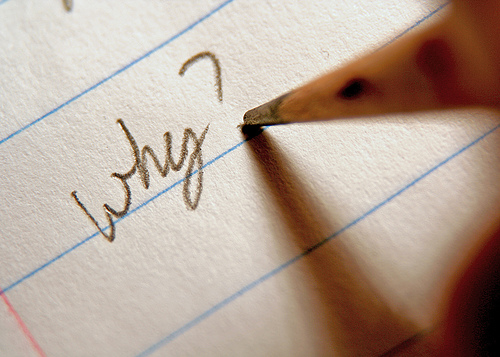
These questions are simple enough to make you think, and challenging enough to make you respond. If you’re not asking these questions about your writing, answer this question: Why not?
There’s no such thing as writing; only rewriting. Inger (aka The Thesis Whisperer) explains:
“…everyone writes badly in the first draft…I never rewrote anything as an undergrad and just assumed I was crap at writing academic papers.”
In my mind, lack of rewriting is one of the biggest issues in the essay writing process. Ask yourself, “Have I left enough time to properly edit and rewrite my essay before it is due in?”
The relationship between time and rewriting/editing is important. Do you respect that relationship?
photo by stuartpilbrow
Writing the bulk of an essay just before the deadline is a common technique. Failure to make the grade often boils down to this and it’s a more difficult method to employ all round. The temptation of a short-term, temporary gain is so great that we’re willing to pull the wool over our own eyes. When it’s too late, the heat is on to find someone else — anyone else — to blame for the shortfall.
With enough of a reality check, it becomes clear that you’re awesome enough to improve on your own terms. What looks like hard work and real discipline is actually more a habit and a willingness not to give in to temptation.
Write rubbish and keep rewriting until it’s treasure. Start right away. You won’t even notice short bursts, but we’ve all experienced the pain of last-minute essay hell…
How willing are you to cast aside temptation and ascend to essay heaven?



 TheUniversityBlog