essays

Are you asking enough questions?

Last week, I talked about understanding questions as a whole and then breaking them down into parts. Both stages are in order for you to get as much meaning from a question as possible.

Questions are important. You need to understand questions, answer questions, and ask questions.
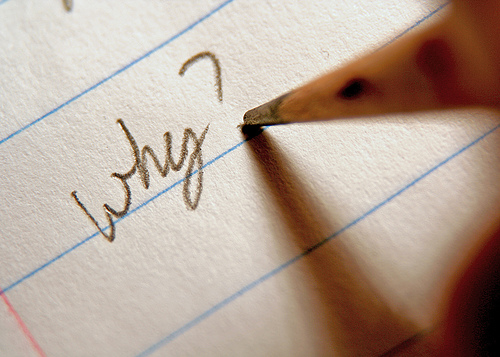
photo by e-magic
photo by e-magic

Assignments go beyond asking how much information you can remember on a topic. Assignment questions also require you to:

  • create an argument;
  • weigh up different views;
  • provide examples and workings, as opposed to regurgitations;
  • demonstrate understanding of the topics under discussion.

It’s easy to get stuck on key topic words that you have a lot of knowledge on. But dig deeper and you’ll notice more to the question. The closer you come to answering the question clearly, deeply, and effectively, the more likely your grade (and enjoyment!) will benefit.

Look for:

  • What’s being asked of you – Does the question ask you to discuss, compare, analyse, argue, evaluate…? The question is probably worded so that you should talk about what you know, but relate to why that’s the case and explain how it could be different or why people have different theories on the matter.
  • Specific focus points – Some questions can be vague, but many ask you to concentrate on a particular feature to base your answer on. You may also notice the question is guiding you to frame your answer in a certain context, such as a single culture, time period, object, opinion, text, and so on.
  • Leading words and phrases – For example, you may be asked to analyse the benefits of something. This is not an invitation to lavish praise upon the subject. To analyse the benefits means to weigh up, to argue whether they really are benefits, and to discuss alternatives. You aren’t being asked a trick question, but you do need to show awareness that there is more than one side to any story. You are welcome to have an opinion on the matter, so long as you explain why you have reached that conclusion and show why you don’t share the same enthusiasm for the alternatives. You’re not stating right/wrong, yes/no, good/bad answers. Instead, you’re reaching a conclusion after exploring the topic.

You also need to ask a lot of questions. Unanswered questions, questions that arise from your study, and questioning assumptions.

Even after you’ve written up a good draft of an essay and you’re happy with it, read through the draft again. Ask yourself — and try to answer — these 15 questions throughout your draft:

  1. How did I come to say that?
  2. Have I backed this up?
  3. Can I say this any clearer?
  4. Does this point follow on?
  5. Should I give more detail here?
  6. Does this assume something I haven’t mentioned?
  7. Does this need referencing?
  8. Will a relevant quotation and/or summary help before I move on?
  9. Is this relevant to the question/title?
  10. Could my main point be made more prominently?
  11. Am I making sense here?
  12. Am I being critical or opinionated?
  13. Does this require an example or demonstration?
  14. Has there been a more recent development?
  15. Is something missing?

These questions are simple enough to make you think, and challenging enough to make you respond. If you’re not asking these questions about your writing, answer this question: Why not?

Always check what you’re being asked to do

I learned an important lesson at school that stayed with me throughout my time at university.

My Home Economics teacher announced to class that, as a change of plan, everyone would be completing a short test during the lesson. We had planned on doing some baking that day, so the alternative was a rough deal. I could make a mean flapjack…

“Don’t worry,” said the teacher. “Maybe we’ll still make stuff after the test. There should be time…”

When the paper was handed out, the teacher said we could start and she told us to read through all the questions first so we understood what we were being asked to do. Naturally, we were more concerned with finishing the test as quickly as possible. So when the time started, we raced off.

photo by Cathdew
photo by Cathdew

The test didn’t seem too hard. Slightly bizarre, but not difficult:

  1. Read through this test.
  2. Write today’s date at the top of the page.
  3. Write your name in any corner of the page.
  4. What is 100 minus 99?
  5. Touch your nose for 5 seconds.
  6. Get out of your chair, jump up twice, and sit down again.
  7. Draw a circle in the middle of the page.
  8. Wave your arms in the air.

And the list went on like this over a couple of pages. The tasks got increasingly lengthy and ridiculous. And before long, the entire class was all over the place and laughing at each other.

But some people grew suspicious and confused. Instead of carrying on, more and more of us started to read through the test. The final task said, “To complete this test, you only need to complete the first task. Everything else is irrelevant. Thanks for reading through the test first.”

The teacher wasn’t trying to make fun of the class. She said that it may have been a laugh, but there was a serious point: It pays to check what you are being asked to do. If you don’t truly know what’s being asked, how can you be sure you’re on the right track?

From that point, I understood the importance of treating essay and exam questions as seriously as the answers. Your assignments aren’t likely to have tricks like the one I’ve described, but it shows how easily you can end up answering the wrong question and lose big marks as a result.

So what do you do?

  • Don’t rush in – Always allow a few moments to take in and read through questions and requirements.
  • Don’t look for key words in isolation – You’re unlikely to be asked to write everything you know about a particular word or subject, so take the question as a whole before you do anything else.
  • Now break the question down into pieces – When you understand the full question (and only once you do), dissect it for clues and pointers. Have you been given a specific target to frame your answer? Does the question ask you to discuss, evaluate, compare, examine, demonstrate…?
  • Look for vague comments and anything that’s open to question – Practically nothing can be boiled down to a right or wrong answer. If you can spot a flaw or anything that’s open to interpretation, it may hold the key to how you should answer. Academic writing usually involves explanations and conclusions, but it also involves asking many more questions in return.
  • If in doubt, ask your tutor – This may not be possible in exam conditions, but for other coursework and class assignments, it’s better to ask for clarification before you rush ahead.

I don’t think I ever thanked my Home Economics teacher for giving us that test. It may not have improved my flapjack recipe, but it was still a great recipe for success…

Why rewriting brings you closer to essay heaven

There’s no such thing as writing; only rewriting. Inger (aka The Thesis Whisperer) explains:

“…everyone writes badly in the first draft…I never rewrote anything as an undergrad and just assumed I was crap at writing academic papers.”

In my mind, lack of rewriting is one of the biggest issues in the essay writing process. Ask yourself, “Have I left enough time to properly edit and rewrite my essay before it is due in?”

The relationship between time and rewriting/editing is important. Do you respect that relationship?

photo by stuartpilbrow

photo by stuartpilbrow

Writing the bulk of an essay just before the deadline is a common technique. Failure to make the grade often boils down to this and it’s a more difficult method to employ all round. The temptation of a short-term, temporary gain is so great that we’re willing to pull the wool over our own eyes. When it’s too late, the heat is on to find someone else — anyone else — to blame for the shortfall.

With enough of a reality check, it becomes clear that you’re awesome enough to improve on your own terms. What looks like hard work and real discipline is actually more a habit and a willingness not to give in to temptation.

Write rubbish and keep rewriting until it’s treasure. Start right away. You won’t even notice short bursts, but we’ve all experienced the pain of last-minute essay hell…

How willing are you to cast aside temptation and ascend to essay heaven?

Another way to write 1000 words a day? – The Thesis Whisperer

photo by Samantha Decker

photo by Samantha Decker

Get to grips with academic writing

Does essay writing trip you up? Do you struggle to know how you’re meant to write? Are you annoyed by gaps in your understanding?

The Guardian says that the change from A-levels to a university degree is too much for many students. Essay requirements are overwhelming.

photo by katiew
photo by katiew

Echoing many people I’ve spoken to in the past, Daphne Elliston told the Guardian:

“…putting my own words into academic language was hard. And it was difficult to believe I was entitled to my own opinion or to disagree with all these academics who’d done years of research.”

You don’t have to write insanely academic language. Rather, you’re meant to create an argument. Your job is to research, assess and reach your own conclusions.

But how? Where do you start? Here are some considerations for tackling essays:

  • Write in whatever order you like – It’s not a linear process. Kate Brooks at UWE says the process is more cyclical: “do some research, draft a bit, read some more, think, consider what you’ve written, redraft.”
    You can write before you research, you can build a conclusion before an introduction, and you can make random points as you go along and reorder those points at a later stage. Your writing route is flexible. Nobody needs to know how you put it together. The end result is all they’ll look at. And all they care about!
  • Consider your opinion throughout – From start to finish, be aware of what you think. Take the essay question the moment you’re given the assignment and ask yourself how you would answer it. Write a paragraph straight away, before you do any further reading. After some research, has your opinion changed? When you’ve finished writing, has your opinion changed? Keep asking yourself what *your* opinion is.
  • Feel free to stop reading – Academic research can go on and on. And on. As an undergraduate, you don’t need to obsess forever. With a load of ideas and a grip of core texts on reading lists, there’s no need to relentlessly search for every last scrap of data and every opinion ever made. That’s impossible. And you’re not expected to mention all this stuff anyway. There’s no science in knowing when to stop. However, if you’re starting to feel overwhelmed with information and don’t have any of your own writing to show for it, you can probably stop reading…
  • Select the best examples – With all this research done and a trillion ways to say the same thing, pick the clearest, most relevant references to make your point. Leave the others to your references only. The simple act of referencing shows you are aware of it.
  • Don’t feel offended – Some departments introduced compulsory modules on writing at degree level. However, some students found this offensive, according to the Guardian piece.
    After completing A-levels and getting good grades, it may feel strange to start all over again. While some students sense an overwhelm from the beginning, others think the process is just a continuation. By stubbornly refusing to discover more about the academic writing process, some students will miss out.
    Be open to learning. Even if you were entirely comfortable all along, give yourself a pat on the back for being so awesome. Not many people reach that level of awesome so quickly. 🙂
  • Discuss the writing as you go along – If possible, grab some time with your tutor (either virtually or physically) to discuss your draft essay. It shouldn’t take long to find out where you’re headed. There’s no need to be specific. Your job is to make sure you’re on the right track before you commit more time.
  • Work in small bursts, over a long period of time – The difference between a First and a fail may come about solely because of the way you use your time. There has long been a tendency to leave essays until a day or two before they are due in. A risky move.
    By waiting until the deadline, you have no option but to write in a linear fashion. Research also goes out of the window. We’ve not even got on to the amount of stress you’ll feel with nothing written and only a short space of time left. This is one of the most common methods of writing essays, but also one of the craziest. Do you really want to take that risk?
  • Think critically – As Daphne Elliston says, it’s hard to accept you have any right to an opinion worth anything compared to acclaimed academics and prolific authors. But you do. On top of that, you are able to disagree with what these published writers have said. So long as you back up the argument with reason and other references, you can argue however you like. I find that one of the most enjoyable parts of the writing process. 😉
  • Use your own voice – YOU are the author of this essay, not someone else. An overactive vocabulary is pointless. Sounding clever and being clever are two different things. Simple language can be just as powerful when you have a solid argument.
  • List the points you want to make – Plan as simply as you can. Get some bullet points down with 4, 40 or 400 things you want to discuss in the essay. The number doesn’t matter; it’s the active consideration that’s crucial. This basic plan will get you thinking right away and will even help shape how you research. The search for references and quotations is much easier when you have an idea of what you’re looking for.

If you want to explore the academic and essay writing process even further, here are some other things you can do:

Your writing will improve as you go along. When you encounter a problem, make an active effort to overcome it. Gaps in your understanding are not weaknesses, they are merely challenges. We all face these challenges every day. Even academics with years of research have to overcome gaps in understanding. That’s why they are academics. If those gaps didn’t exist, there would be nothing left to learn!