All Students

Outlines Are Not All Equal

A short essay is not the same as a long essay. A presentation is different too. So is a dissertation.

That means your preparations need to vary. How you approach each assignment is important.

Outlines are a great way to build an idea of what you want to produce. Here are some brief notes on how your outlines could differ, depending on which type of coursework you are working on.
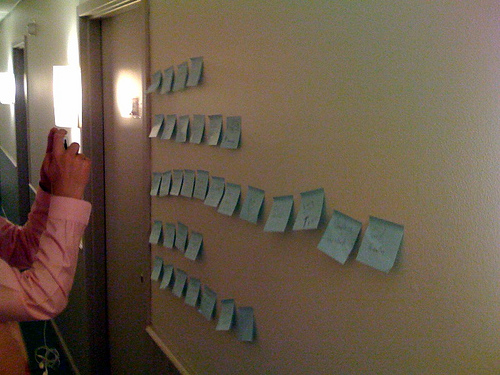
(photo by anselm23)

Post-It Outline. One way to prepare that essay. (photo by anselm23)

Short essay

Start with bullet points of the major arguments you wish to make. If you have too many ideas, either condense them into themes or brutally remove all but the very best. Your main tasks are a clear focus and awareness of key points.

Be aware of brevity needed in such a short space and plan accordingly. There’s no need to outline with the aim to cover every possible base. Highlight your most important areas with one or two clear examples.

Work from there and continue working concisely and to the point. When you’re getting too detailed, it’s time to scale back.

Long essay

This essay contains more room to explore. Most essays tend to come under the ‘long’ description, so stay focused. It’s easy to ramble and move away from the question under discussion.

An outline allows you to stay on track and on message.

Ensure each bullet point you make is related to addressing the question. At each stage of the outlining, refer back to the question.

For every major argument you wish to tackle, give sub-headings that relate to proof, examples, counter-arguments (and how you’re dealing with them), quotations and references, and key descriptions of topics and themes.

Presentation

You’re dealing with more than text here. You’ve got your voice, use of technology and slides, interacting with an audience, and so on.

In terms of outline, you need to prepare for all these things. That means a sharp eye on admin and peripheral issues. Your initial outline must cover use of equipment, size and layout of room, handouts, software use, Internet availability, and so on. While none of this is about your actual subject, it’s all relevant to the way you’re conducting yourself. Best assess the situation early, rather than five minutes before you’re due on stage!

As for content, think like you should a short essay. Your main aim is usually to highlight major arguments and workings as effectively as possible. Alternatively, you might be discussing an experiment or some findings you’ve made. All these examples require bold points and clear detail.

If you need a vague outline to play with, pick a start, middle and ending. In other words, introduce, elaborate (tell stories), and conclude. You may also like to quote something in keeping with your presentation at the beginning in order to set the scene.

Dissertation

Assuming you have agreed a dissertation topic, the most important initial outline is the structure. In what order will you present the themes and arguments? Work out the flow of the dissertation before anything else. Each part should follow on from what has come beforehand.

Spend considerable time outlining for your dissertation. It’s worthy of a post in itself, because a dissertation outline is far more detailed than that of a single essay.

Thankfully, in finding a topic, you should have developed some form of basic outline as part of the process.

Practical work & experiments

First off, develop a plan of action and a rough order of play. What needs doing, how should you prepare, and why are you doing this?

Next, explain what comes afterwards and what you’re going to do with your results and outcomes. If you are being assessed for a written element of this work, make another outline plan for that subsequent assignment.

Seminars & weekly reading

Advance outlines work for some students. Think of it like a timetable without rigid times. The timetabling aspect can come later. What matters in your outline is getting to grips with what you want to know at the end of your week, the books and papers you have earmarked, the questions you want to cover before, during and after seminar sessions, and any problems you may encounter.

You may have a better way to prepare for your regular work. If so, great. If not, see if an outline helps get you closer to the work at hand.

For some, a list is enough. For others, a strict timetable is required. Whatever the case, you can outline anything, so give it a go no matter how small your project is.

Are you a keen outliner? Share your outlining tips in the comments below.

Living Together Through the Years – Top Tips From Fresher to Finalist

How you experience living with others depends on what year you’re in at uni.

Everything changes each time you move somewhere new. Situations, workload, location, friendships.

Since it’s the start of another academic year, I’ll run through some tips and experiences for each year. Just when you think you’ve got communal living sussed, you’re thrown into a brand new set of circumstances.

photo by David Reece

photo by David Reece

Fresher Year

Support those not settling in so well

I wish I’d done this better. I was experiencing loads of new stuff myself, but I could have tried harder to help integrate those who were finding life away from home tough.

In my first year, one housemate was torn apart from being away from family and it seemed only a matter of time before they would leave. It didn’t take long. But in that short space of time, I could have done more to reach out and show a friendly face. I tried once or twice, but I wasn’t consistent, and that’s key.

Work as a team ESPECIALLY when one or two won’t pull their weight

You could easily adopt a ‘down tools’ attitude when one person isn’t willing to get involved in cleaning and other little jobs. But that makes it worse for everyone. Don’t choose to live with mess and muck as a matter of principle.

Start a conversation. Be kind when you speak to them about the situation. Anger will only make matters worse.

And don’t make it a five-against-one showdown either. Before having a house meeting to vent on that single subject, take a soft approach. One or two housemates could have a quiet word first to find out how things are and discuss the situation constructively. Gently does it.

If you’re lucky enough to have cleaners, you may not have these issues. But please spare a thought for whoever is making good your mess.

Prepare to learn a lot in a short space of time

If you’ve never lived with others, especially a bunch of strangers, you’ve got your work cut out. Some positive stuff, some negative.

Use this time as a learning experience, as you do with your degree work. You’ll face surprises, but don’t react too quickly (y’know, unless it’s a fire, in which case GET OUT!!!). Let each situation sink in and make a measured response.

Branch out beyond your own space

No matter what your living situation, university lets you find all sorts of new people. Now is the time to make new friends, connections and contacts. You don’t have to stick with the people you’ve been placed with in housing. While it helps to be on positive terms with them, there are many more opportunities to make new friends from the outset. Make the most of it.

Learn how to hack your life

Washing, cleaning, and admin. Delightful! It’s no surprise so many students ignore stuff like this until it’s crucial. If it’s not the end of the world, it can be left.

But now is the best time to learn how to make life work for you without resorting to professional help (i.e. Mum & Dad).

Take your laundry, for instance. Washing machines look daunting. They have loads of dials and buttons. But it’s not difficult. At all. I used to panic about temperatures, times, spin speeds, and all sorts of settings just to wash my clothes. In my first year, I only washed my own clothes in an emergency. Most of the time, I just got others to do it (yes, parents again).

This was a mistake. I should have taken responsibility much sooner. Five to ten minutes is all it takes to understand what’s going on. That includes looking up what all the cleaning symbols mean on clothes. You’re welcome. [What, that’s not enough? You want a printable PDF of those symbols now? Oh, go on then!]

So long as the clothes get washed, it doesn’t really matter. Most stuff goes at 30 degrees (40 degrees is the norm, but uses more energy and often isn’t needed) and most stuff can have a good old spin session without worry. Those laundry symbols come in useful to find out those odd items that need special attention. Remember those ones and move on!

So this isn’t much about hacking, more about dealing with the issues from the outset. But it’s such a rare treat that your advanced work will seem like hacking to much of the world around you.

Just be aware that you’ll be in demand as the guru to go to…

Second Year

Typically the year when you branch out to private accommodation if you haven’t already.

If you’re living with more new people, the first year tips apply. Read those first.

For the following tips, I’ll assume you’re living mainly with people you know and that you’ve chosen to live with.

These are good times, but you still need to be mindful. Even friends can be difficult to live with when they’re under your feet 24/7.

photo by Ethan Moore

photo by Ethan Moore

Respect the place

This goes without saying, no matter where you live. But some student accommodation through a private landlord may look weathered and worn from heavy use by other students over the years.

That’s no reason to treat your place without care.

Also, inform the landlord of any problems. Don’t leave them to get worse. If the landlord isn’t helpful, try speaking to your Students’ Union or student services for more advice.

Walls are even thinner

Noise can be a problem. Why? Because you have different deadlines, you come in at different times (including very late at night), you have different tastes in music, you have various ‘romantic’ situations, and so on. Just remember that you’re not the only one in the house. The occasional lapse is forgiveable. Don’t make it more than that.

Have rotas

You’re unlikely to find a way to give each person the same responsibility for particular tasks, especially if they are unpleasant ones.

A rota helps everyone pull their weight and allows you to keep on top of the most important household tasks.

Little and often. That works magic. When you leave stuff, it piles up and gets worse. A few minutes here and there makes a big difference over time. So, little and often.

Understand extreme personality traits

Some people are more fussy about cleanliness than others. It’s not unusual to live with extremes. While one shrugs at massive mess, another gasps at a fleck of dust.

It’s a difficult road to travel, so prepare. And listen. And seek solution at the earliest possibility.

Failing that, seek compromise.

Whatever happens, try to steer away from outright household battles. They’re ugly. You don’t want them.

Pay bills on time

Especially ones where it’s in a single housemate’s name. If bills are all inclusive or you’re all responsible for your own shares, that’s wonderful. If not, please PLEASE do the right thing and pay when you’re meant to. Don’t be responsible for giving someone else financial grief.

Final Year

I was a Senior Student, so I went back to university accommodation. But being in my final year, the game changed and I was working on my dissertation among other things.

I didn’t hide away though. I went out a lot more.

Whatever your circumstances, a few things are different about your final year, because you’re closer to the end of your degree.

photo by _bernd_

photo by _bernd_

Be selfish

You need to knuckle down. If you haven’t already made changes, now is the time. Don’t be swayed to go out when you’ve got work to do. Make decisions for yourself and have clear reasons why that’s your choice.

You may need more of your own space. If you need to make your room off-limits, make it clear why. You’re not being anti-social, you’re being sensible. Of course you’d love to spend every waking moment having a laugh with your mates. But it’s not practical.

Have downtime

You may be busy and getting your selfish groove on, but you need to find some time with your housemates.

There’s something wrong when the people you’re living with forget you’re there…

Continue washing, tidying and organising

The odd jobs are the first to go when you’re trying to find time to fit everything in.

Bad move. You waste time living in a mess. It’s impossible to live when you can’t find anything, you’ve got nothing clean to wear, and everything is a general state.

I went to the laundrette on Sunday mornings, very early. I knew nobody would be around that way. I’d take some work to get on with while my clothes were being washed. The best way to avoid temptation is to leave your phone in your room. At a laundrette, it’s the only thing left in your way between work and procrastination.

With no phone to hand, the prospect of doing reading and coursework is (hopefully) better than staring at a spinning machine for an hour or two.

Final Thoughts

When you live with others, you have to take care of them. And yourself.

Sometimes it’ll be tough. You’re trying to work with the situation while it feels like others are messing you about.

Other times it’ll be brilliant. The group dynamic will work just right.

So you’re bound to go through all sorts of emotions, highs and lows. When things are good, cherish it and don’t take it for granted. When things go wrong, know that you will get through it.

For more tips, check out my 20 hints for living with others. Good luck!

Self-Motivation and Mountain Moving

Self-motivation is great. It helps you take those online courses and pass with aplomb. It gets you connecting with amazing people. It inspires you to write about your chosen profession,  your hobbies, and anything on your mind. It lets you present videos, go to talks and conferences.

Self-motivation takes you to a place where you can create stuff, argue stuff, make stuff happen.

But how often is this happening?

It’s easy to forget how useful a dose of self-motivation can be.

So it’s time to remember. Self-motivation is a big deal.

Nothing is guaranteed in life, but you have to reach out to get it.

When you don’t, nothing happens.

converse-fields

The more self-motivated you are to show up and take action, the more likely you’ll find the good stuff. And you see those people who seem to get asked to do absolutely everything? They usually got to that place by asking a lot before all this happened. It took a lot of asking to get a lot of asking back at them.

Choices and Making Things Happen

When you take action, you need to make choices.

Choices are tough. What do you give up? What do you prioritise above everything else? There are only so many hours in the day. And when you do have the time, do you worry about every last detail before committing to something?

First, consider if your actions somehow make a difference to you or someone else. What value does it have? Even if that value is personal, that’s fine.

Second, think useful, not polished. For example, when I write, I don’t edit much until later. Editing as you write is a pain and it limits your output. If your brilliant idea can only be expressed in a few bullet points for now, so be it. You’re better off making a couple of notes than not writing anything at all.

Another example is through Gary Vaynerchuk. When he gets a great idea in his head that he wants to tell the world, he doesn’t care about production values. He’ll take out his phone and, no matter where he is, he’ll shoot a quick piece and post it online. When the message is more important than a fancy presentation or high definition video, push it out.

All you need to do is flip your phone around and shoot a video. Get an idea out there, make something happen. When you’ve got something great to impart, you can move mountains. Keep communicating, keep creating, keep connecting. Don’t wait for someone–including yourself–to tell you you’re good enough, to tell you you’ve made it. That’ll never happen. And if people do tell you you’ve made it, don’t stop learning on account of that.

Don’t stop creating either. There’s always more to do.

So get out there and instead of trying to do something good, try doing something new, learning as you go. Some stuff will be grainy and useful. Some stuff will be polished and rubbish. You’ll even have perfect days and terrible days.

But that’s only if you do it. If you just play it safe and do nothing at all, there’s nothing to show and you get no further forward.

You have to make choices because you can’t do everything. But when you say you really want to do something and it’s perfectly possible to do it, why would you still not do it?

I had an email the other day from someone who wanted to write a guest post for the blog. They said they wanted to get into blogging and were looking for a way in. I asked them what their own blog was and they didn’t have one.

Let me repeat that once more…A person who really wanted to blog, but didn’t have a blog yet and were looking for a way in.

A way in to what? Just sign up and start publishing stuff!

Now, I’m pretty sure their real aim was to promote another website. But imagine if that person really did want to blog. Nothing would be stopping them so long as they had an Internet connection.

If you’re reading this, you can be writing it too.

Taking Life Seriously

As you can tell from this site, I still find university fascinating. I understand that there are other routes and that uni isn’t for everyone. But I’ve found something that speaks to me and that I want to be a part of. It may bore the socks off you, yet it works for me. I want to help students make the most of their time at university and learn about their experiences because I feel in a good position to do that. I like the academic side, the social side, the admin side. It’s a strange position to be in, but a wonderful one.

I moved away from academia after I graduated. It seemed like the only thing I could do at the time.

I was wrong. And I’ve been wrong about a lot of things throughout my life.

We’re all wrong about a lot of things.

Luckily, we get a lot right too.

One thing I was right to do was return to the world of higher education. Not only did I work to my strengths, I also worked on my weaknesses. I didn’t know enough about the administration side of academia, so I made it my business to do so. I took it seriously.

The first step of the process was self-motivation.

If I didn’t want to do this, the outcomes would be different. I wouldn’t have been asked to do many of the things I’ve done. I wouldn’t have found people wanting to consume the content I’ve produced. I wouldn’t have participated in the activities that have helped along the way.

I wouldn’t have taken this seriously.

How seriously do you take the things you’re aiming for?

I’m writing at the time of year when new university students are starting a journey toward a degree while applicants are at school or college writing personal statements so the whole process can begin again next year.

When I was writing my personal statement, I was only half-hearted about it. I wasn’t looking at the bigger picture. Nobody had explained what any of this meant and I hadn’t done enough research of my own either.

That wasn’t the best attitude to have. Yet it’s an attitude repeated time and again for far too many people, year after year.

I had a chance to turn things around and I took it. If I hadn’t, my university experience might have been pretty poor. I may not have gone to university at all.

Yet here I am, writing stuff like this, trying to help others win. Among other things, that needs a regular dose of self-motivation.

None of this is about finding your passion at an early age. Neither is it about ignoring what you believe in. At the core of this is taking what you do seriously. Even the fun stuff. Make every action count and find motivation in what you do.

This Post Is For YOU

I write this as an inspired ramble. I’m posting it here without (much) editing.

This post is for you to chew on as is. If it speaks to you, that’s awesome. Let me know what you’re inspired to do. Keep in touch. Even if it’s just a quick tweet (@universityboy) I’d love to hear what you’re doing and how you’re self-motivated.

And if you think I’m crazy, that’s fine. Do your thing and be inspired by what makes you tick. The point is to find what makes you want to wake up in the morning (or night!) and do amazing work. I’m only trying to help with that. If someone else is helping you achieve that in a completely different way, brilliant.

I’m talking to each and every student out there who gets what I’m saying and who feels like I’m helping them. If I’m not helping you, I’m comfortable with that. If I’m not helping anyone, I need to reconsider.

From where I am, I feel comfortable at the moment. So while I’m self-motivated, I can’t do it all by myself. This is a two-way process.

Thank you for that. Thanks for reading and I hope you get a spark of inspiration from this post or anything I’ve created over the years. May your own self-motivation (along with the help of others) take you to wonderful places.

Not long ago, I referred to a Dr. Seuss book, “Oh, The Places You’ll Go!“. The book’s message is that you can move mountains.

I believe you can move mountains. It’s time to get motivated. Are you ready?

Let me know what your personal mountains are and how far you’ll move them.

move mountains (Dr. Seuss image from Oh! the Places You'll Go) (photo by Curtis Gregory Perry)

“Kid, you’ll move mountains” – Dr. Seuss image from ‘Oh! the Places You’ll Go’ (photo by Curtis Gregory Perry)

Who? That.

You should read Plashing Vole’s post on using ‘that’ and ‘who’ when talking and writing about literature. Does a literary character get lumbered with being a ‘that’ or can they break through to new depths and become a ‘who’?

Plashing Vole explains:

“A Whovian treats characters as real people, a Thaterite analyses them linguistically and celebrates the separation of art and what some people still refer to as ‘real life’.”

Do you have a preference? Plashing Vole prefers ‘who’ and–after brief consideration–I agree it sounds better. I also agree that it’s easier to call a wild animal ‘it’, although I do it for sake of ease and not because it’s a ‘dumb beast’. Unless I went around sexing each creature I wanted to refer to, I’d feel unhappy about giving a 50/50 chance to getting a guess of ‘he’ or ‘she’ correct.

In general English usage, here is what is printed in the Oxford A-Z of English Usage:

“It is sometimes argued that, in defining relative clauses, that should be used for non-human references, while who should be used for human references: a house that overlooks the park but the woman who lives next door. In practice, while it is true to say that who is restricted to human references, the function of that is flexible. It has been used for human and non-human references since at least the 11th century. In standard English it is interchangeable with who in this context.” – p.154 (1st ed.)

Animals are non-human, so ‘it’ seems the way to go. But for literary use? A fictitious character is not human, but does masquerade as one in the mind of the author and reader. At least, that’s the hope.

Perhaps ‘that’ is the easy way out. But when enough people are frustrated by its use, it’s not an easy way out at all. Interchangeable or not, a character that/who is real in terms of what you’re studying is operating in a complicated place.

Given all the potential trouble here, surely we could grace them as a ‘who’…