Month: September 2010

Woody Allen and the art of letting go

Woody Allen has got his head screwed on.  He knows how to let go.

photo by Gilberto Viciedo

photo by Gilberto Viciedo

Allen told the New York Times that he never rewatches his films after they are made:

“I’ve never once in my life seen any film of mine after I put it out. Ever. I haven’t seen ‘Take the Money and Run’ since 1968. I haven’t seen ‘Annie Hall’ or ‘Manhattan’ or any film I’ve made afterward. If I’m on the treadmill and I’m scooting through the channels, and I come across one of them, I go right past it instantly, because I feel it could only depress me. I would only feel, ‘Oh God, this is so awful, if I could only do that again.'” [Source]

He doesn’t want to feel that itch to improve the past.  There’s no point in being embarrassed now.  That type of worry is redundant.

I also admire Allen’s drive to start working on a new project as soon as he finishes the last.  Always moving ahead, never looking at what’s passed.

I’m sure he still learns from mistakes and takes from experiences.  But he won’t dwell.  Neither will he panic about the future.

Compare this with Jenny Diski’s comment in this fortnight’s London Review of Books:

“It’s absolutely true that writing a book doesn’t make you happy (it’s never good enough while you’re writing it or after you’ve finished it, and anyway what about the next one).”

I can’t say how happy Woody Allen is when he’s writing screenplays, but he does manage the situation well:

  • It may never be good enough, but he cracks on with that understanding.
  • He lets go once the project is finished.
  • The next project is a challenge worth starting right away.

How do you use this as a student?

Whatever you do, be ready to let go:

  • Let go of research.  You’ll never know everything.  The aim is to have *enough*.
  • Perfection is not attainable.  Letting go before it’s perfect is necessary, not shameful.
  • When you hand work in, let go of that burden.  Stop thinking of ways to improve on writing style (at least until it’s handed back).
  • When you let go of one project, grab hold of the next as soon as possible.

What do you need to stop dwelling on?  What is your next project going to be?

Straight A and still not OK

3,500 straight-A students failed to secure a place at university last year.

This year, despite a new A* (A-star) grade, a similar problem is occurring.

photo by mugley

photo by mugley

With 3 A* and 1 A, Amber Fox thought she would find a place to study Medicine.  However, none of the universities she applied to offered her a place.  Fast forward to clearing and there were no places to be had in her chosen field.

Consider this story for a moment.  Amber achieves impressive A-level results, she has identified a career path she would like to follow, and that career requires education beyond A-levels.  The natural course of action is, therefore, university.

David Willetts, Minister of State for Universities and Science, says that university should not be the only route to success.  A valid point.  He also states that the application process to university is a competitive one and not all applicants will be successful.

Unfortunately, competition for a place at university is an increasingly random process.  When someone with top grades is denied a place and cannot follow their chosen career without a degree, something is wrong.

Willetts explains the possibility of Further Education in order to work toward a degree.  But even this appears to be a false trail at the moment.  FE principal, John Widdowson, told the BBC that student numbers are similarly capped at colleges:

“It goes against the grain to be turning away well-qualified, enthusiastic students and say ‘I’m sorry, we haven’t got a place for you’.” [Source]

I wish Amber the best of luck in reapplying to universities next year, which is her aim.  Amber is not alone.  Willetts is aware that many straight-A students are falling out the system and that further understanding is required to improve the situation.  It remains to be seen what action is taken on this front.

The application process clearly can’t keep up with other changes.  To rely on personal statements and minor quibbles to sort out potential offers is unreasonable.  I feel uncomfortable when so much hinges upon so little, negating all the effort that came before.  Yet this is what it ultimately boils down to.

Admissions teams are not to blame here.  Popular, heavily fought courses are bound to be oversubscribed.  Despite the A* grade, admissions officers still find difficulty in choosing who to take on.

In following years, as top students reapply, they deny the next set of potential students.  And the cycle continues.

So what can make the system more reasonable?  Some argue that places should be offered after exam results are known, not before.  Others say the artificial cap on university places should be lifted.  There are many options, no absolute right answer, but plenty of room for improvement.

In a competitive field such as Medicine, I doubt all top students would find success even if more places were offered and those offers came after A-level results were released.  However, the situation wouldn’t feel as skewed as it is now.

In years gone by, a story like Amber’s would be shocking due to its unusual nature.  Now it’s shocking because so many young people must suffer in the same way.

For more on this story, Radio 4’s “The Report” is available to listen to for a week.

Should lectures be banned?

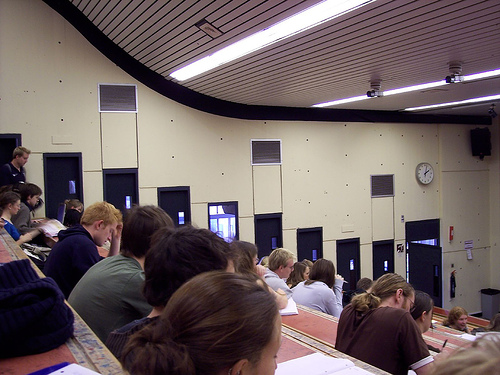
I’ve just been listening to Donald Clark at the #altc2010 conference in Nottingham.  His keynote speech argued that lectures are rubbish.  Thought I’d share a hastily-written post in the aftermath.

Clark asked why students are still lectured to. He suggested that a complete rethink is necessary, not just the odd tweak.

photo by iwouldstay

Would you like to see the back of these? (photo by iwouldstay)

@GeoShore sums things up amusingly via Twitter:

#altc2010 keynote summary: “Lectures don’t work. Lecturers can’t lecture. Everyone’s been doing it wrong. Arse. Feck. Nuns.”

Despite a couple of questions from the audience asking about alternatives to the lecture, no specific answers were forthcoming.  Clark replied at one point that the answers are “staring us in the face”.

I’ve attended both great lectures and awful ones.  That suggests lectures aren’t automatically a bad thing.

The lecture is just one part of the learning process.  We read, we’re lectured to, we participate in seminars, we have one-to-one tutorials, we form study groups, we have online participation…

Clark said he enjoyed TED talks and appreciated their production values, but he seemed to be looking for more.  TED talks are still, essentially, lectures.

Same with podcasts and videos.  Clark agreed that it’s better to record a lecture than do nothing at all.  However, he argued that this method merely results in a load of poorly delivered lectures streaming out, providing no further value to learners.

Other than end lectures altogether, I’m not entirely sure what is required.  A complete rethink may result in new delivery methods, so will they look like lectures at all?

If new techniques do resemble lectures, why have other delivery styles so far been given a lukewarm reception (if that) by Clark?

If new techniques don’t resemble lectures, the result has been to abandon lectures, not rethink them.

Clark suggested that there needs to be more collaboration and discussion present in this type of learning.  That’s what seminars and tutorials are all about.  This isn’t an either/or situation; different methods of teaching and learning are delivered.  If lectures were the single focus for all information intake, we’d be in trouble.  But they’re not.

Over to you.  Are lectures dead?  Is the lecturer to blame?  What are the alternatives? Are podcasts and video lectures good, or not good enough?  Is the physical process of attending lectures a hardship in itself?

I’d love to hear your views!

The irrelevance of degree titles

Would you like a degree in Waste Management with Dance?  Sound like a strange combination?  Apparently not that strange.  The course is available at Northampton University.

The Telegraph has reported on how the Higher Education Funding Council for England (HEFCE) wants to see no change to the way it allocates funds to universities and, therefore, would allow all sorts of bizarre degree courses to continue.

I say ‘bizarre’, but what’s missing from analysis of HEFCE’s stance and The Telegraph’s view is opinion from students taking these courses.

photo by scragz

Might Stomp explain a degree in Waste Management & Dance?

A degree in Third World Development with Pop Music (or Dance with Equine Studies, if you’d prefer) may be perfectly sensible to students taking on the work.  Or perhaps those students are being led down a false trail of hope.  Or they just want a degree and were happy to take whatever they could in current climate.

Until recently, Media Studies used to face the wrath of critics who were ready to dismiss it as a pointless “Mickey Mouse” degree.  However, that particular stigma has disappeared as the years have gone by.  There may still be difficulties securing employment for many graduates, but that’s the same for many apparently worthwhile degrees.  Employability isn’t guaranteed in any field.

As universities cover an ever growing number of bases it’s not so surprising to find joint degrees that cover Waste Management and Dance.  For instance, you may want to combine a vocational interest with an important hobby.  Or you may want to further your experience in ways that cannot be covered with two similar subjects.  I doubt there will be much subject crossover in lectures if you study both Waste Management and Dance.

Many camps are keen to see HE as a resource for churning out employable individuals with a vocational talent.  But that’s never been the overarching point of universities.  You would expect a certain level of development to assist in employability and vocational expertise, but it’s not the sole purpose of HE.

That said, many students take the university route because they see nothing better in their circumstances or because they think it’s the passport to future career success.  Neither may truly be the case, but with a combination of more traditional careers requiring a degree and a lack of proper careers guidance and information for young people, I’m not surprised the situation has arisen.

Ridiculing degrees that sound stupid doesn’t help or prove anything.  Taylor et al explain:

“Barry Matthews, chair of the Professional Association of Teachers, suggested that teenagers were being brainwashed into thinking that university was their only option. Matthews questioned the need for vocational degrees, asking whether bricklayers needed degrees or practical ability, whilst he was also scornful of new ‘Mickey Mouse’ degrees in surfing or soap operas (Matthews cited in Curtis, 28 July 2004, p. 8). It is clear that there are now many new degrees in the portfolios of universities. Degrees have in some ways replaced the old apprenticeships and the practice of in-house training. For example, studies in journalism and in nursing are now successful degrees. We suspect that there will be those who believe that universities should not teach such subjects and should stick to teaching more traditional disciplines. Such a position fails to take into account the changing nature of the job market and the changing interests of students.” [Source]

I don’t have an answer to conclude with here.  In many ways, I don’t see much to answer.  Any degree with little value to the learner should be scrapped, whatever the discipline.  I’m not just talking about employability skills.  For whatever reason, it could be an English or a Biology course that fails in providing value.  At the same time, a single university offering Criminology and Pop Music Production may give students an amazing insight that no other could.  Degree title is irrelevant.

Students and graduates need to be part of the discussion as to what courses matter.  Their voices need to be heard and they need to be told the truth about why their course exists.

Without proper grounding, it’s pointless to worry about funding based on course titles.  And while nobody takes my proposal for a joint degree in Mosh Pit Sciences and Handbag Psychology seriously, I’ll stick with that view…