study

How fonts help (and hinder) your writing

Your academic outfit is a big deal.  Every element related to learning impacts upon you in some way:

  • Time of day;
  • Location;
  • Lighting;
  • Output method (pen & paper, laptop, etc.);
  • Ambient sound;
  • Music (or lack of);
  • Disturbances;
  • Company;
  • And so on.

I give my study setup a lot of consideration and have always been aware of how my attitude changes, depending on my circumstances.

It seems that I overlooked one important element that alters perspective on productivity…Fonts.

photo by vial3tt3r

photo by vial3tt3r

Fonts, the styles of writing you see on screen and on the printed page, are not only useful for layout and pretty structure.  They have another special power.

Your workflow and approach changes greatly depending on the font you use on screen. Fonts bring a new dimension to your writing.

This all came about when I read about the different printing costs between different fonts.  The most efficient font is apparently Century Gothic.  And, as Ampercent mentions, “The more pleasing a font looks at the screen, the less tempted someone will be to print it.  This will save both ink and paper”.

In which case, you should be able to take the logic further to aid study.

When reading, different fonts alter effectiveness and motivation, leading the reader to believe something is more difficult than it really is.

Therefore, your own engagement with text as you type probably makes an impact.

The more pleasing a font looks on screen, you’d hope it would help your own output too.  As you type, you watch the text appear on screen.  You’re engaging with the text.  You’re creating.

Until recently, I didn’t try using different fonts to see if they made a difference to my writing.  But once I changed font to Century Gothic for printing purposes, I noticed a change in how I viewed the text.

After some (still ongoing) experimentation with different fonts, I found that my workflow changed.  Sometimes I wanted to write more and more and more and…

Depending on the typeface, the text suddenly let me open up further with ease.  Even on work that I considered complete.  Quite an eye opener.

I’m amazed I didn’t pay much attention to font use for productivity in the past.  It’s not like I’ve ignored fonts.  Yet I didn’t ever think far enough to imagine a simple change of font could noticeably change my relationship with the text on screen.  Neither did I think certain fonts would let me tap away at the keyboard and enjoy the writing process more.

If you haven’t got enough fonts, or want to experiment with a wider range, a good place to start is Addictive Fonts.  The site showcases all sorts, including:

That should be plenty to be getting on with.  I’m sure that the most effective fonts differ from person to person, so find out what works best for you and enjoy!

I’m curious.  How affected are you by fonts?

How to read around a subject

When tutors suggest you ‘read around’, what do they really mean?  When you get a reading list with hundreds of books on it, where do you start?

 

photo by Valentina_A

photo by Valentina_A

Reading around covers a lot of ground and is important for undergraduate work:

“Reading will be a crucial element of your study in higher education…There is a much greater expectation and requirement, if you are to be successful, to read more independently and more widely than you may have previously.”
Studying and Learning at University – Alan Pritchard (p28)

So, reading needs to be ‘independent’ and ‘wide’.  Let’s go further:

“University work needs more than simple reproduction of facts.  You need to be able to construct an argument and to support this with evidence.  This means that you need to draw on the literature that you have read in order to support your position…What is important is to present a tight, well-argued case for the view you finally present as the one you favour.”
The Smarter Student – Kathleen McMillan & Jonathan Weyers (p226)

What you say must be backed up.  That’s where reading around comes in.  Your aim isn’t to get a unique view on the world.  That’s almost impossible.  You need to refer to what’s already out there, which is why you can’t rely on a small number of sources unless you’re content with a bare pass (or worse).

Here’s what reading around does for you:

  • Reading around helps you fill in the missing gaps you didn’t realise were there;
  • Reading around lets you know the subject, rather than just the facts;
  • Reading around is like filling up a jar in stages.  You start with big rocks of information.  When the big rocks fill the jar, you can still put in small stones of detail that fall between the big rocks.  When the small stones fill the jar, you can still put in fine sand of specifics to fill in the smallest, unclaimed areas in the jar.

How do you start reading around?  Here are a few ways:

  1. Read more than the key texts on reading lists – When tutors list ‘further reading’, ‘extra’ texts, or ‘suggested’ materials, they aren’t giving you anything that’s surplus to requirements.  The purpose of further reading is so you can learn more, not to read more stuff you don’t need to know;
  2. Highlight research that considers similar issues and explore their findings – You are discovering what has gone before.  How have we reached where we are today?  Is research still going on, or have we reached a dead end?  What is influential and why?;
  3. Don’t rely on textbooks alone – Read up online, in journals, in textbooks, in the news, and so on.  Check for the most recent research going on, even if that means no more than a quick Google Scholar search for papers in the last year or two;
  4. Find links between your subject and another field – If you stick to your subject alone, you can’t appreciate the bigger picture.  How does your subject impact upon others and vice versa?;
  5. Don’t think ‘answers’, think ‘questions’ – You’re finding what fits with your argument and how matters can move forward or be explored further.  Research wouldn’t be necessary if we had all the answers;
  6. Check bibliographies of the most useful books – When you find a corker of a book, or you rely heavily on a general textbook, the bibliography and references within can help in the same way a tutor’s reading list does.

Reading lists are detailed for a reason.  For first years especially, they need to show variation, given that students will be coming from many backgrounds and with varying levels of understanding around the subject.  You’re not expected to read everything from cover to cover. You’re not even expected to check every single title out.  But you are expected to use the list to explore and make your own discoveries.

Some books will sing to you like beautiful music, while others relentlessly scream nonsense at you. If a book’s content confuses you, don’t despair.  It doesn’t mean you don’t understand the subject; it means the book isn’t a good fit for you.

To get an idea of how a book or article speaks to you and if it’s important to your research, check out:

  • Chapter titles;
  • Abstracts;
  • Introductions;
  • Conclusions;
  • Headings/Sub-titles
  • Lists, activities, images & tables;
  • First & last paragraphs of chapters.

If certain texts aren’t available in your library, make reservations and remember to do some quick and easy online research about the book.  You can often find a lot of content long before you get your hands on the text.

Whatever you’re studying, a lot of reading is involved.  With so much out there, you may be stuck for a starting point.  John Kay explains that there’s no point in making a specific plan at times like these.  Just jump in:

“When faced with a task that daunts you, a project that you find difficult, begin by doing something.  Choose a small component that seems potentially relevant to the task.  While it seems to make sense to plan everything before you start, mostly you can’t: objectives are not clearly enough defined, the nature of the problem keeps shifting, it is too complex, and you lack sufficient information.  The direct approach is simply impossible.”
Obliquity: Why our goals are best achieved indirectly – John Kay (p175)

Kay’s point can be taken further.  You may worry that you couldn’t possibly read everything.  If you’re meant to read around, how can you do that when there are millions of potential reads?

The answer is to read enough and know when to stop.

How are you expected to know that?  Well, there’s no magical answer to finding a time to stop.  However, as you read around and research, there comes a time when your viewpoint is more confident and you have plenty quotations, references, similar views, and so on.  At this point, it’s pretty safe to start.

If you need to go back later, then do it.  Reading around doesn’t happen in one sitting.  It’s an ongoing process throughout your degree.

Part of the reason why you’re given reading lists in the first place is so you can see what is already viewed as important in your field.  You’ll see the big names, be introduced to the crucial concepts, be handed the most influential texts, and get an idea of what authors/books other academics have heavily referenced.

Reading around gives you a chance to be independent in your research, whilst being pointed in the right direction so you don’t veer too wildly off topic.  There’s no trickery or punishment involved, even if you do feel overwhelmed at first.

As with most things, the more you practice, the more you’ll get into the swing of things.

What experiences have you had with ‘reading around’?

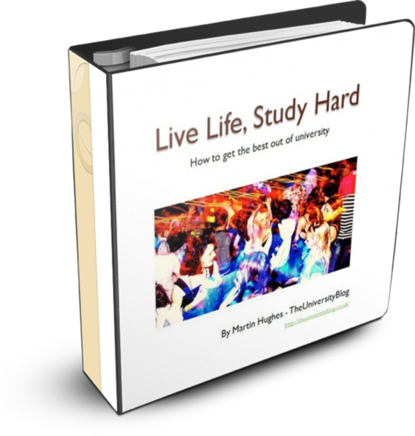
Live Life, Study Hard – Free Book

Today, I’m happy to give you my free ebook on how to get the best out of your time at university.  Live Life, Study Hard [744Kb PDF]:

Would you like to enjoy your experience at uni because of your degree work, not despite of it?  Life shouldn’t stop when you study.  If you want to enjoy the best of both worlds, then “Live Life, Study Hard” is a good starting point.

Working toward a degree needn’t be a chore.  But it’s hard to know where to start.  The first year of uni gives you plenty to think about.  And not much of that thought is necessarily on your study…

Before you know it, you’ve got a small forest of books to read, lectures to comprehend, tutorials to attend, deadlines on the horizon, and all manner of practical work to complete.

Live Life, Study Hard” is a guide to prepare you for this work and get into the right mindset without breaking into a sweat.  Part 1 helps you gear up for what’s happening and what’s ahead.  Part 2 forms the beginnings of study, giving the lowdown on lectures, writing without worrying, and getting to grips with essays.

Here’s the contents:

PART ONE – GEARING UP

  • Your first year DOES count
  • Get serious about university
  • The downside to benefits of uni life
  • Five ways you don’t get the most from your degree
  • Make your own decision exactly that!
  • Achieving balance
  • The importance of paying attention
  • 20 ways to cut down & free up time
  • Study traps you need to know

PART TWO – GETTING DOWN

  • Perfectly prepared for lectures
  • How seminars & tutorials take you beyond the lecture
  • Shifting states: Make writing work for you
  • From “Essay Hell” to “Essay Hello”
  • Escape from Essay Writer’s Block
  • Wonders of the weekend
  • Mental necessities of timetabling
  • More pushes to get you working
  • What next? Getting through your degree

The book is absolutely free to download and you’re free to share it with others.

Hope that has whet your appetite.  If you do only one thing toward your degree this weekend, do the work you need for the following week, no arguments.

If you do only two things toward your degree this weekend, make the second thing a thorough read-through of this book. 🙂

Review: Learn More, Study Less

Scott Young gave me a peek at “Learn More, Study Less“, his new ebook and companion video course that does exactly what it says on the tin.  Today I’m reviewing the product.  I’ve got a short review and a long review.

Here’s the short review:
Learn More, Study Less helps you learn more and study less.  You’d like to do that, wouldn’t you?  If so, buy the course and start seeing the bigger picture.

Here’s the long review:
The best way to explain Learn More, Study Less is by calling it a complete learning system.  Rote memorisation of facts is tired and cumbersome.  Through this course, Scott explains how your learning can become expansive.  Problems aren’t one-dimensional; you’ll often find many answers to the same question.

Scott offers the course as either:
– A 228-page ebook, case studies & worksheets for $39 (about £25);
– A complete video course (around 6 hours) and a set of interviews in addition to the ebook, case studies & worksheets for $67 (about £42)

The book starts by helping you to remove those blinkers and take a good look around.  From this new viewpoint, all the links and connections between subjects become apparent.

Sound overwhelming?  It’s not.  The natural approaches explained in the book are a boon, not a pain.

Scott asks if there are certain subjects you just “get”.  The way you handle these subjects is likely different to those you have a block on, or those you find more difficult to learn from.  The book highlights what elements of learning are in play with the subjects you “get”, giving you scope to use them on other subjects.

In Part 1, a six-step approach is outlined in detail: Acquire, Understand, Explore, Debug, Apply & Test.  In addition, Scott describes the many types of information out there and how to process each type.

Part 2 describes important techniques for bringing the holistic learning strategy to life.  With speed reading, idea linking, mental and emotional images, practical uses to aid learning, and so on, there’s a wealth of goodies you’ll want to play with and master here.

The book gives no quick fixes.  What the book does so well is provide you with detailed explanations of how your everyday learning can become a permanent fix in itself. My own experience has helped me realise that putting in the initial work is far better than slapping on a quick fix at the end.  That’s why I hate cramming before tests and why I can’t stand writing coursework at the last minute.

Learn More, Study Less goes beyond passing tests.  And rightly so. A focus on testing only weakens ability to concentrate on the bigger picture.  The book calls on you to question why you *want* to learn anything.  When you can question the usefulness of what you’re learning, you’re better equipped to learn it.

Part 3 looks past holistic learning and looks at being a productive student and how to educate yourself by using what you’ve learned.  Part 4 contains a helpful summary and recap.

Scott throws in some real case studies and helpful worksheets as part of the package.  These allow you to focus even further on what’s required.  Like I said at the beginning of the review, this really is set up to be a complete and flexible learning system.

Positive Points:

  • I have used most of the techniques within this book at different stages in my life and I know how well they have served me.  This alone is enough for me to heartily recommend the product.
  • The book is easy to read and the writing clear and concise.  Complicated methods are described as simply as possible so you’re free to develop your technique effectively.
  • Scott’s video classes (in the $67 package) are great value for money and complement the book well.  The videos really help bring some of the points to life.
  • You’re not left scared and confused.  At no point are you made to feel out of your depth.  You do have to put the work in to make holistic learning work, but that’s a matter of choice, not a matter of ability.

Negative Points:

  • No references list.  A lot of the methods documented here have been known to work for many years.  Perhaps I’m being greedy, but I’d have liked to see where some of Scott’s ideas had originated from.
  • Price could put off some students. Costing the same as some academic textbooks, it may put you off. Yet seen as a complete course, it does represent good value for money.  Scott also provides a 60-day guarantee if you’re not happy.
  • You must be self-determined.  I’ve already said that the book isn’t about quick fixes.  Commitment is required.  Sadly, not everyone is looking for that.  Simply reading the book will not do.

In Closing:
At the back of Learn More, Study Less, Scott rightly says that “No technique, method or trick can replace motivation”.  This is key to learning well.  Anything less only works as a temporary mask.  And it won’t fool anybody.

Forget masks.  This course gives you the tools you need to up your game for good.

“Find your reason for learning.  Even if the reason is as simple as curiosity, find a reason to want to know.” – Scott Young

[Note: I am happy to be an affiliate for Scott’s course.  I only recommend products if I feel they provide good quality. This product certainly does that.]