Bigger picture thinking: Why it helps to go back to basics

I’m a big fan of seeing the ‘bigger picture’.  I prefer to get a rounded view of what’s going on before getting too bogged down with the detail.

Once I have the basics in place, I’m all set to engage with the specifics, because I have built a foundation from which to explore.

This approach isn’t tough and should save time in the long run.  However, far more often you’ll find people working in the opposite direction.  First they take on the specifics, only to discover what’s surrounding them afterwards.

I fully understand the need to specialise.  If nobody dug deep, we wouldn’t advance in the spectacular ways we do.

But you can’t specialise convincingly until you’ve taken account of the bigger picture in the first place.  There’s nothing wrong with getting back to basics.  It’s so much easier to achieve a clear, focused attitude once you see the big concepts that are flying around you.

photo by dvs

photo by dvs

You’re likely deep in exams and revision hell right now.  Either way, think about your revision technique and how you best take information in.  At degree level and beyond, a bunch of specialist facts without a grounding or any basic connections won’t get you far.  You can memorise all sorts of detail, but putting it all into place is practically impossible.

At any time you feel uncertain, whether it’s in your study or an everyday situation, don’t be afraid to look outward at the basic information until you reach a point of understanding.

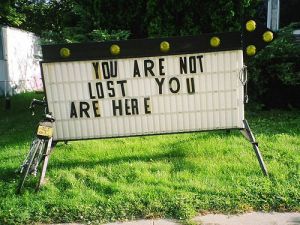
Imagine getting lost when you’re out.  The first thing you want to do is find a familiar landmark or a sign for a place you can get your bearings from.

Next time you don’t fully understand something, try stepping back a little and take into account the basics.  Search for that familiar landmark.  Keep stepping back, revisiting more basic concepts each time until you reach a point of understanding.  From here, look again at what seems to be getting in the way of your grasp of the topic.  Quite often it’s not a specific detail you’re missing, but a more general overview.

Who are you trying to impress? Cast aside the critics!

The creative process is never easy.  I’m not just talking essays.  Even the stuff you want to create is an uphill struggle.

Even a blog post, like this, is liable to bring a person down on their knees.  I want to make something, but I also want it to have meaning, value and purpose.  A lot of thought needs to go into the work.

photo by alicepopkorn

photo by alicepopkorn

How much care and attention should you give to a job before it’s presentable to anyone else?

Notice that I use the word ‘presentable’.  This isn’t about perfectionism.  I’m looking more at the self-conscious concerns that build up as soon as you start writing our own script.  You’re don’t know what direction this will take.  It’s exciting.  It’s interesting.  It frees you up to do what you want.

And that’s scary.

All at once you feel an awareness of a critical public watching your every move, preparing to pounce on every weakness.  All eyes are on you.  The critical public are waiting for you to slip up.

Most of that critical public exists only in the creator’s head.  Unfortunately, that’s the worst place the critics can exist!  It only serves to make the real-world critics seem even more threatening.

Critics, wherever they exist, should be no threat.  You owe it to yourself to push past the critics and get on with living:

“Sure, criticism hurts.
But a life unlived hurts more.” – Jonathan Fields

All too often, criticism is a trap.  Let’s say you’re performing something for 20 people.  19 of those people are satisfied with what you’re doing.  Only one person questions your performance and digs in to what they saw.

How do you react?  Are you happy that 19 people appreciated what you did, or do you focus on the one critic?  Or…or…do you stick to appreciating your own creative process in your own way?  You don’t have to focus on any of the 20 people.

Nevertheless, many people would react to that one critic in the room.  It hurts and the comments may eat away at you for a while.  I’ve fallen into that trap before.  In the hugely connected and public world we now live in, we are acutely aware of our position under the spotlight. Just one comment can lead to doubt.

Whenever you doubt yourself, remember this: you are an individual with faults and failings, just like every individual.  If you can use criticism to improve your future efforts, fantastic!  But mere opinions that goes against your creative plans aren’t worth worrying about.

Artist Grayson Perry has an interesting take on the creative process:

“Being creative is all about being unself-conscious; being prepared to make a bit of a fool of myself. In my experience, embarrassment is not fatal.”

Robert McCrum analysed Perry’s words in The Guardian and makes an interesting point:

“If genuine originality is at stake, the artist will probably be in two minds about what he or she is up to, and unwilling to offer an easy account.”

Is it acceptable for us to make public mistakes or to step back from trying to impress everyone out of fear?  Will there really be any relevant and damaging repercussions if you suffer the odd embarrassment?

Try your best and it’s highly unlikely you’ll suffer any real damage in the process.  Creativity is random and subjective.  If you have a willingness to learn from all that you do, criticism should either be constructively helpful to you or words to ignore.

It’s impossible to know how to impress all the time.  The creative process is about enjoyment and discovery.  Creativity under stress isn’t creative at all.  Have you ever heard of restrictive creativity?  No, me neither.

Can exams ever be fun?

Imagine a hobby you’ve loved for years.  Think how much time you’ve spent mastering the subject and getting to know so much about it.

Chances are, you’d have no problem explaining concepts, discussing what’s important to you, and debating best practice or proper technique.  You may even enjoy it.

But now imagine you have to answer questions about your hobby in an examination setting.  You’ve got three hours to answer questions on the subject.

photo by Juliana Coutinho

photo by Juliana Coutinho

Faced with something that you know well, it’s still possible to fold under the pressure of strict exam conditions.  It’s enough to strike fear in the hearts of the most confident minds.

That’s surely how it is for those people competing for fellowships at All Souls College, Oxford.

While the All Souls exams aren’t based on hobbies, a lot is based on general concepts or open questions and statements.  Far from being restricted, candidates are given a spring board from which they can jump off in whatever way they wish.

Questions include:

  • Is it immoral to buy a £10,000 handbag?
  • “I don’t care if anyone reads my books; I write for myself,” said the author of a half-dozen published novels. Is there anything wrong with this statement as a theory of art?
  • Why do Jane Austen’s novels continue to be so popular?
  • Can any public and political institutions be trusted to reform themselves?
  • Does celebrity entail a loss of dignity?
  • Is the desire for posthumous fame irrational?
  • Can a painting change the world?
  • Can (and should) Europe maintain its relatively high standard of living as compared with emerging economies?
  • Can you love someone if you don’t respect them?

These questions are taken from a 2008 paper, as printed in the Guardian.  Candidates had to answer three questions from a list of thirty-four.  Yes, 3 our of 34 questions.  There was a lot to choose from.  Something for everyone!

When I look at the questions on offer, I have vast, philosophical answers for them all.  I start drafting answers in my head and start having a lot of fun with what’s been asked.

All Souls College has just scrapped the most open and daunting paper.  Every year, candidates were given a card with a single word on it.  It could have been “Morality”, “Harmony”, or “Water”.  One random word to write about for three hours within a scholarly essay.

Again, when I read about this exam offering, I almost squealed with glee at the possible answers I could have given.

Okay, perhaps my enthusiasm can go a bit far… 🙂

Still, the idea of having such free reign feels like something to celebrate.  It’s part of what makes academic study worthwhile.

When I tweeted about the demise of the one-word exam, I wasn’t the only person to feel a pang of sadness.  Kate Maltby called the news “a real shame” and said it “always sounded fun”.  Krishna Omkar said, “That is a great shame about All Souls, it was the one paper I enjoyed”.

Krishna makes a good point about enjoying the exam.  It’s easy to forget that while an exam may be held under timed conditions and (usually) without the help of books and notes to guide you, the purpose of an exam is to discuss or examine what you have already studied and explored.  There are not meant to be trick questions.

“The examiner is not concerned to expose the bottomless pits of ignorance in the student’s mind (however much he may suspect them to be there).  He is interested rather in the little hills of erudition which also diversify the scenery of an otherwise even plain.  In this he relies in the last resort upon the student to help him.  The student can help best not by endeavouring to conceal the pits but by drawing attention with a measure of pardonable pride to the presence of the little hills.” – C. A. Mace [The Psychology of Study]

The beauty of such open ended questions and invitations to discuss something is that you’re free to add your own questions and even to question what is being questioned to an extent.

Exam essays do not have a specific right and wrong.  There is no single correct answer.  You must attempt to answer the question and show that you grasp the relevant concepts, but you have the power to make it your own answer.

When you’re sat in the exam hall, whatever the subject is and however prepared you think you are, ignore the stuff you’ve forgotten and set aside any worry that you’re ignorant of important information.  Work on what you do know and build upon what you have learned.  You’re there to create a wonderful scene with your ‘little hills of erudition’.  You may just turn some molehills into mountains.
EduLinks – Deep Thought & Deep Cleansing

Here we go again with the linkageness!

The American Scholar – Reading in a digital age

We need the Internet, we need novels, we need to read.  We also need to sort out quick fixes and deep focus. This article explores our engagement with text.  Set aside some time for the piece; it’s well worth poring over.

From Donald Clark Plan B – What Are Universities For?

“The current University model is based on the 18 year old undergraduate. The whole university experience, for many a drunken meander through a three year degree, where you attend as few boring lectures as you can get away with, crib from your mates, then cram for finals, is as embedded today as it was thirty five years ago, when I attended. Yet more and more older students and part-time students, with a more focussed agenda, are doing degrees. The drunken meander is perhaps a luxury we can no longer afford.

“Another solution to the clearly inefficient system is the use of technology. The Open University has nearly 200,000 students, nearly 20 times more than Sussex, yet none are on the campus. Learning, has to a degree, freed itself from the tyranny of time and location. I’m not saying we should abandon all face-to-face activity, but we can at least introduce a better blend of delivery.”

Lisa Harris Marketing – Online Personal Branding

Your online identity, online brand, online presence, and online reputation are important.  Don’t take just my word for it.  You can find lots of examples in Lisa’s presentation.

From The Situationist – The Situational Effects of Hand-washing

“It turns out that Shakespeare was really onto something when he imagined Lady Macbeth trying to clean her conscience by rubbing invisible bloodstains from her hands. A few years ago, scientists asked people to describe a past unethical act. If people were then given a chance to clean their hands, they later expressed less guilt and shame than people who hadn’t cleansed.”

Various document templates for:

The template selections for the above tools should further enhance your productivity.  Hope you find something useful.

Nick Vujicic – Look at yourself after watching this:

I’ve seen videos of Nick Vujicic before, but don’t think I’ve linked to any here. Pretty inspirational stuff.  I came across this video through Ian’s Messy Desk.

Spiked – ‘Yes we Lacan’: the revolt of philosophy students

Middlesex University announced in April 2010 that they were closing down the Philosophy department. It has resulted in a huge backlash from students, academics, and even celebrities around the world.  There’s even a website about the campaign to save the department.  And a Facebook Group with over 12,000 members.

Philosophy students at Middlesex occupied the Philosophy building over a week ago.  It looks as though the university has taken legal action and is about to have them evicted.  Whatever the case, this closure has caused upset on many levels and I don’t see the hurt going away any time soon:

“Over the past week the philosophy students have bedded down inside the mansion, waiting for a constructive dialogue to begin with the university administration. They have turned the mansion into a hive of philosophical debate and discussion. Hoiby, who came from Norway to study at the department because of its reputation for research in Continental Philosophy, has found that the occupation has enriched his studies. ‘We’ve got everything in here’, he said. ‘We’re all living on top of each other and we’ve been having some really positive exchanges of ideas. We spend our time doing a bit of everything: discussing essays, doing close-text readings and staying up all night arguing philosophy. This is what university is supposed to be: a place for learning.'”

TED – Dan Meyer: Math class needs a makeover

Students of all ages need to stop and think.  Life isn’t full of problems that helpfully start at Point A and are pleasantly paved toward Point B.  Problems need to be more real in order to get students on a level playing field and ready to question what’s going on.