Too much advice and not enough productivity?

Simple advice can usually be taken the opposite way.

  • Want to achieve your goals?  Make them public!  No, keep them private!
  • Want to focus better on revision?  Listen to music while you work!  No, sit in silence!
  • Want to save money on your shopping bill?  Make a list!  No, shop less strictly to bag the bargains!

You may have heard me say that one person’s poison is another person’s potion.  When it comes to uncomplicated suggestions from a friend, or a blog post with some quick tips, the advice won’t necessarily work for you.

 

photo by RobeRt Vega

photo by RobeRt Vega

If there was a single answer, we’d all take that route and we’d all love the success it brought.  Nobody would have to worry.  But, naturally, life isn’t like that.

The same goes for if a selection of answers all produced the same, successful, result.  Suggestions are great, but you have to make them your own before they’ll work.  Even then they may not yield the fruit you were expecting.

Yes, it’s frustrating, but life isn’t simple.  That’s why so many people are hooked on finding a quick fix or an astounding life hack.

Whenever you stumble upon something great, let’s call it ‘lucky’.  Without seeking any advice, you won’t be as lucky as one who does the searching.  You do have to ‘create your own luck‘ to an extent.  However, there is a saturation point where even the one who searches is wasting their time.

After all, there are so many blogs devoted to study tips and life hacks that it’s easy to spend too much time reading themDo you really want to save time, or do you want to procrastinate? At some point, you need to act on the advice you already have.

Darren Rowse of ProBlogger made some great points over Twitter about all the supposedly time-saving advice out there:

“Problem with productivity techniques: so many focus upon how we can stuff more into life – which just sets us up for heart attacks later.  Not sure what the answer is but it strikes me that a better approach to productivity would be becoming focused and doing less things better.  Or maybe thinking about all this productivity stuff is just a distraction from being productive.”

Darren was inspired to make those comments because of this video:

We do face distractions.  They won’t go away.  Neither should we be forced to rid ourselves of all disruption.

However, the idea of ‘doing less things better’ is important.  Doing more isn’t automatically more impressive.  A limited number of key pursuits can be more convincing.  You may find that, in the transition, you focus on more demanding work within the deliberately limited scope.  The good news is that hard work under these conditions is often more satisfying.

I’m not trying to suggest that general productivity hacks and tips are useless.  Far from it.  Much of the advice I give on this blog is general.

I see the difficulties of taking advice working in two ways:

  1. Specific advice is easy to action because there is little need to interpret.  Just follow step by step.  However, it is less likely to yield as much success as the person who achieved it and advised in the first place;
  2. General advice is harder to action, because you have to take responsibility for making it your own.  You may develop the approach wonderfully, you may reach a dead end and seek out different advice, or you may find it too hard to take on that responsibility at all.

Advice, no matter how specific, should be examined and considered, but at no point should you expect an automatic win.  Even if you’re persuaded it’s a no-brainer.

It’s great to take a punt and win.  It’s hell to expect the best and lose.

The advice I give is based on my own experience and those of others.  I sometimes advise stuff that doesn’t (or hasn’t yet) worked for me.  Why?  Because I know many others who have been successful using those methods.

We may not be the same, but we share many similar features and goals and thought processes.  It would be insane if nobody listened to others for advice.  It would be equally insane if you took everything they said as the truth. The only person who can find your truth is you.  And it’s not an easy road.

That doesn’t mean it can’t be fun.  Have a nice trip.  And don’t make *too* many stops on the way for advice.  You can’t refuel if you’ve not started using your own resource tank yet.

Want to hear more? Just before I went to publish this, Darren Rowse put up his own video on whether productivity systems really work.  I’ll leave you with that:
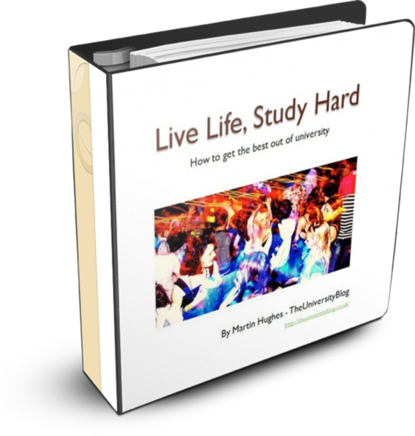
Live Life, Study Hard – Free Book

Today, I’m happy to give you my free ebook on how to get the best out of your time at university.  Live Life, Study Hard [744Kb PDF]:

Would you like to enjoy your experience at uni because of your degree work, not despite of it?  Life shouldn’t stop when you study.  If you want to enjoy the best of both worlds, then “Live Life, Study Hard” is a good starting point.

Working toward a degree needn’t be a chore.  But it’s hard to know where to start.  The first year of uni gives you plenty to think about.  And not much of that thought is necessarily on your study…

Before you know it, you’ve got a small forest of books to read, lectures to comprehend, tutorials to attend, deadlines on the horizon, and all manner of practical work to complete.

Live Life, Study Hard” is a guide to prepare you for this work and get into the right mindset without breaking into a sweat.  Part 1 helps you gear up for what’s happening and what’s ahead.  Part 2 forms the beginnings of study, giving the lowdown on lectures, writing without worrying, and getting to grips with essays.

Here’s the contents:

PART ONE – GEARING UP

  • Your first year DOES count
  • Get serious about university
  • The downside to benefits of uni life
  • Five ways you don’t get the most from your degree
  • Make your own decision exactly that!
  • Achieving balance
  • The importance of paying attention
  • 20 ways to cut down & free up time
  • Study traps you need to know

PART TWO – GETTING DOWN

  • Perfectly prepared for lectures
  • How seminars & tutorials take you beyond the lecture
  • Shifting states: Make writing work for you
  • From “Essay Hell” to “Essay Hello”
  • Escape from Essay Writer’s Block
  • Wonders of the weekend
  • Mental necessities of timetabling
  • More pushes to get you working
  • What next? Getting through your degree

The book is absolutely free to download and you’re free to share it with others.

Hope that has whet your appetite.  If you do only one thing toward your degree this weekend, do the work you need for the following week, no arguments.

If you do only two things toward your degree this weekend, make the second thing a thorough read-through of this book. 🙂

Universities: A non-market market?

With a Browne Report and a Comprehensive Spending Review out of the way, it’s now clear to see what the future holds.

Wait, no it’s not.  The future is more clouded than ever.  Fiddlesticks.

If you’ve had any interest in Browne and the CSR, you’ll have seen plenty of commentary.  I don’t want to go over the same stuff, although I’ve made lots of notes and can post more at popular request… 😉

Instead, I’ll keep in brief.  And I’ll leave most of the words to others.

Giles H. Brown, Editor-in-Chief of HE policy journal, Perspectives, explains that universities can’t be viewed the same way as businesses:

“Research suggest tertiary education is unlikely ever to operate as a market in a way an economist would recognise (Brown 2008); we are therefore likely to remain market-like, but not a market, in the same way as we are increasingly having to be business-like, but cannot operate truly as a business.  Like it or not, we cannot strictly separate the sector from the market; we are increasingly dependent on the ‘market’, while recognising the importance of retaining some degree of autonomy from it.”

[Perspectives, Vol.14, No.3, 2010]

So how much autonomy will there be?  Times Higher Education (THE) highlights concern.  This week’s editorial stresses that Browne claims to be offering universities freedom, but actually introduces a ‘state-controlled and regulated industry‘.

The Higher Education Policy Institute (HEPI) has published their response to the Browne Report, dismissing much of it as a serious way forward.

Then there are the concerns surrounding fees.  Prospective students be warned; if Browne’s proposals go through, there may be no real market on fees, much like now.  THE reports that most unis may have to charge around £8,000 just to get by.  This has led NUS to say the spending review informs an entire generation, “you’re on your own“.  And these possible fee rises may not even accurately factor in the natural decline in 18-21 year olds from 2012.

This may also have a knock-on effect for widening participation.  Steve Smith, President of Universities UK (UUK), explains:

“We know we are facing a demographic downturn from 2012, with a 15.6% decline in the 18- to 21-year-old age group within the decade – not the only cohort, but a major one, for student recruitment: already this year the participation rate has fallen from 41% to 39.7%.  Unless we can raise the attainment levels of 16-year-olds, the numbers coming into higher education from the lower socioeconomic groups will not increase at the pace we would like them to.”

[Perspectives, Vol. 14, No. 3, 2010]

Compare this with Browne’s wish for a further 10% of students to enter higher education.  Getting a particular percentage into HE is not the point.  Widening participation isn’t about greater numbers, it’s about ensuring that those who can benefit from HE are given that chance.  Some people enter HE who would have benefited from something else and I believe just as much effort should be placed on helping these individuals.  One positive aspect of the Browne Report is its recognition that better careers advice and prospective student guidance should be given to allow greater understanding and to give individuals a better chance in making decisions that suit their individual needs.

But can we achieve these things under a market system that doesn’t necessary work like a market?

These are strange times.  Bonkers, in fact.  All of us will be affected one way or another.  And nobody really knows how yet.

But there is one certainty: No matter what your opinion is — even if you don’t care — none of us can put our head in the sand.

What will be the future of education?

Lord Browne’s Independent Review of HE Funding and Student Finance is due tomorrow.  If reports on the content of the review are to be believed, students are not going to be happy.

As students across the country prepare to march in London on 10 November 2010, I’d like to share some quotations with you that I spotted recently.

First up, on what education has become:

“There is no denying that education is an essential preparation for life and work in an advanced economy.  Modern economies require skilled and motivated workers, who can only profit from the opportunities they afford if they are equipped to respond to their demands.  So much is now received wisdom.

“But a large part of the problem with education is that this connection has become too direct.  Aristotle said that we educated ourselves so that we can make noble use of our leisure; this is a view directly opposed to the contemporary belief that we educated ourselves in order to get a job.  To that extent the contemporary view distorts the purpose of schooling, by aiming not at the development of individuals as ends in themselves, but as instruments in the economic process.”

A.C. Grayling, The Meaning of Things (2001)

The connection between education and economy comes even closer, showing no signs of stopping:

“…universities in need of funds had little choice but to accept corporate money.  As social status and career success correlated ever more closely with service to profit-making entities, many academics were willing to play along.  A Labour Education Secretary, Charles Clarke, channelled the spirit of the age when he claimed that the idea of education for its own sake was ‘a little bit dodgy’; students, he insisted, needed ‘a relationship with the workplace’.  This insistence that market values can be applied to education continues to inform both policy and rhetoric.  In November 2009 the irrepressible Peter Mandelson was promising a ‘consumer revolution’ in higher education.”

Dan Hind, The Return of the Public (2010)

The Browne Review is expected to recommend a continuation of this ‘consumer revolution’ by suggesting higher fees, a real rate of interest on loans, and the possible lifting of the fee cap altogether.  Universities must, therefore, ask (and answer) crucial questions on student matters:

“What is the value we add for each and every student above the basic cost of paying the staff who teach them and providing the core facilities that they have to have? We should be able to answer this question anyway, irrespective of whether the substitution of private for public funding of teaching goes through, and whether or not the cap on student fees is set at £5,000, £7,000 or more than £10,000. Being able to account for our premium will be essential both to setting the prices of our qualifications in the future, and to remaining competitive in a rather different world.”

Prof. Martin Hall (Vice Chancellor at Salford)

The BBC has a load of links with information on the future of universities and fees, but that detail and speculation cannot answer the question as posed by Professor Hall.  Each university will need to have an individual response based on their own position and qualities.

While this rolls along, the ‘student as consumer’ problem looms.  The Quality Assurance Agency (QAA) published a series of documents on “Rethinking the values of higher education” in 2009, looking beyond the simplistic and misleading ‘consumer’ tag:

  1. Students as change agents?
  2. Consumption, partnership, community?
  3. The student as collaborator and producer?

Whatever the Browne Review concludes, and however students are perceived, we still have to see whether the coalition government will be in a position to feasibly implement the recommendations.  If the key recommendations are as expected, I’m not sure they can.