Fearing the Unknown

The unknown tends to get in the way, doesn’t it?

You want to know what questions will come up in an exam, but that is unknown until you sit down and turn the paper over.

You want the party to go well because you’ve prepared so much for it. But you won’t be sure until the party’s over.

You have a job interview coming up. You understand the type of person the company is looking for (you, of course!), but you still don’t know what type of questions the panel might throw at you.

These situations can easily eat away at you. You imagine a million and one possible scenarios and outcomes. You panic over the negative thoughts going through your head.

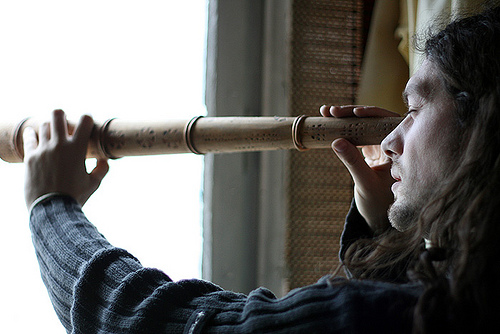
photo by zetson

photo by zetson

None of those million and one scenarios turn out to be the correct one in the end. Often, you’re not even close. And the negative stories always drown out the positive ones in the end.

Not exactly a recipe for clear thinking.

I noticed this before a recent family gathering. Twenty of us were meeting up from all over the country for a special meal in a posh country restaurant. One of the organisers felt a tinge of responsibility and felt that everything had to pass off perfectly. Should anything go wrong with the orders or the timing, they thought the blame would be theirs.

The stress built and built. There was no need for it. The meal was great. Was it really worth hours of stress beforehand?

It made me wonder why the unknown is so good at making us weaker at the very time we’re trying to be strong.

Then it struck me. A very simple thought that makes a lot of sense:

It is much easier to attach importance to non-events than it is to attach importance to *the* event.

Why? Because there are so many non-events swimming around your head, ready for you to re-enact whenever it suits. But there is only one actual event. And since it hasn’t happened yet, it’s easy to latch on to non-events.

It’s right to be aware of unknowns, but it doesn’t help to worry about them beyond initial awareness and preparation.

A while back, I was going for a meal with a group of old school friends with the aim to catch up and look back at our past. The food was a general focus, but the company was more important.

It could have been so easy to worry:

  • What should we talk about?
  • Will people have changed?
  • Have we picked a good enough restaurant?

But I didn’t bother. It was impossible to know what the future would hold. So I went without rehearsed expectations and concerns.

And then it all went wrong. In all the right ways…

It began when I didn’t get a starter along with everyone else. I guessed it would come along soon. After a minute or so, my friends stopped waiting and got stuck in to their food. They didn’t miss the opportunity to make a big deal of how delicious the food was!

Plates were cleared and main courses were put out. I hadn’t got my starter.

Guess what? I didn’t get a main course either.

The joke was now a big part of our conversation. Not getting my food had become the entertainment. None of us were going to forget what had happened.

None of us could have predicted this either.

The waiter asked how we were enjoying the food. This in itself got a big laugh. I replied, “I couldn’t comment on the food, because I haven’t eaten any yet”.

After explaining the issue to the waiter, he made a rather embarrassed apology and ran off to sort things out.

The thing is, he didn’t. Other staff came out of the kitchen and handed my friends their desserts. To make the hat-trick, my pudding didn’t turn up. My entire order had disappeared and, it seems, so had the waiter.

At this point, the manager was walking about and casually asked us if we were enjoying the evening. When we, still full of laughter, explained why the evening had been so great, the manager went nuts and promised to sort things out.

Finally, my starter arrived just as everyone was finishing the pudding. It felt like I’d been parachuted into a sitcom.

But the entire disaster helped to create an amazing evening. And to top things off, the manager was so apologetic about the oversight that she offered the full meal on the house and let us have more drink as a further sweetener.

Who’d have expected this to happen? When life delivers so many curveballs, what is the point in worrying about the unknown?

  • Stay calm –  Take a walk, talk to a friend, smile, close your eyes and take a deep breath, accept the uncertainty and embrace the possibility.
  • Let go of false control – Personally reject responsibility for anything that you don’t have control over. Give yourself that peace. No matter how much you wish you could control it, you must accept it when the issue is out of your hands.
  • Do more research – Worry about the unknown can develop when you don’t know enough about what you’re stepping into. If you have a question that has an answer, seek out that answer!
  • Ask for help – If you’ve done the basic preparation and you still can’t let go, reach out to others. It’s not weak to ask for help. A few words of reassurance may be all it takes to remove those fears.

Preparation is fine. Acknowledging the situation is fine. Trying your best is fine.

But is it worth going beyond the basics and attaching so much importance to non-events? After all, it hasn’t happened until it has happened.

EduLinks – Week ending 27 May 2011

The Independent published a slideshow of the top 10 universities with the best student-to-staff ratio. The figures look at how many students there are to each member of staff. Bedfordshire and UCL take 3rd and 2nd place respectively. Taking the top spot is Buckingham, with a ratio of 8.9.

Lower fees, smaller classes & an international cohort are apparently enticing Brits to Europe. This also in The Independent.

The Student Room have released their Postgraduate Survey for 2011. Among other things, it reports that “course costs and funding are already the main barriers to students continuing their university education beyond their first degree, which indicates that when the first batch of ‘£9,000 tuition fee’ students graduate in 2015 the number looking to continue on to a postgrad course will be significantly lower than today.”

The Boar reports that Warwick’s Vice Chancellor has given a ‘grim verdict’ on the future of the public university, stating: “There is not much hope of education as a public good.”

On his trip to the UK, US President Barack Obama has agreed further collaboration in higher education, science, and innovation with the UK.

In the US, tuition discounting has hit a record high, according to the Washington Post. The price you see isn’t always the price you pay.

Talking of the US, Howard Hotson wonders if anything will stop similar issues abroad from being repeated in the UK.

Finally, a video for you to enjoy. It’s worth reading about the piece at Brain Pickings. They head the piece up with: “What’s wrong with copyright law, or how neurological supremacy channels 100 cello revelations.”
Whether or not you read the article, I hope the music by Jon Schmidt and Steven Sharp Nelson helps as a nice little prelude to the weekend. Enjoy!

7 Ways to Feelbetter – Review

University is a time when you can experience great changes and do all sorts of amazing things.

Sometimes you need a bit of focus and direction to make the most of what’s available.

So as I was going through my Google Reader, I noticed a promotion for a new book, “7 Ways to Feelbetter“. Written by the team behind the website FeelGooder, I thought I’d give the book a read and review it for you.

7 Ways to Feelbetter (FeelGooder)

As the title suggests, “7 Ways to Feelbetter” focuses on seven themes to help people feel and be better:

  • Exercise
  • Save
  • Connect
  • Eat
  • Act
  • Play
  • Think

Sounds pretty straightforward, huh? As with most things, though, it requires a leap on our part to make it something big.

7 Ways to Feelbetter” gets you started in making that leap and thinking ‘big’.

Although the book is a quick read, it is meant to be read and actioned over seven days. If you interact with the book (i.e. work on your own actions and complete the exercises) the week long digest will help you take on board the ethos of the book, as well as your own focus.

The book “isn’t about giving you all the answers – rather it’s a springboard into the next week to help you more intentionally explore 7 ways to feel — and be — better”.

Each short chapter contains:

  • a set of questions about yourself;
  • an introduction to getting started;
  • simple tips to inspire you;
  • resources;
  • motivational quotes;
  • space to expand upon your plans going forward.

As you can see, you’re given a platform to help you focus on improvement. That requires dedication and a sense of responsibility, but that’s how it should be.

Take anything seriously and you do assume a certain amount of responsibility. The book offers up advice on how you could start, but the main thrust is that you can find a course of action to suit your individual circumstances. I definitely prefer something that lets you call the shots.

By making your own choices — perhaps with a bit of help from the inspiration — you can make each step as big as you like. Prefer small baby steps? Fine. Want to take a huge leap? Go ahead.

Much of the advice given in the book is to help you start forming new habits and practices. The aim is to get a new view of the world and return to past views that you once valued but thought were lost.

This doesn’t automatically require hard work or a lot of planning. For example, chapter 6, ‘Play’, helps you open up in fun ways. Sometimes you just have to do something unusual or something you haven’t done for a long time:

“Tap into the solitary play you used to enjoy as a child.
Haven’t drawn a picture in years? Give it a try. Remember your old train set? Get it out! That cute miniature barnyard? Set it up!”

The final chapter, ‘Think’, somehow manages to focus a lot on relaxing, letting go, and removing all the noise from everyday life. By doing this, you’ll hopefully be able to hear yourself think!

The chapter states, “Meditation and philosophy are just two studies that have resulted from the human need to make sense of your own thoughts”.

The final page of the book closes with a social/community feel. The hashtag #FeelGooder7 is used for readers to share their experiences and personal tips through blog posts and tweets. Since the FeelGooder team are set to share the best tips at their website, it’s a good hook to get more people in on the brand.

If you’re feeling reflective and want a boost of inspiration for life, give this a whirl. The book is written with a wide audience in mind, so not everything relates to students. Nevertheless, there’s plenty you can do and a lot of scope to find stuff to suit your lifestyle.

At the time of writing, some copies are still available for $4.99 (around £3.00) and the usual price is $9.99 (around £6.00). I may ask Darren Rowse if I can give away a copy or two on here…

Darren is the main name behind FeelGooder and is best known online for ProBlogger. Darren offers a full money-back guarantee on the book, so you don’t need to worry even if the content doesn’t fit for you.

In summary:

Pros

  • Easy to read;
  • Quick bursts of inspiration to get you thinking and acting fast;
  • Nicely presented;
  • Focus is on *you* and the way *you* want to do things.

Cons

  • Requires some responsibility on your part. Simply reading it won’t change you;
  • Web links aren’t all relevant to UK. Mostly fine though.

This isn’t a sponsored review and I’m not an affiliate for the product. I just wanted to bring “7 Ways to Feelbetter” to your attention as a tool to help you focus on making the most of being you.

You are special and unique. So is everyone else. Work with this book and let those unique qualities shine even brighter.

Putting students at the centre of HE thinking

Nobody knows precisely what they want and exactly how to get it.

If you’re lucky, you can get close. But life isn’t exact. Things change. You change.

And we learn. University allows you to discover new things, find out more about your subject, and find out more about yourself. At least, that’s a big part of what it should bring.

Looking to the future (photo by ckaroli)

Looking to the future (photo by ckaroli)

From this perspective, you may have a good idea about what you would like to experience and what is necessary to move you forward in the ways you wish. But how that can be achieved and whether everything will fit into place perfectly isn’t a given. There is no exact science, however much you prepare.

Earlier this week, I attended the launch of a new book about the future of higher education, “Blue Skies”. I wrote a chapter for it, about the wonder of contradiction in HE. Yay!

Something that struck me at the launch event was just how much students were at the centre of the discussion. A good thing, since they are a huge part of higher education…

Rod Bristow, President of Pearson UK, said that the National Student Survey is being featured more highly and being used more prominently throughout the HE sector. Universities Minister, David Willetts, agreed and suggested that students are being put in a better position to control where money will go. By voting with their feet, students will make the calls.

Willetts further cements this point in Times Higher Education:

“The critics may dismiss this as mere consumerism. I call it harnessing the power of the student to put the classic values of excellent teaching centre stage once again.”

As a soundbite, this is impressive. As a reality, it is more complicated. Nevertheless, the power of the student can still be harnessed.

You can, and should, form a huge part of what goes on in terms of teaching, learning, research, and the future. In my chapter of the book, I champion the work of “Student as Producer” at the University of Lincoln, which tackles effective student action head-on.

There is no doubt, therefore, that students do have power to make effective change. Anybody has that power given the right circumstances.

Yet surely this power isn’t best actioned by voting with feet and calling a consumer revolution based on fees and a general sense of entitlement, even if the two issues require great consideration.

Frank Furedi puts this far better than I could:

“From a Socratic perspective the very term ‘student satisfaction’ is an irrational one. Why? Because students need to be placed under intellectual pressure, challenged to experience the intensity of problem solving. Such an engagement does not always promote customer satisfaction. Not a few individuals at the receiving end of a Socratic dialogue felt provoked and angry. Today, this old philosopher would not rank very high in a student satisfaction survey. So the question worth asking is ‘ought the satisfaction of the student customer be one of the central objectives of the university?’ From the perspective of the development of a stimulating and creative academic life, the answer must be a resounding NO! The moment that students begin to regard themselves as customers of academic education, their intellectual development is likely to be compromised. Degrees can be bought; an understanding of a discipline cannot.” [Source]

Conflict exists. But does it have to be this way?

Imagine if we lived in an age where fees didn’t exist. A time in which HE was fully funded by the state.

[I know that might be difficult, even hurtful, to consider, but hopefully you’ll get over it…]

If you didn’t have to pay fees, I’m guessing you’d still expect a certain amount of satisfaction from your course. It’s probably reasonable to assume you would not appreciate poorly communicated lectures, a lack of good learning resources, and a run-down atmosphere.

Undergraduate education can still be student centred. But it can be done in ways we have not yet imagined.

David Willetts wants better information given to prospective students. That’s great news. Obviously.

Now we need to carefully consider what information is best placed to help an increasingly diverse set of people choose courses that will work for their individual circumstances.

Nothing can be perfect, but that’s no reason to stop thinking about it altogether.

The chapter following mine in the new book is by former FT columnist, Stefan Stern. He makes a great point that may have been lost over the years:

“…what I shall tell my children in due course is that university is there for them to deepen their love of a subject and to develop as individuals. Job prospects, employability skills and building networks of ‘contacts’, must be a secondary or even tertiary concern. Study something that fascinates you, and worry about the future later on.” [Source]

Is now the right time to get back to learning for the sake of learning? Take pride in your work. Enjoy what you do. Get excited by education in the same way you treat your social life. We won’t be able to irradicate ‘Essay Hell’, but I firmly believe in the possibility that we can easily increase a genuine ‘Care for Coursework’.

What say you? Is this possible? What role should students play for the future of HE?