Fare Is Fair – How to get the lowest price for your rail travel

A survey of over 700 university students in the UK found that 99% overestimated the lowest possible price of a single ticket between London Euston and Manchester Piccadilly.*

How often do you see low priced tickets though? I did loads of train travel as a student and the long distance journeys were pretty costly. Not having enough money, I had to seek out the best prices.

photo by R~P~M

photo by R~P~M

The student survey, for thetrainline.com, discovered that 72% were aware that a Young Person’s (16-25) Railcard can save a third off fares, but only a quarter of the respondents knew that more savings could be made by booking ahead.

I was hot on the cheap advance tickets. Even after I found the cheapest fares, I still got another third off the price with my 16-25 Railcard.

You have to be quick to get the very best prices. Tickets for the next long holiday may not be the first thing on your mind the moment you arrive back from the last holiday, but advance legwork may be the best way to save some serious cash.

Ian Hildreth, thetrainline.com’s Marketing Director, says, “The cheapest Advance train tickets for travel in the Easter break go on sale up to twelve weeks in advance”. He advises students to sign up to their Ticket Alert email so you get the lowdown on when the tickets you want go on sale. That way, you’ve got the best chance to grab a great deal.

Another way I search for the cheapest deals is through the National Rail website, where they offer a cheap fares finder. They check the different train operator’s prices for you and they can vary a lot. Be flexible about dates if you can, because you’re more likely to find the best deals that way.

Even if you have to book at the last minute, it’s still worth seeking out a cheaper advance ticket a day or two before the journey. In fact, Martin Lewis says on moneysavingexpert.com, “Always check if advance tickets are still available, even if you’re on the way to the station”. Check out the MoneySavingExpert section on rail travel for more tips, including hardcore tactics such as splitting your tickets for even bigger savings.

*If you’re wondering, the lowest priced fare from London to Manchester is £12. I did check a date in the future to see this for myself. Those prices were available, but they can go fast. And remember, with a Young Person’s Railcard, that price goes down even further to £8. Good times!

On Writing

Today I welcome Rod Pitcher to TheUniversityBlog. Rod has written a piece on the writing process.

Rod is a PhD student in Education at The Centre for Educational Development and Academic Methods at the Australian National University, Canberra, Australia. The focus of his study is the metaphors that doctoral students use when describing their research and other matters related to their studies. He uses metaphor analysis to arrive at an understanding the students’ conceptions.
Rod Pitcher’s profile is at http://cedam.anu.edu.au/people/rod-pitcher and you can contact Rod at Rod.Pitcher@anu.edu.au

photo by chic.geek

photo by chic.geek

On Writing

Writing is not a simple process. It depends on a number of factors, three important ones of which are knowledge, incentive and the ability to write. I have never had any problems with the last one. I enjoy writing and do it well according to my supervisors. The others are not so easy.

Knowledge
It seems a truism to say that good writing depends on knowledge, but it is true, none the less. If you don’t know what you are going to write about it will be difficult if not impossible to produce anything sensible. You need knowledge to frame the paper, give an account of what it is intended to illustrate and to provide information to the potential reader. A knowledge of others’ work on your topic is necessary to provide the references that put your work into its context.

If you don’t know what you are writing about, how can you expect to make sense? Whether the paper is factual, biographical or speculative you need to know the background to it. You must be familiar with the topic, the background and anything previously written on the topic so that you can place your work in the context of other’s work on similar topics.

Incentive
Having gained the knowledge about your topic you must then have an incentive to write. Common incentives include finishing your thesis to gain your PhD, writing a journal paper to improve your publication list, or writing an application for a job that you would like after completing your doctorate. Note that the reward for doing the writing should be important to you, personally. The personal incentives are by far the best. Working to someone else’s incentive is a recipe for disaster.

It is sometimes difficult to find an incentive to write, but it is important that you do so. The more important the incentive is to you the more incentive you have to write. Writing without a good incentive can be soul-destroying as you try to imbue some interest you do not have into the work.

Ability
Lastly, you need the ability to write. If you have that ability without being taught then you are lucky. If not, you can be taught to at least produce good quality prose. Your university probably runs courses on it. Take all the courses you can. They can’t do you any harm and you might find the spark that brings out the creative writer in you. Join a writers’ group to get feedback on your work – and LISTEN to the comments, don’t just let them pass you by. Take advantage of other writers’ experience. Finally, practice writing. The more you write the better you will get.

Writing is not easy for most of us. We need help to produce our best. Even the best writers can use constructive feedback and comments about their writing. Use all the resources available to you to develop your writing skills. You will gain from it in your writing – and so will your audience.

Focus On New Experiences If You Want Change To Stick

Change is easier if you don’t call it change. I found that out when I changed my diet started eating differently.
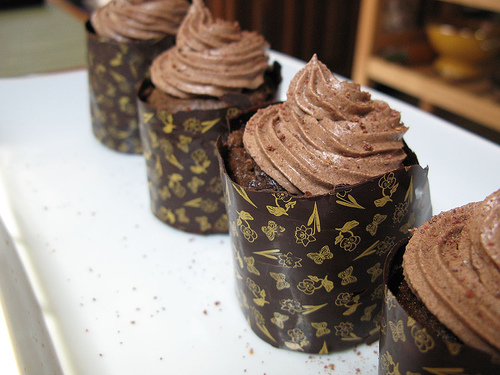
photo by QuintanaRoo

Vegan cupcakes (photo by QuintanaRoo)

We all have to eat. Without food, we wouldn’t get far. But when you’re able to choose whatever you want to eat, could you make handle trying something new?

Two Imperial College students did just that and went vegan for a month to raise money for the Multiple Sclerosis Trust.

In that month, Clare Cheng and Hannah Cox found plenty to enjoy, even if it was a challenge.

And that was just a month. If their goal was to become vegan on a permanent basis, they would have found plenty plenty more to explore and discover.

But this was no ethical choice or health-related change. From meat-eating, dairy-loving and egg-devouring human beings, the change to a vegan diet seemed pretty hardcore to them:

“Our preconception of the vegan lifestyle was that of tasteless and unfulfilling meals that satisfied your body, but not your mind. So it was a surprise when we found that actually some parts of being vegan were pretty good.”

I live with a vegan, so I get to eat a lot of vegan meals. Days go by (maybe weeks) and only then I realise that I haven’t eaten any meat in ages. Even dairy products and eggs don’t get a look in for a while. And I’m fine with that, so long as the diet is healthy and doesn’t miss out on any nutrients that are hard to find in a vegan diet. Fortunately, that’s covered too.

But while I’m going so long without the food I was so used to in the past, I don’t feel like much has changed. I’m living differently, but I acknowledge the final choice is still my own. I don’t actively class myself as vegetarian or vegan, even though I’m close to being that anyway.

When I’ve spoken to people who made a choice to go veggie or vegan with an ‘all-or-nothing’ approach, cravings can be an issue. Many vegetarians admit that they miss bacon more than anything else. For vegans, the craving for an occasional egg can be pretty strong at times. Yet I haven’t particularly felt that.

Some thoughts why:

  • I don’t have the stress of feeling it’s a hardcore change – At no stage have I labelled myself with the description ‘vegetarian’ or ‘vegan’. I simply explored what was available and allowed myself to eat anything I wanted. Meat and dairy products have never been off the menu. All that’s changed is that I picked a different meal from the menu. It’s all about my attitude toward change.
  • The more time I put in to new recipes and combinations opens the doors for more, not less – I was asked to bake a cake recently. I have never baked a cake before. And this had to be a vegan cake too!
    One quick flick through a vegan recipe book gave me the confidence to make a chocolate cake. And it was yummy. Like a chocolate brownie. Then I made another, in an attempt to improve the consistency a bit. Two tablespoons of apple sauce later and the second cake was even more presentable. In no time I’d gone from never having baked a cake to finding ways of improving a recipe. [I enjoyed another slice in the middle of writing this. Win!]
  • I’m going in search of new food I haven’t tried, and food I’ve never heard of – Limitations in one area move you to explore other areas for alternatives and workarounds. Cheng and Cox had a lot of soya milk, although my favourite is oat milk. I’ve tried hemp milk, rice milk, and various other concoctions. Some weren’t even on my radar until recently!
  • I’m still learning more about myself – Big changes get you thinking about your current circumstances as well as your future ones. Questions come flying. Why am I doing this? How can I do things better? What are the implications? What are the differences between Point A and Point B?

One of the uncomfortable things about change is that it forces us out of the comfort zone and into new territory. But once you’re there, it’s usually just as comfy, if not better than before.

What can you do when change is afoot?

Firstly, try not to label the change and don’t take an all-or-nothing approach if you want this to be long-term. New Year resolutions and giving stuff up for Lent give an artificial totality to what you’re doing. Altering your lifestyle in such a complete and sudden way is hard to do successfully and happily.

Second, not doing something in the past doesn’t automatically mean you cannot do it at all. It’s easy to say “I can’t” when you really mean “I’ve never tried”. Give yourself a chance, make a few mistakes, and build up the confidence to build bigger and better things.

Third, there is so much choice out there that you have made thousands of unconscious limitations and automatic choices for the sake of ease. That’s fine in itself much of the time. But when you want to change, those limitations and choices seem practically hard-wired! Next time you’re faced with a challenge, sit down and think about what’s limiting you. Then seek out alternatives to help move you along. It’s not always easy, but sometimes all you need to do is to search around.

Finally, all these big questions help your critical thinking, as well as open up your attitudes to change. If the challenge is big enough, you may come out the other side thinking you could do almost anything. The world is out there, waiting for you to make your next move!

Going back to the start of this post, change does require huge effort. Even when everything is in place and you want to rise to the challenge, there’s the question of willpower. As Cheng and Cox explain of going vegan:

“It makes everyday life that little more difficult when you walk down the aisles of delicious Easter Eggs or pass a good ol’ burger bar with that smell of meaty goodness.”

And they are right. When you make such an extreme change, missing out on so much that you’re used to is a threat to your intention. I used to love Creme Eggs and I ate all sorts of meat. But the less I have these things and the more I enjoy the wealth of food that’s still available to me without these options, I realise that I don’t particularly miss the choc and the meat. Not to mention the eggs and dairy products.

My once favourite Creme Eggs are now viewed with hardly any emotion at all. When they went on sale again in January, I didn’t play my usual hand of buying several dozen straight away. I purchased 12 eggs and enjoyed two a day. They were gone in less than a week, but my craving was satisfied. And I haven’t bought any since. Even writing about them here isn’t upping any desire to munch on one.

Why? Because I stepped out of my comfort zone and kept going. It’s certainly easier with someone else by your side who is taking their lifestyle seriously. I’m lucky there. However, if I wasn’t actively embracing the change, nothing could have put me in the right mindset to take on the challenge.

For me, the mindset necessary was to focus less on the change (the hard part) and more on the new experiences (the fun part). The key was not to label myself as ‘vegetarian’ or ‘vegan’. By not formally recognising any barriers around my eating, I’ve found it easier to keep the barriers up.

The next time change is afoot, see how far you can take things without actively calling it ‘change’.

Are you ready to rise to the next challenge?

photo by floridecires

photo by floridecires

Expansive Learning Is Your Friend

You live and learn. Or so the saying goes.

When you finish a course module, do you put it behind you, or do you keep hold of the ideas, knowledge and possibilities that you built up over that time?

Unlike at school, your degree gives you more opportunity to take a holistic approach to learning. A discovery in one area of work can change your perceptions in other areas.

Make use of multiple connections as you learn (photo by identity chris is)

Make use of multiple connections as you learn (photo by identity chris is)

At university, you must take knowledge as a whole. The bigger picture matters. What you learn in one class may be relevant to another class. What you discovered in the first year is still often relevant in the second year and beyond.

Joelle Fanghanel quoted an academic in her book, Being An Academic, suggesting that compartments of learning are worryingly favoured over the expansion of knowledge as a whole:

“If you ask [students] a question which perhaps involves some knowledge that they have learnt in some other part of the course, they get indignant with us saying ‘well we haven’t done that with you, we have done that with somebody else in a different course’…There is very much this feeling that you do the work, you are tested, and that’s the end of it, you close the door on that piece of work.” [p.56]

Rather than close doors, make your bigger picture even bigger:

  • Use links to your advantage – The academic above stated that students can get annoyed when they find or discuss a link between one course and another. Instead, see it as a gift. Links like this help you not only strengthen the bonds between different strands of knowledge, but also build upon what you already knew in one easy step.
  • Keep your notes and quotes – Over the years, you’re expected to search deeper in your field of study. By ignoring your past work, you risk having to remind yourself further down the line. Worse, you may even be starting from scratch for no reason. I used to resent the need to study Milton’s Paradise Lost on about four occasions at school and uni, because I didn’t enjoy it much. But by the final time I was working on it, I realised how much reading and research I had already done on it. As a consequence, I made much better use of my time and past work than before. It saved me a lot of time and bother.
  • Take your own initiative – So what if you weren’t told about something in class itself? If you’ve stumbled across it in a different tutor’s lecture, let it add to your overall learning. Use your initiative and make the reference where you see fit. It’s no different to doing your own research in books. Treat all your discoveries as equally relevant, however you found them.

There will be times when you spot links that make you shout “Of course!” (not always literally…) and realise that your life has been made so much easier because of it.

Keep your mind open to expansive learning and you should get many more of these “Of course!” moments coming your way.

original photo by farleyj

original photo by farleyj