How You Can Do What You Keep Putting Off

Ah, distractions!

Distractions are a lovely way to do anything other than what you should be doing.

Distractions are plentiful and a recipe for forgetting. You have an ever-expanding list of things that are hard to resist. Then you have Facebook and Twitter (and the rest!) all bringing a steady stream (or a heavy flow, perhaps even a tsunami) of tidbits that can take you to every destination imaginable, and from every direction you care to come from.

Why is it so difficult to get rid of distraction and stop procrastinating?

  • Fear of missing out;
  • Everyone else doing it;
  • No natural end;
  • It feeds your pleasure centres in the brain;
  • It can *feel* useful, even when that’s an excuse.

Sid Savara’s procrastination survey shows that, overwhelmingly, people just don’t feel like doing the things they’re meant to be doing. They put it off because they *want* to put it off.

What can you do to stop this spiral from going further and further out of control?

photo by Bernat Casero

Tick, tock, putting it off… (photo by Bernat Casero)

Set an incredibly short amount of time

Ten or fifteen minutes should do it. Push yourself for just that amount of time and see how you feel. You may be happy to continue after that set time.

Switch off notifications

A beep or a screen notification will stop you from what you’re doing, whether you like it or not. No matter how much you tell yourself to ignore it, you’ve already been alerted to it. The temptation is there, itching away at you at exactly the wrong time. Switch those messages off!

Mindmap

Starting is easier when you have a better overview of what you want to achieve. A mindmap will let you consider ideas and links with ease. It may be what you need to conquer your procrastination. I recently gave mindmapping software, Mindmaple Lite a whirl. It’s free and it’s easy to use, so you can concentrate more on the mindmap than the software.

Outline

If mindmapping isn’t your thing, how about a brief outline of what you want to achieve? Build up your sections and sub-sections to break down your research and writing into smaller tasks. I recently discovered Quicklyst as an online way to create outlines.

Act like it’s a blog post

The pressure of writing an academic essay can lead to procrastination. So treat the writing more casually. A recent post on Lifehack explained that 1,000 words doesn’t have to take a lot of time when you work in the right order.

Try writing a snappy title or headline if the essay question is getting in the way (making sure that you’re still trying to answer the same question!). Then, see if you can rattle off a quick introduction and conclusion to help your own mindset (you may wish to rewrite later, so this is just for you right now). Then make a quick outline of the major points you want to cover throughout the essay. After this, fill in the gaps. Do this with a timer if you prefer, so you challenge yourself to get the bulk written quickly, rather than worrying over every last word and detail. Edit and re-draft later.

Go somewhere different

Location makes a huge difference to your productivity, your attitude, and your outlook. Find places you’ve not been to before and explore where it takes your mind, not just your body.

Watch an inspiring talk or presentation

Find a TED talk and watch it. You’ll be procrastinating (win), and you’ll feed yourself some brain-food that’ll get you more psyched up for work (win).

Well, so long as you don’t just keep watching more TED talks…

Understand what’s stopping you

Okay, so you want to put this off. But why? What is the real reason for your procrastination? Be honest. Are you not interested in the topic itself? Do you have difficulty understanding the subject (time to fire up Wikipedia for the basics)? Have you got loads of friends tempting you away for fun?

If you don’t work out why you’re putting the work off, you’ll keep on putting it off!

Stop expecting perfect

Perfectionism is a recipe for procrastination. When you picture the most amazing coursework to have ever graced this earth, everything you do will be a disappointment. After a while, you’ll feel inadequate and start putting off the work instead of cracking on.

Nothing is perfect. And your first drafts are certainly not meant to be anything other than, well, first drafts. Successful writers almost never finish on their first attempt. They redraft, they edit, they get opinions from others. If established writers need to do this, you can stop beating yourself up over flaws. Even a First Class essay has flaws!

 Believe that you can keep learning

As a child, I was told that I was ‘good at maths’. Children tend to believe what they are told. So I went through school believing I had a good grasp of maths. That was fine for a while, but when new concepts arrived that I didn’t understand, I started to think I wasn’t good at maths any more. I guessed I wasn’t as smart as some people had made out.

The concept of ‘smart’ and ‘clever’ is flawed. Turn the perspective around. We all have to learn. Nobody is born with great wisdom and knowledge. What matters is a willingness to keep learning new things and stop worrying that you’re not ‘smart’ enough.

Don’t discount the future

According to one paper about procrastination:

“…the value of socializing in the present is weighed heavily while the value of getting good grades in the future is discounted. This quirk leads to delays in studying for tests, writing term papers and getting prepared for weekly assignments. As can be expected, students who procrastinate generally discounted future values greater than students who don’t procrastinate.”

The future seems a long way away. No wonder it feels easy to put tomorrow to one side. But the future soon becomes the present and it’ll bite you on the bum if you don’t deal with it in good time.

Forgive yourself

We all fall down from time to time. The occasional lapse is allowed. It’s not uncommon to put something off for ten minutes and then find you’ve put it off for ten days.

So long as this doesn’t happen all the time, you can let yourself off the hook. You’ll probably procrastinate less on the next task if you forgive yourself.

Procrastination can happen when you suffer a delay beyond your control, like when you’re waiting on a crucial library book to be available. Even then, you can find ways to move beyond the initial setback. Sometimes you do just have to wait. That gives you time to spend on other stuff anyway! 😉

How will you keep the procrastination beast at bay today?

How 750 Words Can Help Your Productivity

Sometimes, you just want to write. But it’s not always that easy.

You sit down with the best intentions, but it’s so intimidating when you start a potential masterpiece.

Your internal editor chips away at your confidence before you have even touched the keyboard.

You have no sense of the goal you’re aiming to achieve.

And that’s where 750words comes in.

For a while now, I’ve heard some academic peeps raving about 750words.com as a fantastic way to write without distraction and other concerns. These are academic peeps I trust. So I’ve given the service a go.

And I give it a thumbs up.

When you want something a little more inviting than an empty document and a flashing cursor, 750words may be the trick. It doesn’t offer much more than a blank page and it still features a flashing cursor —Hey, stick with me!— However, there are other reasons why the service may help you write more than other methods:

  1. Free-writing: Instead of carefully thinking about what you have to say, you may prefer to riff and find your voice by bashing out a load of words. Even if you find 95% of the words come out as irrelevant rubbish, the remaining 35–40 words may be exactly what you wanted. That may not sound like much, but it could be enough to spark something amazing.
  2. Challenges: 750words gives you the option to sign up to a monthly writing challenge, where you promise to write 750 words every single day in the month. If you do, you make the Hall of Fame. If you don’t, you make the Hall of Shame. If you thrive on that type of thing, the monthly challenge is for you!
  3. A blank page: Distractions aren’t welcome. If you want a blank screen, free from other goodies, you’ve come to the right place. 750words is pretty limited in terms of features. All on offer is a place to type some plain text. No fancy fonts, no bold and italics, no special layout features. Just type away until you reach the magical number of words required.
  4. No need to check word counts: Just keep on writing until you get to 750 words. When you do, you’re congratulated. And if you’re on a roll, great! Just keep writing until you’re done. You can see how many words you’ve written by looking at the bottom of the screen. No procrastination or interruption necessary by checking the ‘Word Count’ option. It’s all there for you already.
  5. Statistics: Want to know how long it takes you to write those words? 750words will tell you. Concerned about how many times you’ve moved away from your writing with other distractions on the computer? 750words will tell you. Wondering what types of words you tend to use most? 750words will tell you.

I’ve tried the service for over a week now and I enjoy the simplicity of the service. I’m not bothered about writing a particular number of words every day and I doubt I’ll sign up for the monthly challenges any time soon. I’ve already missed a day on purpose.

Still, there is certainly something satisfying about writing until you reach the number of words allotted. You cannot change the number of words set in the challenge, but nobody is forcing you to stick to that specific number of words. You can write a single sentence and stop, or you can keep going until you’ve written a whole book in a day. It’s up to you.

The user average each day is just over 900 words. I think 750 is a pretty good number to work with for most situations, though. That works out as a pretty good length for a blog post, and it’s half a 1500-word essay. You’re being challenged, but not made to bust a gut.

Here’s one more thing for you to consider: This post was written using 750words on one of my days. It took about 12 minutes to write. And I spent about ten minutes editing after that; so the post wasn’t originally a complete mess, even though I blasted it out quickly.

Remember, even if you have no use for 95% of what you write, the 5% of awesome you can use is worthwhile. And, in the case of this blog post, I only took out a few words. More like 95% used, 5% chucked out. Win!

Next time you want to get your write on, give 750words a whirl. Take up the challenge. You may just surprise yourself!

Essential Study Skills – Reviewed

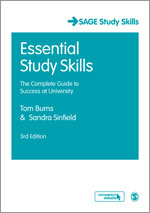
[The people at Sage have sent me a copy of the latest edition of “Essential Study Skills: The Complete Guide to Success at University” by Tom Burns and Sandra Sinfield. This is my personal review of the book.]

Sometimes you need a place to start in order to start organising your thoughts. Sometimes you need a place that’ll give you some thoughts to start off with. “Essential Study Skills” attempts to do that.

The authors are keen to make their book as easy to digest as possible. The first chapter guides you through the layout of the book and how to use it effectively.

With more than 450 pages, Essential Study Skills —which they call ESS3 for short— is not designed as a fast read to be digested in one go. Rather, the book covers many aspects of your learning and also advises on various other aspects of uni life that you’re likely to encounter.

Each chapter starts with aims and learning outcomes, then ends with review points. Within each chapter are many additional tips to help you on your way. Even at a glance, you can see this is a feature-packed book.

ESS3 is written with a focus on students who are the first in their family to go to university, so it doesn’t assume you have any prior knowledge or guidance. And there is still plenty to chew on, no matter how many generations of your family have attended uni.

With so much information at your fingertips, you may even feel overwhelmed. Must you *really* know all this in order to study effectively? Well, no. The point of the book is to help you ease into your work and pick up important tips and techniques as you go along. It’s the type of book you would be glad to have around throughout your degree, not the day before your essay is due in.

There are times when the advice goes so far that I can’t see many students following the whole way. For instance, the chapter on working in groups has so much detail on making the team work that it ends with a group building exercise to bring everyone closer. There’s nothing wrong with the idea, but it’s an idea of how the authors clearly did not want to leave any stone unturned. If this is going to benefit one group of students, then the authors have succeeded. This type of overkill is great, unless you’re overwhelmed by so much detail, as I mentioned earlier.

But I urge that you take a deep breath and let the book work over time, as it’s designed. Here are two reasons:

  1. We are all different – One person’s potion is another person’s poison. The book gives you various alternatives and lets you explore what works best for you. ESS3 isn’t a ‘this is how to…’ book, it’s a ‘this is how you…’ book.
  2. You will find things you wouldn’t have expected – As I looked through the book, I found a list of 10 sites for creating outlines. There were sites I hadn’t heard of. Sites that I was glad to discover, such as Quicklyst.

And going back to the first point, you’re bound to find at least one outlining tool from the list of ten that works for you. That’s the beauty of having alternatives to try. If the first doesn’t suit, you’ve got nine more to try!

You will probably find yourself devouring some sections of Essential Study Skills, while merely glancing through others. You may or may not return to those chapters later. I would have spent little time on the chapter about making notes, while you may think that the most useful chapter in the book.

The book covers more than the “Essential Study Skills” that the title suggests. The book’s subtitle is “The Complete Guide to Success at University”. That’s why you’re treated to information about being a fresher, using university services, dealing with emotions, and working on your Personal Development Planning (PDP).

The final chapter on what to do once you’ve finished university is strangely brief. The authors are aware of this and explain that many of the necessary skills required to be a successful graduate are similar to those skills required to be a successful student. Precisely what the whole book is about!

While this is true enough, any student about to graduate should look for more information elsewhere for a fuller picture. In particular, only one paragraph discusses the possibility of postgraduate study and the main advice is to prepare like you would for “an especially tricky assignment”.

However, if you have bought this book in your first year (or even before you start), it will easily take you through several years of study. The brevity of the final chapter is not exactly a major issue. Think of it more as a surprise when you’re used to chapter after chapter of detailed advice on mastering your academic technique.

Essential Study Skills is a great book to keep close to you while you develop during your degree. You’re not expected to be perfect after years of practice, let alone after a single term in your fresher year. This book helps you to understand that, yet at the same time helps you strive to bring out your best at all times.

The book is available now in paperback (RRP £14.99) and hardback (RRP £56.00) editions.

What ‘Preparation’ Really Is

In loads of posts for this blog, I say that you should prepare for stuff. Prepare for the year, prepare for lectures, prepare for seminars, prepare for essays, prepare for exams. Prepare, prepare, PREPARE!

You might think that preparation is pointless. After all, you don’t get formal recognition for it.

Well, that’s not quite true.

Preparation isn’t a dress rehearsal before the real thing. Think of it more as a scaffold toward better formal recognition. To prepare is to start. And it’s not just any old start; it’s starting big.

Shape ideas in your mind as early as you can, have the end in mind, ask yourself what you want to get out of the project, get an overview of the subject, develop an awareness of what’s going on…

When you put the time in from the outset, you’re in a better position to finish. And, as Scott Young says, starting isn’t useful without finishing.

We’re very good at filling time. There’s always something to do. That’s why it’s so easy to get into the mindset that you’ll start — or finish — tomorrow. Always tomorrow. When it’s too late, there is no time to prepare.

photo by D Sharon Pruitt

photo by D Sharon Pruitt

Preparation has no fixed strategy. Make it useful to you. You could:

  • Outline an idea with estimated timescales and outcomes;
  • Build up a skeleton understanding or scaffold framework of a concept/subject;
  • View what you need to get from A to B (that is, from start to finish);
  • Get the right tools in place to allow an effective and efficient transition.

These are just a few of the possibilities. No matter what your take is, your starting moves should represent the beginning of a journey as you consider why you’re undertaking it.

“‘Everything will be alright” is not the same as ‘everything will stay the same’.” – Seth Godin