Open your mind while you revise

With Christmas fast approaching, you’ve got a lot of time to explore your productivity by testing out different ways of working.

It doesn’t matter if you hate change, you may be surprised to find that incorporating some change in your life can work wonders.  And as you get used to making changes, any lack of change becomes the difficult beast.

For many of you, exams are just around the corner.  Revision covers so much ground that it’s not always clear where to start.  Do you re-read your notes, write further notes, make flash cards, read scholarly books, create mnemonics, devise weird and wonderful learning tables…?
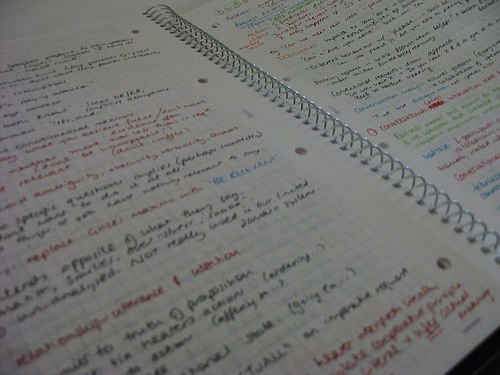
Revision Notes - photo by jez`

In revision, I suggest you should mix the game up a bit and embrace change.  I mean several different things:

1. Use a variety of media

  • pen & pad: An oldie but a goodie.  We’re so used to working from computers now that it can be quite liberating to write things down in longhand.  You may be surprised at how differently your thinking can be when writing to how it is when you type at a keyboard.
  • word processor: If you’re working from lecture notes, it might help you to set them out electronically.  Not only can the new input on screen help your memory, but you should also be able to make the notes more concise and readable.
  • flash cards: Not always applicable, but if you can work like this with your subject, don’t forget to make the most of memory jogging flash cards.  They sound like a good idea to many students, but regularly get forgotten about.  If you can remember things this way, you’re doing yourself a disservice if you don’t give yourself the time to create the flashcards!
  • e-mail: Sometimes it’s good to see a different screen when you’re working, even if just for 10 minutes.  Why not tap away an e-mail to yourself?  The nature of writing this way is different to writing a letter, so you may be able to fool yourself into using different parts of your brain.  Watch more ideas and memories come flooding out to help you with your revision!
  • mind maps: For a more diagramatic set of notes, mind maps work wonders.  It will also provide links that you may not have noticed if you were working from words and numbers alone.  If you’re not aware of mind maps, check Litemind, MindmappingMashable and Wikipedia for introductions, tips, and helpful software/websites.
  • tables: No matter what subject you’re studying, you may be able to create tables in Excel or similar.  Even if it’s just to note down similar concepts in a row, the shaping within tables can sometimes be quite helpful.  When you look through a magazine, the tables and pictures are usually the most striking and memorable elements.  It stands to reason that you can, therefore, make use of tables in jogging your memory rather well.
  • dictation machine: Your own voice is a powerful tool in itself.  Don’t forget that speaking out loud can help your memory greatly.  So why not speak out loud, which is a help in itself, but record those speeches at the same time?  Listening back to yourself will open up yet more parts of your mind.

2. Visit numerous places for study

  • bedroom
  • dining table
  • library
  • friend’s house
  • park
  • cafe
  • campus

Changing area regularly while you study is a boon for some.  Instead of getting bored with the same surroundings, it can keep the mind active.  It can also engage your interest if you pick areas that you haven’t been before.

If you have a number of different places to go to, you may also find it helpful to pick a different topic for revision each time, so you can think back to when you were in a particular place.  That should help the mind open up the memory banks.

Study in the park - photo by ortonesque

3. Go further than set texts

  • look AROUND the subject as well as within: It’s important to get a grasp of the bigger picture, even if you’re studying a niche area.  Gaining a knowledge of the basics around what you’re studying can help all the pieces of the jigsaw come together.  It’s the equivalent of finding all the corner pieces of the jigsaw first, so you know how the bigger picture is shaped.
  • research up-to-date journal articles: Academia goes far beyond your undergraduate degree, as you’re bound to know.  Professors around the world are writing their own essays to fill millions of books and journals.  That means you’d be wise to keep abreast of recent issues of journals that are relevant to your line of study.  If you can refer to new discoveries, recent theories, and up-to-date opinions in your exam answers (and your essays, of course), you’re on the way to being a cut above.
  • read book reviews on related topics: While I was at uni, I found it so useful to read book reviews.  They would give a potted explanation of the book, as well as the most important and controversial issues.  If these were brand new books, sometimes the reviews were the only place you could get word of the book’s content, unless you were willing to pay huge amounts to buy the book yourself!
  • ask knowledgeable people (from professors to librarians): If you want more info, or if you’re stuck looking for some important revision material, don’t suffer alone!  Always ask for help.  Nuff said.
  • join mailing lists & read in forums: You may be treated to brand new arguments, or you may be propelled into some mind-expanding debate between people…if you’re lucky, it’ll be scholars arguing amongst themselves, which could give you a bit of working into their ways of thinking.

Blogging Goals for 2008

Achieve 3 - photo by Woodsy 

With three months on the clock and over 100 posts, TheUniversityBlog has been an enjoyable project for me that’s gone from strength to strength.

And there’s plenty more to come too.

Thank you for all your support so far.  It’s exceeded everything I’d imagined by a long way.

The Christmas break is underway for most of you now, just as it will be for me at the end of this week.  A university without lots of student activity is a university that inevitably closes for many of the staff too.

Therefore, Friday 21st December will be my last day of posting until the New Year.  I’ll be back to the posting as of Friday 4th January, so I hope to see you back then.

Once the Christmas break is over and we all get back into the swing of things, I plan to take the blog further, mainly with regard to its promotion and organisation.  My aim is for as many students as possible to have knowledge of TheUniversityBlog.  Then it’s their choice whether or not to visit, natch!  At the moment, only a select number of students are aware of this place, which is obviously a shame.

At least they’ll have a large back catalogue of posts to catch up with when word gets out…

I’m writing about my aims today because of a post over at Daily Blog Tips.  The site has got a new group writing project, focusing on everyone’s “2008 Blogging Goals“.  I thought it a great excuse to explain my plans and thoughts for the coming months.

So here goes…these are my goals:

Greatest Goal II - photo by scottwills

1. Inform universities of this blog

I’m taking this site seriously and I want people to know it’s available.  I write about academia in the UK to help students make the most of their time studying.  If universities are aware of this, it gives them another source of writing to refer students to if they need to know about something.

2. Let Student Unions know about the blog too and engage with them to find out what students are looking for help/advice with.

Following on from my first aim, it would be crazy to ignore the actual Student Unions.  After all, I’m writing articles for students, about student life!  Not only will the SUs know how I can reach out to students, but they’ll also be able to tell me the important issues on the minds of students.  These things change, so the only way to keep up with it is to listen first-hand about what’s going on.

3. Write posts well in advance of publication

After having been struck down with illness twice in quick succession, my regular posting on TheUniversityBlog took a beating.  This didn’t make a difference in terms of visitor numbers (they went up!!), but I was annoyed at myself for not having a backup plan.

Therefore, I hope to get a lot of articles finished in advance over the coming months.  Then I’ll be ready for posting no matter what.  Queue evil laugh…

4. Set aside more time to communicate with other bloggers, academics, students, influential people.

When I started TheUniversityBlog, I thoroughly enjoyed speaking to others to get interviews and opinion.  I was unable to continue spending dedicated time on that, but I miss it and will be incorporating some of this communication time into my plan.

I also want to do more guest posting and establish a stronger link between bloggers in similar territory.

I’d finally like to hear more from individual students, past and present.  The focus will be on advice they would pass to others, how their lives have been changed by university, and what they would like to know more about.

5. Link my work in Higher Education with this blog

So far, I’ve spent very little time focusing on my own development within HE.  I’m only a couple of months into my first position within academia, so it’s no surprise that I haven’t made full use of this link yet.  But I’ve certainly learned a lot already and it’s great to be in this position.

My final blogging goal is admittedly a vague one, but it’s an important one.  There’s a lot of scope to give TheUniversityBlog greater depth and I’m working toward understanding how I can take it to the next level.  Getting back into the thick of HE can only enhance the possibilities for this blog.  So watch this space!

EduLinks – Advice, Alcohol, Accounts

Just one more regular EduLinks to go before Christmas/New Year.  Time flies, doesn’t it?

Lifehack.org – Advice for college graduates

[Following on from the previous EduLink, this post sums up all the advice given by readers to Lifehack.  The main tip in this post is NETWORK!  To be honest, it’s a tip you really need to use.]

College Scholarships Blog – 6 Things to Remember When Cramming for Finals

[That’s right, it’s revision time.  We know that all too well at TheUniversityBlog.  This link will give yet more help on getting the most from the work.]

Academic Commons – Special Issue

[I haven’t read this, but I’m determined to make this some Christmas reading of mine.  I thought I’d share the link, because it sounds interesting.  A special edition of Academic Commons, devoted to Cyberinfrastructure and the Liberal Arts.  Many articles, lots of reading, might be interesting to you too.]

Litemind – Five Reasons to Collect Favorite Quotes

Litemind – 6 Tips to Generate Outstanding Ideas

[A new blog that I found a few days ago.  I thought I’d provide a couple of worthwhile links.  If you’ve not read the blog before, I suggest you give them a look.  Both links above are helpful for creating ideas, expanding your creativity, and opening your mind.]

Telegraph – Are you drinking too much? // Millions more classed as danger drinkers

[Larger measures, stronger wines…they make it sound like we’ve never had it so good.  But when we don’t realise how much we’re drinking…hic!  No wonder some people get drunk on just one or two drinks!]

Officer Online – Money makes the world go around

[The financial position of the NUS and how the NUS is looking to change for the better.  Interesting to have an understanding of where the Union is going and how it’s been working.]

Study Hacks – The Most Important Paper Research Advice You’ve Never Heard

[If you’re seriously ready to work toward an essay that’s not good, but GREAT, you’d be wise to follow the tips Cal describes in his post.  Work like this and you’ll be well on the way to supreme quality.]

Independent – Universities can inspire the young

[Teeside is making its mark and letting young people know about it.  Their outreach attempts sound promising.  Let’s all shout from the rooftops how fantastic and beneficial university really can be!]

Paying Attention: Not too little, not too much

I’m not one for watching much TV.  So when I find a programme that engrosses me, I focus my attention on it rather a lot.  On one occasion, my attention was so focused that I felt like I couldn’t breathe any more.

That must be unhealthy.  But this rather surreal happening taught me a few lessons that I’d like to share with you in this post.  Too much attention can become a bad thing.

You’ve got millions of attention focuses.  Most of your day involves giving your attention to something, even if it’s mundane.

But we take our attention for granted and forget that it’s an important commodity.  If we use it wisely and consciously, we have a lot to gain.

Let’s take account of the points:

  • At school, you’re told to pay attention.  In turn, we treat attention like an on/off switch.  We need to detune this automatic response and give it a third dimension.
  • In being attentive to unproductive, upsetting and unhelpful issues, you’re breeding negative attention.
  • Attention can lead to obsession.  Too much focus on one thing destroys the attention we give everything else.
  • Attention isn’t like multitasking.  It can be either focused or blurred.  Put your attention glasses on and stay focused!
  • You need to give just as much attention to your rest and recreation time as you do to your work time.  Chances are you do this already, but you probably didn’t recognise it in that capacity.
  • Attention needs to be fed.  It feeds off planning and preparation.  With this diet, you’ll find a pin-sharp focus.  What may have taken hours may take you mere minutes.

By regularly treating attention like an on/off switch, it’s no wonder that focus can be so hard to achieve on certain projects.

Far from flicking a switch, it requires nurturing and understanding in order to get the best from it.

So when there’s a lot on your plate, plus a desire to have some fun and then get some rest in along the way, our attention wanders all over the place in a mad haze.

Developing your attention is not difficult, but the flawed beliefs about it make development an unlikelihood.

As the points above state, we need to change our view in order to develop any effectiveness.  Our attention is always focused on something.  But we generally ignore that this is the case.  It’s only when we want to develop our attention that we consider it.

That’s like turning up to an exam and wanting to pass without any proper preparation.

So we need to turn our attention to developing our attention:

Plan ahead

The first of the ‘attention foods’.  Put simply, if you know where you’re heading, you won’t be forced to consider your position every five minutes.  Give yourself an awareness of what’s expected to achieve maximum effect.

Prepare the tools so you’re ready to work from the outset

The other ‘attention food’.

Starting on a new project feels a lot better if you’ve started on it already.  Let me explain…

When you’re making a start on something new, it’s best to collect all the necessary tools and gather the information that’s needed before you take the plunge.  This is, essentially, starting the work, but it’s a step that doesn’t bring you any closer in what you’re doing.  It’s simply a preliminary step.  If you treat it that way, your proper start can be a much brighter occurrence and you’ll feel like you’ve actually made some progress from the first moment.

When distracted, note down what you need and forget about it until later

The danger of a wandering mind isn’t half as dangerous if you’re ready for it.  When your concentration is disturbed by a brilliant idea popping into your head, write it down for later and move on.  With a developed attention, there’s no problem in picking these issues up later and giving them all your focus then.

Give yourself deadlines

Instead of working toward a tutor-inflicted deadline, why not stay in control of your own work and make your own deadlines?  Even if you shift a due date forward by just a couple of days, it gives you more control and even allows you to recover more easily from disaster.  Your attention will also be more focused, because the setup of deadlines will be your own doing.  That shows good planning ahead.

Accept limits

It’s natural for your mind to wander.  It’s going to happen.  You can’t do anything to stop it.  So if you’re looking for perfection, forget it.  That’s why attention is a tool to develop, not master to the highest level.

Set specific goals to get the best from your attention

If you create a bland set of goals, the mind will not have worked out what is truly needed.  In the resulting confusion, you won’t be able to concentrate your attention properly.  You need a solid understanding of what’s required with each goal.  It’s also further reason to set your own deadlines, so you’re certain of where you need to be and when it needs to be sorted out.

Move on before you over-expose yourself

Finally, before obsession creeps in, give your attention to something else.  No matter how much you enjoy a particular pasttime, it’s unwise to allow over-exposure.  This will breed negative attention and undo all the good work you’ve achieved in the meantime.  As the title of this post explains, you need to give the right amount of attention to what you do…not too little, not too much.

Further reading on similar topics: