EduLinks – Positive & Negative, Concentrate & Procrastinate, To Google & Not To Google

EduLinkz

1. Mindful Ink – Me, Me, Me: Find Your Voice and Make it Shout

Self-promotion time!  I wrote a guest post for Gideon’s wonderful blog, Mindful Ink.  A lot of development and productivity can come directly from you.  It’s time to see if you can unearth that inner-goodness!

2. Happy Brain Storming – How to figure people out

One huge article that outlines different character traits in people and how you can read them to your advantage. All traits, good and bad, make a difference to the way we see the world. In tapping into what makes a person tick, a lot more can be discovered. I found this link through Lifehacker.

3. College Students Rule! – 7 Ways To Recover From Your First “F” This Semester

Fantastic advice to get you back on track if you ever get a bad grade. You owe it to yourself to pick yourself up, be honest, and do all you can to make sure it doesn’t happen again. Now, be truthful, were you really trying your best…?

4. Tal Ben-Shahar – Positive Psychology

Tal Ben-Shahar has been referred to as the bridge between self-help books and academia.  Check out some of his tips and articles here.

5. Fruitful Time – How to Concentrate

More tips on closing all distractions out of your mind.

6. Education Guardian Weekly – Tara Brabazon: Bowling Google a googly

Fascinating interview.  It’s clear that Google is used more than scholarly textbooks by some students, but I don’t know to what extent this happens.  I still see people using the library and studying with textbooks, but maybe a lot of extended research is being lost to simple searches over the Internet.

I like some of the ideas Tara Brabazon is using, and I understand why she’s championing them.  However, in asking students to exclusively use the references she has chosen, that can be just as stifling as only using info from Google.  Either way, the transition between school/college and uni is a strange one that Brabazon is looking to tackle, and I think she’s doing a good job.

7. Ian’s Messy Desk – 22 Annoying Things to do in an Elevator

This caught me as very funny. I went back to it later and still found it funny. I also noticed a few things that I’d done before. Like 5. And 7. And 8. And 9. And…well, quite a lot of them. I’m just a big kid really.

8. Telegraph – How safe are your daily supplements?

Everything seems to be good one day, terrible the next. No wonder we end up making our own decisions on so many things! I take vitamin and mineral supplements (point 9 in my Healthy Hits post), and I’m aware that studies are just as likely to question their benefits, but I’m going to stick with them for now.  Anyway, here’s another article for you to consider…

9. University of Nottingham – U-Now Open Courseware

Yay! More free learning tools. There seems to be more out there with every new day that passes!

Beyond the Lecture, Before the Testing: Effective Seminars & Tutorials

Not marked. Not assessed. Not important? Not likely!

Seminars are potentially crucial for your learning. Not everyone realises this, because a seminar isn’t part of your final grade and sometimes it can feel like you’ve already got enough information from the initial lectures.

This type of attitude is totally wrong. If a student wants to achieve good grades with confidence and greater ease, seminars and tutorials can make all the difference.

Seminar 10am Friday

So, what are they for:

  • Expanding upon lecture topics.
  • Asking further questions.
  • Gaining answers to some of your questions.
  • Getting closer to what your lecturers may be looking for in your essay and exam answers.
  • Allowing you to confirm your understanding of the topics.

How can you make the most of them:

  • Do the background reading and exercises.
  • Prepare as much as you think you need.
  • Note down any questions you have in advance.
  • Get stuck in! Ask questions, give answers, participate in the discussions.
  • Listen for different views and consider how they differ from your own.

Moving things forward:

  • Note information that the tutor deems important…it’s likely to come up in essay titles and exams.
  • Research the different points of view, especially if you hadn’t thought about them before.
  • Look for new questions that may have risen from the seminar/tutorial work and find possible answers.
  • Compare new thoughts and notes with your original lecture notes and initial reading. Do they change your point of view?
  • Embrace what interests you. Your seminar work can easily lead to a particular focus that would shape a future essay rather well. Don’t lose sight of these lightbulb moments.

What problems occur:

  • Keeping quiet – If you don’t loosen up and use the opportunities available, you’ll miss out on a great deal.
  • Lecture extensions – Tutors sometimes use the extra time to tell you more, without allowing you the time to actively work and ask questions. But make sure the tutor isn’t doing all the talking just because you’re not willing to participate.
  • Lack of preparation – Another reason why the tutor may be doing all the talking…if you want to gain a greater understanding of what you’re meant to be learning, get the work in!
  • Too much time asking irrelevant/simple questions – No question is stupid and you should be brave and ask all that you can. But if you know certain questions can wait for afterwards and are easily answerable in a reference book, it’s best asking the questions that aren’t as simple to get to the bottom of.
  • Finding arguments intimidating – University becomes a hotbed of controversy at times. And that’s just in the classroom! It pays to be passionate about what you think. I’ve seen people panic when differences of opinion occur, but that’s all part of the fun and discovery. Even if the tutor argues with you, it might be because they are passionate themselves, or it could be a test to see how far you’ve considered your own position. You’re likely to be told quickly if your argument isn’t going anywhere…so if the argument is pretty philosophical and leading to further questions, you’re probably doing a good job.
Playing Roles

Don’t miss out on how valuable your education is from every angle. Seminars and tutorials are every bit as important as the lectures, essays, exams, reading…well, they’re all as important as each other. Miss out on one and you may do yourself an injustice.

Have you encountered any spectacular seminars? Did a particular tutorial change your ideas for the better? Have you improved your grade after a successful seminar?

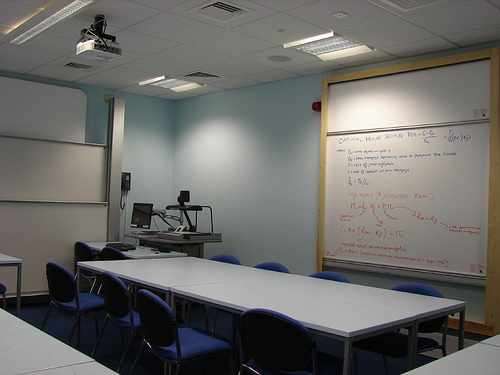
Dry Wipe

Kill Conflict Dead

Arguments are all too easy to fall into. Don’t “act first and consider later”. Instead, take a moment to consider the three stages to staying on the right side of the situation:

photo by ragesoss

1. Stop the Gossip and Start to Talk

Most of us can probably remember a time when we were moaning about something that annoyed us. It needn’t be a big issue, just a slight annoyance that we want to get off our chest. And it’s not limited to people we don’t get on with either.

Unfortunately, a lot of moans turn into bitching sessions. Before you know it, you’ve got an issue with a pretty good friend and you’re finding a lot of negative stuff to say about them.

A tiny seed of annoyance grows into a reason to dislike a person. No wonder I’ve seen several close relationships end, yet neither party really understood how the problem came to be in the first place.

2. Take a Time Out

When you’re unhappy about a particular situation, give yourself a chance to let things settle in. Acting on impulse is crazy, because you won’t have allowed reason to kick in.

I’ve just explained the need to start talking, but it’s important to talk with a reasonable outlook. Nothing off the cuff will do.

A time out simply prepares you and allows you to consider your view outside the heat of the moment. In doing so, you have the opportunity to focus on the final stage…

photo by [simply].shambolic

3. Look at the Other Person’s Perspective

Whether or not you’re in conflict with a person, we could all benefit from considering how a situation looks from another person’s point of view.

Conflicts all too often occur because we get wrapped up in our own lives. Not enough thought goes into the wants, needs, and beliefs of others.

Before launching into any situation, it’s good practice to explore what other people might be thinking about and why they act the way they do.

You’re not going to be able to read their mind or fully understand the situation, but your consideration works on other levels:

  • It helps you step back calmly from your own opinion;
  • You realise that not everyone thinks just like you;
  • This unleashes your creativity to an extent…imagining what it’s like to be in someone else’s shoes.

While it’s unlikely you’ll suddenly change your mind and see eye to eye, at least you will come a little closer to accepting differences. It’s perfectly plausable that you’ll still find the other party behaving unacceptably, but at least you will have come to that conclusion from a more reasoned approach.

Aftermath

And if you do still feel angry, remember to take deep breaths in and out, really feeling that air lifting you up. And there’s nothing wrong with testing your own patience by holding your tongue and counting to 10 (or 100, or 1000, or however long it takes to relax!).

If you consumed alcohol at the time of an argument and were too drunk to follow the three stages, be prepared to apologise, even if it wasn’t entirely your fault. Don’t be stubborn with the old, “They started it, so they can come to me first”. It doesn’t do anyone any good.

A true conflict requires more than one person, so you still owe it to yourself to maintain a responsible attitude. That way, you won’t look unreasonable in your actions, no matter what the outcome.

EduLinks – Fancy that…

Just after I write about the definition of a university, along comes the Times Higher Education and has a big feature article and leader along those lines.  I’ve not read it yet, but I’m looking forward to doing so later…it’s a good stop press EduLink, which is why I’m a little later delivering the post…

EduLinkz

Times Higher Education – Diversity Challenge

Times Higher Education – Leader: Cardinal lessons and virtues

[Here you go.  “What is a university?” discussed in a big way.  At least, I think that what it’s going to be about…At time of writing, I’ve not read it yet.  But I’m very much looking forward to.]

Student Help Forum – How to Enact Damage Control After a Classroom Catnap

[Some sound advice here.  If you go and fall asleep in lectures or – even worse – seminars, it’s time for a little bit of damage limitation.]

Lifehack.org – Tips and tricks for distraction free writing

[Why is everything out to distract us?  We even seem out to distract ourselves.  This article at the ever-helpful Lifehack will take some of those distractions away.  I especially like the idea of wearing headphones when people are around, even if you aren’t going to listen to any music.  You may still look for distractions yourself, but people are less likely to bother you if they think you’re in the middle of a particularly satisfying riff…]

JISC – ‘Google Generation’ is a myth, says new research

[My questions for you: Do you live an Internet life beyond Google and Wikipedia?  Are you impatient when searching for information?  Do you feel that searching skills should be taught on a regular basis?  Are you excited by new information resources, or is it just another annoying thing to remember?]

Achieve-IT! – 32 Disciplines & Psychological Stunts That Bring Optimism, Upgrade Visualization Skills and Make You Unstoppable

[If nothing on this list helps to motivate you more, I don’t know what will!]

Dumb Little Man – Keep Your Day Super Productive

[The article may begin, “As a freelancer, entrepreneur, or everyday office worker…”, but the tips here are totally relevant to students too.  Schedule time for social networking, limit your e-mail, plan your day…it’s all there.]

Education Guardian – How to be a student: The art of writing an essay

[Another of the Guardian’s ‘How to be a student’ column.  Lots of good, punchy advice here.  Even if you’ve heard it all before, it’s a good one to keep hold of so you can remind yourself each time you sit down to work on your essays.  Print it out, tack it up, use it!]

UPDATE: In all the fuss of the THE articles, I forgot one of the EduLinks I had noted.  Silly me.  Here it is:

Study Hacks – How to Edit Your Paper in Three Passes or Less

[Yes, I could wait until the next lot of EduLinks, but I don’t like to deprive you lot.  And if you’ve never edited your essays without asking the question, “Am I completely insane!?” you really need to read this and change your ways.  Quickly, before it’s too late!]