The wrong people who are right for you

No matter how mild mannered you are, I’m sure there are people out there who you vehemently disagree with.  You may keep it to yourself, but you’ll certainly ignore everything they say.

Also, no matter how positive you are about your life, I’m sure there are people out there who look like they live such an effortless life that it’s annoying.  While you struggle, even slightly, there’s always someone else who looks like they’re having a better and more successful time than you.

photo by Ana_Fuji

photo by Ana_Fuji

We compare on a regular basis.  And it’s not just objects and concepts.  We compare ourselves to others and we compare our situation to others.

But the only person we really know is the person we live with 24/7.  I know me.  You know you.  We can’t go further than that.  At least, not until mind-reading is developed on a total scale.  And I imagine that’ll bring the end of the world anyway, because we won’t like hearing what everyone else is thinking!

Of all the people you like, look up to, and respect, you probably do so because you agree with a lot of what they do.  You may even see a bit of yourself in those people when you make comparisons.  Perhaps you try to emulate them from time to time and don’t even notice yourself doing it.  A lot of this is down to the contradiction known as the ‘comfort zone’. It makes you feel good in the short term and it doesn’t stretch you.

Who do you look to when trying to break out of that ‘comfort zone’?

What about the people you don’t gel with?  What about those you disagree with?  What about the ‘effortless’ people who don’t appear to try?

These people are sometimes the best characters to turn to when you want to improve your own circumstances.  Here are four reasons why:

  1. You need a challenge – If you only find people who tell you what you want to hear, you’re not doing anything to push yourself forward.  Not everyone is like you.  A person’s difference isn’t a weakness and it isn’t necessarily wrong.  Sometimes it takes an opposing view to get you out of a rut or help you open up the bigger picture.  You may still not agree after listening, but it should help challenge your own thought process and give you more scope in the long run.
  2. Everyone has something worthwhile to say – However accomplished you are, you need to listen to other people.  People from all backgrounds, cultures, viewpoints.  A specialist in any subject/career, will get people on board who specialise in things that they don’t.  And the most committed (and likely, successful) specialists will look to other specialists in their own field, to find new ideas and possibilities.  They’ll come together to debate the future, to understand difficult concepts, and to uncover issues that they hadn’t considered themselves.  A specialist in the same field may be the competition, but that’s likely to mean what they say is more worthwhile, not less. A real genius doesn’t pretend to know everything.
  3. The ‘effortless’ people try harder than you thinkThere’s no such thing as ‘overnight success’.  Perhaps a random lottery win or one-in-a-million fluke.  For most people, success happened overnight after many months, if not years, of work.  You’ll see one side to these people, but unless you become that person (hint: you won’t), you can’t fully grasp the difficulties they face.  And I bet some of their challenges are over issues that don’t phase you one bit.  Read the autobiographies of successful people you think have it so good and you’ll probably be surprised at what they’ve had to face.
  4. People you disagree with can often provide valuable advice – I’ve already mentioned above that we’re all unique.  We have opinions and viewpoints and they make us who we are.  When someone suggests something that sounds wrong, ask yourself why it sounds wrong and question how bad things would be if you went down that route.  Would it truly be the end of the world?  Does your thought process suddenly uncover a problem that you wouldn’t have noticed otherwise?  Before you dismiss so-called ‘bad’ advice, let it make an impact on you so you have good reason to dismiss it.  You may realise there’s more in the advice than you first thought.

If you’re surrounded by people who agree with everything you say and do, it’s easy to lose touch with reality.  The ‘comfort zone’ leads you down a dangerous path, which ends up being rather less comfortable than you’d imagined.

So don’t ignore a critic.  Faced with a critic, you’ll either learn about flaws that will help you improve, or you’ll have the energy and knowledge to prove them wrong.

“Most leaders will receive criticism at some point or another. The strength of their leadership is often how they respond to that criticism.”

[Jackie Cameron]

Who has helped you push through difficulty, despite differences?

photo by FilmNut

photo by FilmNut

EduLinks: Eyes, Education, Essays & an EBook

Straight into the EduLinks. Happy reading.

Apostrophe.me

It’s easy to get confused with apostrophes.  Help is at hand with this visual aid.  I don’t notice the “your” and “you’re” issue, so here’s my take on that one.  Whenever you want to say your/you’re and aren’t sure which to use, just take the sentence in context and replace your/you’re with the words “you are”.  If “you are” doesn’t make sense in the sentence, you need to use “your”. If “you are” is exactly what you wanted to convey, you should use “you’re”.  In short, “you are” is your friend and you’re better off knowing it!

University of Leicester – Essay Writing Diagnostic

This is a quality link you’ll want to bookmark.  The guide lets you choose how you approach essays and examine what problems you have, rather than just giving general advice.  Once you highlight your experience, the guide helps you improve in the areas you need to focus on most.  Simply set out and tailored to you!

Think Simple Now – 7 Keys to Reading Faster

I love speed reading.  It’s worth investing the time to improve your reading speed.  Scott Young heads you in the right direction.  And it’s not just about the ‘speed’.  You need to know when to slow down too.  Scott explains:

“Many people I’ve talked to after introducing them to speed reading brag about how quickly they dashed through a book. But, these same people later confess that they remember little about what they read.”

How to Get More From Life – free EBook from Scott Young

If you like Scott’s post on reading faster, be sure to check out his new EBook.  It gives a broad introduction to all sorts of ideas and advice on learning, productivity, confidence, fitness, and even the meaning of life.  Scott says, “I write at least as much to articulate my own thoughts as I do to provide advice”.  We should all take a journey of discovery through our own thoughts.  Writing helps solidify those thoughts. Who knows, perhaps this EBook will spur you into writing down what’s on your mind too.

Eye Movement that boosts your creativity (Scientific American / BPS Research Digest)

“Sixty-two subjects performed a creativity task, where they had to come up with as many alternate uses for common objects like, a paper clip, pencil, shoe, etc. as they could in one minute.

“After this initial task researchers asked subjects to move their eyes to follow a target as it moved horizontally left to right for 30 seconds. This exercise is thought to increase the cross-talk between the hemispheres.

“Then the subjects completed the creative task again. Results were surprising. Subjects came up with significantly more unique uses for the everyday items, than the control group who stared straight ahead.” [Scientific American]

Cognitive Daily – What’s the best way to take a study break?

Time to get closer to nature.  A better break means for better study.

From Josh Blacker – HE funding and ‘value for money’

“If anything, tuition fees are a misnomer. We pay to join a community of learning. (At least in the current funding regime; previously, there was no ‘joining fee’, and as one alumni told me the other day, he came out of university with a cash surplus!) That’s what the arguments should be about – not whether a particular university course is ‘value for money’ or if students get ‘enough’ time with lecturers (bearing in mind, lots of us in the Arts and Humanities skip lectures because we might view particular lectures irrelevant to our own interests!).

“The question we should be asking – of ourselves, of universities, and of the public – is, ‘Should we have to pay to join a learning community?'”

Six Minutes – How to Deliver Group Presentations: The Unified Team Approach

The introduction to this extensive piece says it all: “A group presentation is only as strong as its weakest presenter.”

Introduce clarity, control and commitment to your presentation preparation with this guide.  It’s not squarely aimed at students, but there’s plenty of relevant detail to take on board.  You may not want to separate into ‘project manager’, ‘gap analyst’, and ‘chief researcher’, but don’t let that take away from the good advice given here.

And if you really want student-facing advice on presentations, TheUniversityBlog covers it in these posts:

Tommy Gilchrist – RUSU 1 – Reading 0

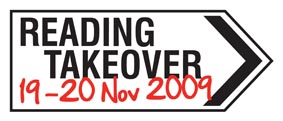
It’s the Reading Town Takeover later this week.  I’m pleased to hear how Reading Students’ Union (RUSU) is already out in full force to fight for fairer funding in HE.  RUSU started their Town Takeover events on Saturday, taking things very seriously.  But fighting a serious cause can still be a lot of fun, which Tommy (VP Education at RUSU) describes in his latest blog post.  Bring it on!

You Are Remarkable

This week is Nightline Awareness Week (16-23 November).

Now, before you start shouting that there’s a week for just about anything these days, I think it’s important to mention Nightline.

Nightline is a support service, run by students, helping other students.  In times of difficulty, whatever the problem, however they feel, students can ring up and talk to other students on the end of the line who are happy to listen.  They don’t have the answers, but they are there to provide you with emotional support and a willingness to listen…no matter what it’s about.

Sometimes all a person needs is the chance to let out their emotions.  Being at university, you’re surrounded by so many other people, but you may still feel alone.  Nightline provides an anonymous service that gives you the chance to connect with someone, no matter what you want to talk about.  Don’t worry, you won’t be judged.

There are currently 33 participating Nightline members up and down the country, with more coming to the service soon.  If you want to find your Nightline, check their website for details.

How does it help to talk about problems and feelings? Student Mental Health Practitioner and Counsellor, Mark Goulborne, explains why here.  And he says something that every one of us should bear in mind as we go about our daily life:

Remember we are born with no expectations on us other than survival….every single additional thing we achieve is remarkable – not expected. You are remarkable.

That’s why it’s important to mention Nightline.  Universities are getting into the swing of things.  Nottingham is giving out free hugs, York has a quiz and is giving away freebies (like cake…always good!), and Sheffield is doing some Speed Dating!  It’s all good fun and worth celebrating the wonderful service that Nightline provides.

If you aren’t feeling remarkable and you want to speak, in confidence, about whatever you want to get off your chest, get in touch with your Nightline.

Change, Take Action, Forge Ideas, and Drive

I hope you enjoyed my recent six-part series on Time.  However, the path to success in your studies – and beyond – goes further than effective time management.

Life is unpredictable.  Whether or not you plan into the future, you still want to exercise control over that future.  However, an unexpected event can dramatically alter the course of your life, whether you like it or not.  A change in popular trends, a personal tragedy, an oversight with timely consequences…anything can reshape what’s going on and thrust you in a different place to where you’d expected.  And where you’d calculated.  And which you saw with total certainty until now.

So what’s the point in being so rigid?  Yes, planning is necessary for success…

But so is accepting change.

You may even change yourself.  Scott Young mentions on his site that he’s stopped setting long-term goals, because everyone changes so much so quickly.  If you read what he says, you’ll understand why one of the craziest job interview questions is, “Where do you see yourself in five years’ time?”

Manage time effectively by initially narrowing your scope, not widening it. Long-term goals are one thing, but they should be based on general ideas.  To achieve those goals, you need to see in smaller chunks of time.

University is definitely a time of massive change to you.  Even a long-term childhood passion can fade away, in place of an even bigger passion.  If you don’t have a passion, it may start developing while you’re an undergraduate.  It’s all to play for.

The best way to focus on the need for change is to review on a regular basis. Review your short-term plans, long-term goals (if you have any right now), and all your personal passions.  Without noticing, you may find that what you held dear last year now leaves you cold.

Once you accept change with open arms, the next thing to do is to *take action*.

You could have the best idea in the world since the dawn of time.  But if you don’t take action to process that idea until it becomes reality, you might as well have not come up with the idea in the first place.

Ideas are funny things.  When you accept change and take action, you still need to go further.  Harvard Business posted an interesting piece a few days back, about structuring experiments for success.  One striking piece of advice is:

“Executives and university administrators should stop trying to predict the success of very early ideas, instead they need to be sure they have enough of them and that their pool of ideas is diverse.”

The suggestion shouldn’t be limited to executives and administrators; I think it’s sound advice, whoever you are.

It’s like when I write.  If I only had a single idea, I wouldn’t last long before running out of steam.  I have a wide range of post ideas on the go at all times.  I write all sorts of notes and even full drafts of posts that, in the end, don’t go anywhere.  I’ll keep them for when it makes sense to bring them out again, but that’s why ideas are so great.  The more you feel for ideas, map out your thoughts and write about all your little lightbulb moments, the better.  Be aware of your ideas at all times to give yourself the best chance of developing.

So far, so positive.  Yet even with a huge list of amazing ideas, you still can’t control everything about your future.  Luckily, you are the very person who can drive it.

That’s the next step.  You’re willing to change, you want to take action, you have ideas.  Now drive!

The poet, Philip Larkin, wrote these words:

“And once you have walked the length of your mind, what
You command is clear as a lading-list.
Anything else must not, for you, be thought
To exist.”

[From Continuing to Live (1954)]

There is so much calling out for your attention, but it’s up to you to filter until you’re left with what you need to succeed.  This is where the big picture really comes into play.  Your life doesn’t roll down a single track and you’re bound to have loads of responsibilities, interests, mates, and so on that you want to make a big part of your existence.

Armed with the want to change, a readiness for action, ideas and drive, your priorities should be crystal clear.  With such clarity, you’ll have more time to enjoy.

So if you ever find yourself at a loss, without a structure, lacking a goal, or lacking control, it’s time to let go of some of the junk cluttering your life.  It may have seemed important a while back, but when you focus on too many things to cope, you might as well not focus on anything at all.