Study

Beyond the Lecture, Before the Testing: Effective Seminars & Tutorials

Not marked. Not assessed. Not important? Not likely!

Seminars are potentially crucial for your learning. Not everyone realises this, because a seminar isn’t part of your final grade and sometimes it can feel like you’ve already got enough information from the initial lectures.

This type of attitude is totally wrong. If a student wants to achieve good grades with confidence and greater ease, seminars and tutorials can make all the difference.

Seminar 10am Friday

So, what are they for:

  • Expanding upon lecture topics.
  • Asking further questions.
  • Gaining answers to some of your questions.
  • Getting closer to what your lecturers may be looking for in your essay and exam answers.
  • Allowing you to confirm your understanding of the topics.

How can you make the most of them:

  • Do the background reading and exercises.
  • Prepare as much as you think you need.
  • Note down any questions you have in advance.
  • Get stuck in! Ask questions, give answers, participate in the discussions.
  • Listen for different views and consider how they differ from your own.

Moving things forward:

  • Note information that the tutor deems important…it’s likely to come up in essay titles and exams.
  • Research the different points of view, especially if you hadn’t thought about them before.
  • Look for new questions that may have risen from the seminar/tutorial work and find possible answers.
  • Compare new thoughts and notes with your original lecture notes and initial reading. Do they change your point of view?
  • Embrace what interests you. Your seminar work can easily lead to a particular focus that would shape a future essay rather well. Don’t lose sight of these lightbulb moments.

What problems occur:

  • Keeping quiet – If you don’t loosen up and use the opportunities available, you’ll miss out on a great deal.
  • Lecture extensions – Tutors sometimes use the extra time to tell you more, without allowing you the time to actively work and ask questions. But make sure the tutor isn’t doing all the talking just because you’re not willing to participate.
  • Lack of preparation – Another reason why the tutor may be doing all the talking…if you want to gain a greater understanding of what you’re meant to be learning, get the work in!
  • Too much time asking irrelevant/simple questions – No question is stupid and you should be brave and ask all that you can. But if you know certain questions can wait for afterwards and are easily answerable in a reference book, it’s best asking the questions that aren’t as simple to get to the bottom of.
  • Finding arguments intimidating – University becomes a hotbed of controversy at times. And that’s just in the classroom! It pays to be passionate about what you think. I’ve seen people panic when differences of opinion occur, but that’s all part of the fun and discovery. Even if the tutor argues with you, it might be because they are passionate themselves, or it could be a test to see how far you’ve considered your own position. You’re likely to be told quickly if your argument isn’t going anywhere…so if the argument is pretty philosophical and leading to further questions, you’re probably doing a good job.
Playing Roles

Don’t miss out on how valuable your education is from every angle. Seminars and tutorials are every bit as important as the lectures, essays, exams, reading…well, they’re all as important as each other. Miss out on one and you may do yourself an injustice.

Have you encountered any spectacular seminars? Did a particular tutorial change your ideas for the better? Have you improved your grade after a successful seminar?
Dry Wipe

Don’t ‘Learn’ it, ‘Understand’ it!

When it comes to strange and fascinating facts, it’s no surprise that some are kooky enough to take hold of your brain and stay with you for quite some time. But read too many silly facts and you won’t remember them all.

If it’s hard enough to remember something outrageous, how difficult must it be to remember everything you need for an exam?

The answer is in the way in which we learn things.

Nose and finger (Stockholm) - photo by cranberries

After reading some useless trivia, you’re not given the encompassing reasons behind the facts. There’s nothing to take with you other than the figures themselves. Because of this, you’re only able to learn that information. You haven’t been given the tools to fully understand why the answer is structured the way it is.

Your revision can go two ways too. On one hand, you can try digesting the hard facts, arguments, opinions, quotes, and statistics in isolation of the bigger picture. If you’re lucky, you’ll get a vague grasp on the wider implications and remember most of the facts so you can cobble something together under exam conditions.

On the other hand, you can take in the bigger picture first, truly getting to grips with the how and why of what you’re studying. If you’re faced with some facts that you need to learn, you’ll have a greater chance of remembering them if you ask yourself where this information fits in and how it works.

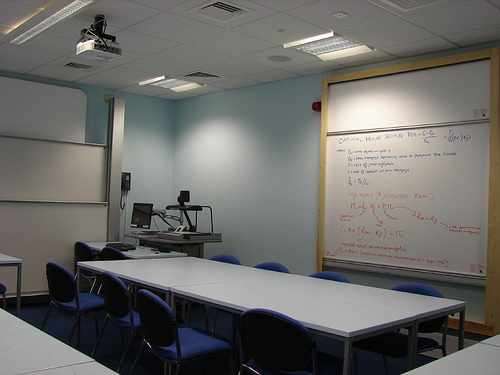
Lecture Room (Birmingham) - photo by jisc_infonet

Your aim is to understand what you’re revising, rather than learning it by rote.

It’s not that good students pick this stuff up with ease. The secret is more that they ask questions and get background on what they don’t understand. When you’re given certain information to learn in preparation for an exam, things can go two ways:

A good student says, “I don’t understand this. I can see it’s important and clearly needs to be remembered, but how does it fit in with the bigger picture? How did this fact come to be?”

A half-hearted student says, “This is so difficult to learn. It just won’t go in. Why can’t I remember this kind of stuff? I don’t understand it anyway.”

Both types of student are in the same position, but one is willing to go beyond the surface in order to get a fuller understanding of the subject. Yes, it may require a little more time and research, but it’s not going to take much longer, so the payoff is good.

In fact, any research that takes a good student too long becomes a false economy…so they don’t do it, natch! The main thing to remember is to always keep one step ahead. It’s one thing to be clueless about an entire subject, but it’s another to waste too much time on a small area that’s difficult to perfect. Even the best students have blocks and difficulties. You need to know when to stop obsessing and start relaxing.

If you can develop the mindset to ‘understand’ and enhance your working, you’ll be well on the way to some quality revision and a confident state of learning.

In my next post, I’ll set out five tips for revision that will help focus your revision even more clearly.

Techno-Cafe - photo by jisc_infonet

Open your mind while you revise

With Christmas fast approaching, you’ve got a lot of time to explore your productivity by testing out different ways of working.

It doesn’t matter if you hate change, you may be surprised to find that incorporating some change in your life can work wonders.  And as you get used to making changes, any lack of change becomes the difficult beast.

For many of you, exams are just around the corner.  Revision covers so much ground that it’s not always clear where to start.  Do you re-read your notes, write further notes, make flash cards, read scholarly books, create mnemonics, devise weird and wonderful learning tables…?

Revision Notes - photo by jez`

In revision, I suggest you should mix the game up a bit and embrace change.  I mean several different things:

1. Use a variety of media

  • pen & pad: An oldie but a goodie.  We’re so used to working from computers now that it can be quite liberating to write things down in longhand.  You may be surprised at how differently your thinking can be when writing to how it is when you type at a keyboard.
  • word processor: If you’re working from lecture notes, it might help you to set them out electronically.  Not only can the new input on screen help your memory, but you should also be able to make the notes more concise and readable.
  • flash cards: Not always applicable, but if you can work like this with your subject, don’t forget to make the most of memory jogging flash cards.  They sound like a good idea to many students, but regularly get forgotten about.  If you can remember things this way, you’re doing yourself a disservice if you don’t give yourself the time to create the flashcards!
  • e-mail: Sometimes it’s good to see a different screen when you’re working, even if just for 10 minutes.  Why not tap away an e-mail to yourself?  The nature of writing this way is different to writing a letter, so you may be able to fool yourself into using different parts of your brain.  Watch more ideas and memories come flooding out to help you with your revision!
  • mind maps: For a more diagramatic set of notes, mind maps work wonders.  It will also provide links that you may not have noticed if you were working from words and numbers alone.  If you’re not aware of mind maps, check Litemind, MindmappingMashable and Wikipedia for introductions, tips, and helpful software/websites.
  • tables: No matter what subject you’re studying, you may be able to create tables in Excel or similar.  Even if it’s just to note down similar concepts in a row, the shaping within tables can sometimes be quite helpful.  When you look through a magazine, the tables and pictures are usually the most striking and memorable elements.  It stands to reason that you can, therefore, make use of tables in jogging your memory rather well.
  • dictation machine: Your own voice is a powerful tool in itself.  Don’t forget that speaking out loud can help your memory greatly.  So why not speak out loud, which is a help in itself, but record those speeches at the same time?  Listening back to yourself will open up yet more parts of your mind.

2. Visit numerous places for study

  • bedroom
  • dining table
  • library
  • friend’s house
  • park
  • cafe
  • campus

Changing area regularly while you study is a boon for some.  Instead of getting bored with the same surroundings, it can keep the mind active.  It can also engage your interest if you pick areas that you haven’t been before.

If you have a number of different places to go to, you may also find it helpful to pick a different topic for revision each time, so you can think back to when you were in a particular place.  That should help the mind open up the memory banks.

Study in the park - photo by ortonesque

3. Go further than set texts

  • look AROUND the subject as well as within: It’s important to get a grasp of the bigger picture, even if you’re studying a niche area.  Gaining a knowledge of the basics around what you’re studying can help all the pieces of the jigsaw come together.  It’s the equivalent of finding all the corner pieces of the jigsaw first, so you know how the bigger picture is shaped.
  • research up-to-date journal articles: Academia goes far beyond your undergraduate degree, as you’re bound to know.  Professors around the world are writing their own essays to fill millions of books and journals.  That means you’d be wise to keep abreast of recent issues of journals that are relevant to your line of study.  If you can refer to new discoveries, recent theories, and up-to-date opinions in your exam answers (and your essays, of course), you’re on the way to being a cut above.
  • read book reviews on related topics: While I was at uni, I found it so useful to read book reviews.  They would give a potted explanation of the book, as well as the most important and controversial issues.  If these were brand new books, sometimes the reviews were the only place you could get word of the book’s content, unless you were willing to pay huge amounts to buy the book yourself!
  • ask knowledgeable people (from professors to librarians): If you want more info, or if you’re stuck looking for some important revision material, don’t suffer alone!  Always ask for help.  Nuff said.
  • join mailing lists & read in forums: You may be treated to brand new arguments, or you may be propelled into some mind-expanding debate between people…if you’re lucky, it’ll be scholars arguing amongst themselves, which could give you a bit of working into their ways of thinking.

Enjoy your study more

Whether or not you find personal study time satisfying and worthwhile, it’s easy to forget how many ways there are to boost the way you feel when it comes to the crunch.

From reading to revision, from writing essays to planning presentations, your work is just another part of life.

Procrastination hangs around like a bad smell…it’s horrible, but you can get rid of it if you find the source and work toward eliminating it.

There are more ways to enjoy your study than you think. But the mistake many people make is to concentrate on the study itself. There’s no need!

The study comes naturally if you put the right preparation in to everything else.

Breathing

 Breathing (photo by LunaDiRimmel)

Never take your breathing for granted. Without it, we’d be goners!

This is overlooked much of the time. When you want to feel more relaxed and focused, spend just 2 or 3 minutes to take in some slow, deep breaths. With each breath in, keep it there briefly before discarding it. Try breathing in through your nose first, but breathing out through your mouth.

Remember to make those breaths deep and full of air.

Further info linkageness: RIRIAN PROJECT – Take a one-minute break to marinate yourself

Music

Music (photo by psoup216)

Find out how your ears can help your head. While we all have different preferences over listening to music before, during, and after study, it’s not simple enough to do what you want. Test out different scenarios to find what’s best for you. If you listen during study and it gets in the way (i.e. you sing along and get carried along by the music more than your study), then why not listen to music prior to studying, to get in a positive working mood?

Rest breaks

(photo by christopherleonard)

Be it five minutes in every 15, or 15 minutes in every hour, make sure you have a dedicated rest to recharge your batteries.  If you don’t, you won’t be making the most of your working time.

Changing area

(photo by austerlitz7)

…And while you’re resting up, don’t just sit at your desk and count the time down unimaginatively. Get up from your desk and make a deliberate move somewhere else, even if it’s just two steps away over to your bed!

It also helps to change your study area too. If you work heavily in the same place all the time, you might be surprised at how your mind will open up to working elsewhere. Even if you choose to sit on a step or bench somewhere on campus, it might be enough to access different areas of your brain.

Who knows, you may even associate different chunks of revision with the places you studied it in…!

Changing light

(photo by Lua sp)

You may not be lucky enough to have a dimmer switch in your student halls, but you have a chance to be creative here.

When you experience a change in the amount of light around you, your body and brain reacts with it. If you subtly change the light getting to you (up or down), the chances are you’ll be able to work harder again.

Try opening or closing your curtains, finding a shadier or more sunny spot, rearranging your study area to nearer the window, etc., etc.

Just as long as you don’t settle down anywhere too dark…your body will think it’s time to go to sleep!

Powernap

Power Nap (photo by midiman)

Talking of sleep, I heartily recommend a 10 minute powernap before cracking on with the business at hand. Just set your timer for 10 minutes, lay down, shut your eyes, and relax. Even if you don’t start to nod off, it’s absolutely fine. The brief rest will pep you up and help you blast through more work than you could have done without it.

Further info linkageness: Lifehack.org – How to get the perfect nap

Embrace change

(photo by gak)

That is to say…Stop Being Stubborn!

If you’re not happy with your productivity, then look to your own ways of working and be determined to make a change.

The power is within you, so excuses won’t cut it at this stage. Tell yourself to behave!

Schedule your procrastination

Procrastination (photo by FredArmitage)

It’s great to know that fun is just around the corner.

Procrastination is a problem when you don’t have any planned stoppages, so put them into your schedule. Reward yourself, pamper yourself, make it a wonderful and decadent (but legal!) time.

If you’re still tempted to spend your time on goodies and fun after that, you’re just being plain greedy! Where’s that good old work/life balance!?