personal development

Self-Motivation and Mountain Moving

Self-motivation is great. It helps you take those online courses and pass with aplomb. It gets you connecting with amazing people. It inspires you to write about your chosen profession,  your hobbies, and anything on your mind. It lets you present videos, go to talks and conferences.

Self-motivation takes you to a place where you can create stuff, argue stuff, make stuff happen.

But how often is this happening?

It’s easy to forget how useful a dose of self-motivation can be.

So it’s time to remember. Self-motivation is a big deal.

Nothing is guaranteed in life, but you have to reach out to get it.

When you don’t, nothing happens.

converse-fields

The more self-motivated you are to show up and take action, the more likely you’ll find the good stuff. And you see those people who seem to get asked to do absolutely everything? They usually got to that place by asking a lot before all this happened. It took a lot of asking to get a lot of asking back at them.

Choices and Making Things Happen

When you take action, you need to make choices.

Choices are tough. What do you give up? What do you prioritise above everything else? There are only so many hours in the day. And when you do have the time, do you worry about every last detail before committing to something?

First, consider if your actions somehow make a difference to you or someone else. What value does it have? Even if that value is personal, that’s fine.

Second, think useful, not polished. For example, when I write, I don’t edit much until later. Editing as you write is a pain and it limits your output. If your brilliant idea can only be expressed in a few bullet points for now, so be it. You’re better off making a couple of notes than not writing anything at all.

Another example is through Gary Vaynerchuk. When he gets a great idea in his head that he wants to tell the world, he doesn’t care about production values. He’ll take out his phone and, no matter where he is, he’ll shoot a quick piece and post it online. When the message is more important than a fancy presentation or high definition video, push it out.

All you need to do is flip your phone around and shoot a video. Get an idea out there, make something happen. When you’ve got something great to impart, you can move mountains. Keep communicating, keep creating, keep connecting. Don’t wait for someone–including yourself–to tell you you’re good enough, to tell you you’ve made it. That’ll never happen. And if people do tell you you’ve made it, don’t stop learning on account of that.

Don’t stop creating either. There’s always more to do.

So get out there and instead of trying to do something good, try doing something new, learning as you go. Some stuff will be grainy and useful. Some stuff will be polished and rubbish. You’ll even have perfect days and terrible days.

But that’s only if you do it. If you just play it safe and do nothing at all, there’s nothing to show and you get no further forward.

You have to make choices because you can’t do everything. But when you say you really want to do something and it’s perfectly possible to do it, why would you still not do it?

I had an email the other day from someone who wanted to write a guest post for the blog. They said they wanted to get into blogging and were looking for a way in. I asked them what their own blog was and they didn’t have one.

Let me repeat that once more…A person who really wanted to blog, but didn’t have a blog yet and were looking for a way in.

A way in to what? Just sign up and start publishing stuff!

Now, I’m pretty sure their real aim was to promote another website. But imagine if that person really did want to blog. Nothing would be stopping them so long as they had an Internet connection.

If you’re reading this, you can be writing it too.

Taking Life Seriously

As you can tell from this site, I still find university fascinating. I understand that there are other routes and that uni isn’t for everyone. But I’ve found something that speaks to me and that I want to be a part of. It may bore the socks off you, yet it works for me. I want to help students make the most of their time at university and learn about their experiences because I feel in a good position to do that. I like the academic side, the social side, the admin side. It’s a strange position to be in, but a wonderful one.

I moved away from academia after I graduated. It seemed like the only thing I could do at the time.

I was wrong. And I’ve been wrong about a lot of things throughout my life.

We’re all wrong about a lot of things.

Luckily, we get a lot right too.

One thing I was right to do was return to the world of higher education. Not only did I work to my strengths, I also worked on my weaknesses. I didn’t know enough about the administration side of academia, so I made it my business to do so. I took it seriously.

The first step of the process was self-motivation.

If I didn’t want to do this, the outcomes would be different. I wouldn’t have been asked to do many of the things I’ve done. I wouldn’t have found people wanting to consume the content I’ve produced. I wouldn’t have participated in the activities that have helped along the way.

I wouldn’t have taken this seriously.

How seriously do you take the things you’re aiming for?

I’m writing at the time of year when new university students are starting a journey toward a degree while applicants are at school or college writing personal statements so the whole process can begin again next year.

When I was writing my personal statement, I was only half-hearted about it. I wasn’t looking at the bigger picture. Nobody had explained what any of this meant and I hadn’t done enough research of my own either.

That wasn’t the best attitude to have. Yet it’s an attitude repeated time and again for far too many people, year after year.

I had a chance to turn things around and I took it. If I hadn’t, my university experience might have been pretty poor. I may not have gone to university at all.

Yet here I am, writing stuff like this, trying to help others win. Among other things, that needs a regular dose of self-motivation.

None of this is about finding your passion at an early age. Neither is it about ignoring what you believe in. At the core of this is taking what you do seriously. Even the fun stuff. Make every action count and find motivation in what you do.

This Post Is For YOU

I write this as an inspired ramble. I’m posting it here without (much) editing.

This post is for you to chew on as is. If it speaks to you, that’s awesome. Let me know what you’re inspired to do. Keep in touch. Even if it’s just a quick tweet (@universityboy) I’d love to hear what you’re doing and how you’re self-motivated.

And if you think I’m crazy, that’s fine. Do your thing and be inspired by what makes you tick. The point is to find what makes you want to wake up in the morning (or night!) and do amazing work. I’m only trying to help with that. If someone else is helping you achieve that in a completely different way, brilliant.

I’m talking to each and every student out there who gets what I’m saying and who feels like I’m helping them. If I’m not helping you, I’m comfortable with that. If I’m not helping anyone, I need to reconsider.

From where I am, I feel comfortable at the moment. So while I’m self-motivated, I can’t do it all by myself. This is a two-way process.

Thank you for that. Thanks for reading and I hope you get a spark of inspiration from this post or anything I’ve created over the years. May your own self-motivation (along with the help of others) take you to wonderful places.

Not long ago, I referred to a Dr. Seuss book, “Oh, The Places You’ll Go!“. The book’s message is that you can move mountains.

I believe you can move mountains. It’s time to get motivated. Are you ready?

Let me know what your personal mountains are and how far you’ll move them.

move mountains (Dr. Seuss image from Oh! the Places You'll Go) (photo by Curtis Gregory Perry)

“Kid, you’ll move mountains” – Dr. Seuss image from ‘Oh! the Places You’ll Go’ (photo by Curtis Gregory Perry)

The Real Reason Why ‘Be Yourself’ Gets a Bum Deal

There are many times when you hear the advice ‘just be yourself’:

  • Meeting new people;
  • In unknown social situations;
  • At an interview;
  • When giving a talk or presentation;
  • Trying to achieve almost anything;
  • Making an application

‘Yourself’ seems pretty quipped to win all the prizes.

So what’s going on? Why are so many of us not being ourselves? It seems like a pretty easy thing to aspire to.

Two little words. Ten letters in total. It doesn’t amount to much and it promises the world.

— BE YOURSELF —

Herein lies the problem. The advice is vague. It doesn’t mean enough in isolation.

Yet ‘Be Yourself’ is often touted as a solution. It is not.

Just stay the way you are and be true to that… Nothing is solved by that. Being yourself is not a talent.

You are not fixed in place. Seek to better your skills and experiences. Find out more. Try harder and keep trying. Hardly same old, same old.

To be yourself is to owe yourself better each day. When you fall, you pick yourself up. You accept and you either move on or you try again. What you don’t do is give up or do something you don’t believe in. Challenge yourself and do new things, but do it with purpose and with your own interests at heart. Do what you need to do, not what you think people would like or expect you to do.

change (photo by Send me adrift)

You are not unchanging. Yourself is a term that exists in many different states. (photo by Send me adrift)

There’s little point in trying to emulate someone else either. Susan Cain makes the point nicely in her book, Quiet:

“Bill Gates is never going to be Bill Clinton, no matter how he polishes his social skills, and Bill Clinton can never be Bill Gates, no matter how much time he spends alone with a computer.”

However, there are many things you can improve without changing how you are as a person. At the beginning of his career, Mars Dorian was told that a lack of empathy was part of his personality and he should find something that didn’t involve customer communication.

Rejecting the idea that Dorian had a flaw that could not be rectified, he looked to learn and improve his understanding and skills in that area. In his words, “I worked hard to become my best self”.

There we are again. The ‘best self’ is not sticking to your guns and shirking improvement. Neither is it a refusal to learn new things. Being your best self is about discovery, renewal, and at times surprising everyone, including yourself.

The more you strive to be your best self, the more you should embrace change as a necessary part of finding what works for you.

Think about very young children. When a parent delights at how their son or daughter thrives on just being their own person, they acknowledge a child that is learning all the time and adapting to their circumstances.

Let’s recap. To be yourself is to find what works for you at any given time. To be yourself is to question your actions. To be yourself is to embrace change in yourself and have the confidence to accept you’re not perfect and that you’re always learning.

How often are you told to be yourself on those terms? No wonder it gets a bum deal.

Why Pointless Learning Still Has a Point

What’s the point in learning anything with no future purpose? Take juggling. Isn’t it just a waste of time when you could be learning something more relevant to your future?

Not always.

photo by Stéfan (CC BY-NC-SA 2.0)

photo by Stéfan (CC BY-NC-SA 2.0)

Lifehacker talks of a University of Oxford study from 2009 that discovered changes in the brain when learning new and complex tasks. In the case of the study, juggling.

This is positive. But hold your horses. It’s hard to come to any bold conclusion straight away:

“MRI is an indirect way to measure brain structure and so we cannot be sure exactly what is changing when these people learn.”

Nevertheless, this may be a sign of how important it is to stretch yourself. You may not want to always look for the easy option.

When you feel like you’re on a roll and you’re getting through everything easily, it feels good to work in that state of flow. We tend to enjoy flow as a productive state and gravitate toward it as much as possible.

But Cal Newport explains that flow is not as useful as the state of strain. When you’re in the flow, there’s nowhere to go. Not much challenges you.

The challenge comes when you introduce something new, difficult, and potentially risky. If you’re not used to juggling, it’s difficult, and you risk dropping a lot of stuff that you’re not meant to drop. Just to clarify, juggling involves keeping stuff up in the air…

The activity of juggling itself may provide few direct benefits for you, yet the magic comes through the indirect qualities of such ‘strain’ on the brain.

I spend more time when learning new things than when dealing with tasks and content I already have awareness of. Although it’s easier to find the state of flow because I’m enjoying and recognising what I’m doing, it isn’t challenging me in a total sense.

I have never learned to juggle. But if I ever wish to, I should jump on it.

Same goes for you. The combination of desire to learn mixed with rising to the challenge is strong. No wonder Josh Kaufman says it only takes around 20 hours to get pretty competent in something new. Forget 10,000 hours to become world class, spend less than one day total becoming good enough. It’s surprising how much you can learn this way.

Strain sounds uncomfortable. It certainly doesn’t sound preferable to flow. But under the right circumstances it’ll bring you far more satisfaction and open your mind to far more than you could imagine. Over the past year or so, I’ve spent relatively little time learning a lot about nutrition, baking, ukulele and guitar, early years learning, and the beginnings of humankind. I’ve also picked up some basics regarding steam engines, the solar system, and physics. Much of it has come about outside of anything I deliberately wanted to learn. Yet I still discovered a lot.

The strain I felt fuelled my enthusiasm further. None of it was easy, but it was multiple times easier than I would ever have imagined. A spark is all it takes. A bit of strain is just as necessary as the state of flow.

New and complex tasks sound scary and time-consuming at first. But it seems that’s the point!

Next time you’re interested in something with no apparent future purpose, it may be one of the most important things you learn.

What are you going to challenge yourself to today?

Put Your Subject Before Your Grades (and How to Do It the Right Way)

When Clearing got underway for another year, the Telegraph reported that rising tuition fees had caused a sharp increase in demand for ‘jobs-based’ degrees.

This kind of story is becoming more commonplace. Students taking up vocational degrees and job-related learning rather than studying more ‘traditional’ subjects.

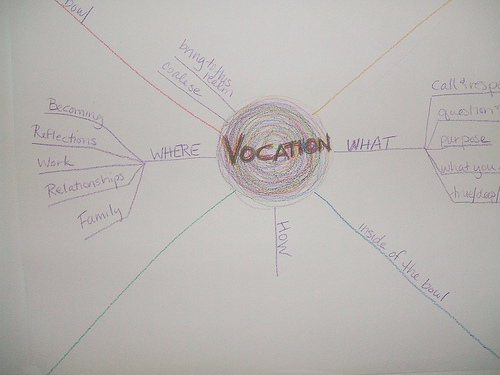
Vocation (photo by Ninth Raven)

Photo by Ninth Raven – CC BY-NC-SA 2.0

The key passage comes at the end of the article:

“But Prof Alan Smithers, director of the Centre for Education and Employment Research at Buckingham University, said the shift in applications may be ‘short-sighted’.

“‘Fees are causing students to think a lot more seriously about the part that going to university is going to play in their future lives and whether they will get a good return for their investment,’ he said.

“‘But it is a little bit short-sighted to simply concentrate on a career above all else at the age of 18. Studying a subject you love, such as the humanities or English literature, will enhance your life and could throw up future employment opportunities that you’re not yet aware of.'”

If fees and the future are making such an impact, how much does subject matter in the long run? Students risk moving away from a subject they enjoy just because it doesn’t visibly link up with a certain career.

Interests and Passions

Research from YouthSight suggests that students still pick subjects based on their interests. However, I wonder how those interests are defined now. What compromise is made when choosing a subject?

The YouthSight data also suggests that business students are far less likely to be studying due to a love for the subject. This is a concern. Why would you choose to study something you weren’t that keen on learning about?

Perhaps it’s expected of you. Perhaps you like the salary prospects. Perhaps your friends are doing it.

These aren’t reasons for choosing a degree or a subsequent career. Same for following a passion. You need to put in work that you’re not so keen on to allow the passion to come to fruition. And passion is overrated anyway. The situation is far more compicated. Don’t take my word for it, check out Cal Newport’s extensive back catalogue of posts on the subject. Here’s a selection to get you started:

Regardless of where you stand on passion, and whether or not you claim to have found yours, now could be the worst time to shy away from a course you want to do.

Fees force a rethink, but that doesn’t always mean you end up seeing things differently. Imagine having to put in some unenjoyable work for a subject you really like. Annoying, but usually manageable. Now imagine doing the unenjoyable work for a subject you were never that keen on in the first place. Double whammy. There’s no motivation to get you motivated.

And the reward in the distant future is still based on that vocational subject you’re already not that keen on. If that’s not being set up for a fall, I don’t know what is.

Do you make the choice or is the choice made for you?

A recent study of humanities graduates at Oxford between 1960 and 1989 found that degree subject was not a barrier to most careers. This study only covers Oxford (one university is hardly indicative of the entire HE sector) and doesn’t take into account almost a quarter of a century of growing student numbers since 1989. Nevertheless, the report provides a hint that what you study doesn’t need to be linked to a direct career path. Choosing History doesn’t penalise you from a wide range of jobs, for instance.

Does a more ‘traditional’ course hold less weight than it used to? Are we stuck with making a choice between a degree that will get you a job and a degree that will get you enthused?

I doubt it. Learning and discovery comes more naturally when you appreciate your course. You have room to find out what makes you tick. Studying won’t feel so forced.

In other words, you gear yourself up for a fall when you’re only on a course for what takes place after you graduate.

Your attitude matters. Although it sounds wrong, the course is more important than the grade. It sounds wrong because we generally focus on what an employer wants to see. In reality, you need to focus more on yourself. Who is this mythical employer in your mind?

Study a subject you respect and enjoy. I know that’s far too simplistic, but so is slogging through a course in the hope that it’ll be worth it for the massive wodge of cash or better prospects at the end. It’s a false trail, because you’re concentrating more on the content than your own ability.

So when I say the course is more important than the grade, it’s based on your choice and focus on developing your abilities. From my perspective, that’s all the more reason to choose a degree that you want to spend three or more years of your life poring over.

In my next post, I’ll look at ways you can focus on your career no matter what you’re studying.