Internet / Online

Why blogging is no popularity contest

Is blogging really on the decline?

More importantly, does a decline in blogging matter?

Blogging Tips examined data from a study by Pew Internet that found very few people blogging themselves and fewer than half of respondents saying they read blogs.

But a blog is just a type of website. Past surveys have discovered that some people who say they’ve never read a blog don’t realise when they are. After all, it’s just surfing the web and finding content that you like.

And I’m fine with that.  Definitions don’t matter.  Neither does the popularity. A blog is a published part of you and an opportunity to shine.

Writing - photo by JohnONolan

Writing – photo by JohnONolan

What if nobody else is doing it?  The main question to ask is: “Am I making or can I make good use of my time and resources by publishing my content online?”

If the answer is ‘yes’, it doesn’t matter how many other people are doing it. You can still make good use of things, so go ahead and be brilliant.

A blog is a way of building up a portfolio. You don’t even need loads of readers and traffic. Once you’ve written something, you have achieved something. There are all sorts of ways you can flag up those achievements.

Before I started writing on TheUniversityBlog, I didn’t have a huge portfolio of writing on higher education matters.  I hadn’t started publishing advice for students.

Fast forward three years and now I have an archive of articles for all to see. I did it in my own time and in my own way. Not only is this portfolio now visible, it also demonstrates my genuine interest in a particular field.

Before I went to university myself, I was interested in higher education. That interest has never gone away. It only grows. Yet before I started this site, got tweeting, and generally took things public, I was never able to show the true extent of what’s important to me.

Anyone can say they are passionate about a subject. Anyone can feign interest in a topic. But not everyone can highlight a growing example of work as a clear indicator that they care and know what they’re talking about.

You’re not just blogging…

You’re writing. You’re communicating. You’re creating.

In the film Julie & Julia, office worker Julie starts a blog and it becomes a hit. In less than a year, the character is getting offers of book deals, TV shows and the like. In response to her surprise success, Julie tells her husband, “I’m going to be a writer!”

Julie’s husband replies, “You ARE a writer!”

And that really is the point. Even if blogging declined until you were the only person doing it, the decline would be irrelevant.

Do stuff because it works for you; not just because it’s popular.

How to study a book before you have it

The wait for a crucial book to become available in the library is frustrating.  Even worse when the library doesn’t have the book at all.

Aside from inter-library loans, buying the book yourself, and other costly or time-heavy options, what other options do you have in the meantime?

photo by Newton Free Library

photo by Newton Free Library

To Do: Dissertation has some great tips on what to do while you wait for that book to become available.

But it got me thinking about others ways to the book that may work in your favour.  Here are a few ideas that might land you more access to a book than you think you have:

  • Check publisher’s website for excerpts and sample chapters – Some publishers are great at making PDF samples available to download.  You may get instant access to the Introduction, first chapter, possibly more.  Even a simple table of contents or index is a helpful head start on your research.
  • Check library online databases for books in electronic format – Don’t just check the library shelves.  An increasing number of books are now available online.  Services such as Cambridge Books Online provide a huge range of books at your fingertips.  Find out if your library has access.  If not, ask if they can get a trial.
  • Use Google Books – It’s not just Google Scholar that can help your research.  With Google Books, you can look through the pages of many books as a preview.  And the previews can be extensive.  Combine that with the ability to search for specific terms within each book and you may not even need to track down the physical copy of the book at all!
  • Use Amazon “Look Inside” – An alternative to Google Books, Amazon have their own preview function for a large number of books.  Again, you can search within the book and get busy with the research straight away.  However, it looks like Amazon may start charging for this feature soon.
  • Play Google and Amazon off with each other – Online previews are limited and don’t display all pages.  Rightly so.  You’re not meant to read entire books with the services.  However, when researching, you may find a specific page is excluded.  If both Google and Amazon have a preview available, that missing page on one resource may be there to view on the other.
  • YouTube talks – Why wait to read what the author wants to say when they may have said a lot of it in a talk or lecture?  By searching for the author (and maybe even book title) in YouTube, you may stumble upon directly relevant content for your research.  It’s another worthwhile reference to add to your bibliography too!
  • Read reviews – All sorts of texts get reviewed, not just bestsellers.  Reviews can give a breakdown of a book’s main ideas, flaws and coverage.  A Google search for book title and author and the word ‘review‘ should bring up newspaper reviews.  You can also check Times Higher Education.  It’s worth checking Google Scholar or journal databases for the title and author too, which should point you toward scholarly reviews and even related papers by the same authors.
  • Search for author details – Personal websites, university web pages, Google Scholar, JSTOR, etc…  All these can give further detail on the individual and their background, as well as other literature they have produced.  You may not have the book, but you may uncover key opinions and similar texts to chew on.

Don’t let the wait for a book stop you from getting on with your reading and research.  In the unlikely event that you find absolutely nothing after these searches, you can still go back to those helpful tips from To Do: Dissertation.

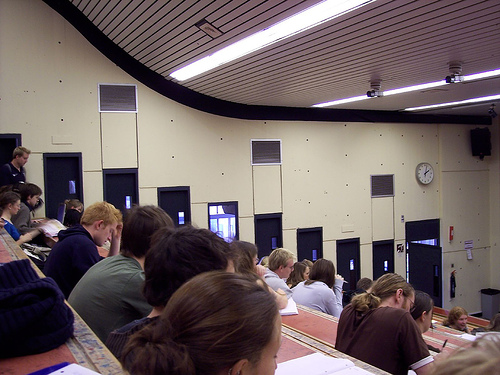
Should lectures be banned?

I’ve just been listening to Donald Clark at the #altc2010 conference in Nottingham.  His keynote speech argued that lectures are rubbish.  Thought I’d share a hastily-written post in the aftermath.

Clark asked why students are still lectured to. He suggested that a complete rethink is necessary, not just the odd tweak.

photo by iwouldstay

Would you like to see the back of these? (photo by iwouldstay)

@GeoShore sums things up amusingly via Twitter:

#altc2010 keynote summary: “Lectures don’t work. Lecturers can’t lecture. Everyone’s been doing it wrong. Arse. Feck. Nuns.”

Despite a couple of questions from the audience asking about alternatives to the lecture, no specific answers were forthcoming.  Clark replied at one point that the answers are “staring us in the face”.

I’ve attended both great lectures and awful ones.  That suggests lectures aren’t automatically a bad thing.

The lecture is just one part of the learning process.  We read, we’re lectured to, we participate in seminars, we have one-to-one tutorials, we form study groups, we have online participation…

Clark said he enjoyed TED talks and appreciated their production values, but he seemed to be looking for more.  TED talks are still, essentially, lectures.

Same with podcasts and videos.  Clark agreed that it’s better to record a lecture than do nothing at all.  However, he argued that this method merely results in a load of poorly delivered lectures streaming out, providing no further value to learners.

Other than end lectures altogether, I’m not entirely sure what is required.  A complete rethink may result in new delivery methods, so will they look like lectures at all?

If new techniques do resemble lectures, why have other delivery styles so far been given a lukewarm reception (if that) by Clark?

If new techniques don’t resemble lectures, the result has been to abandon lectures, not rethink them.

Clark suggested that there needs to be more collaboration and discussion present in this type of learning.  That’s what seminars and tutorials are all about.  This isn’t an either/or situation; different methods of teaching and learning are delivered.  If lectures were the single focus for all information intake, we’d be in trouble.  But they’re not.

Over to you.  Are lectures dead?  Is the lecturer to blame?  What are the alternatives? Are podcasts and video lectures good, or not good enough?  Is the physical process of attending lectures a hardship in itself?

I’d love to hear your views!

Keep a professional Facebook profile and still be yourself

Your Facebook profile is a little piece of you.  You want it to provide an accurate representation of yourself.  Facebook is where you probably feel safe enough to say what you like and act how you want.

How would you feel if professional social networking could get you better job prospects?  What if you might fare better with an open profile?  What would potential employers see when they typed your name into Google?

photo by constantine✖belias™

photo by constantine✖belias™

Internet psychologist, Graham Jones, recently mentioned a University of Wisconsin study that gave social networks like Facebook a positive spin for employment:

“[The report] shows that users of social networks are more likely to get a job and when they do get the job they get higher starting salaries than people who do not engage with online social networks.”

Even better, it’s good enough just to focus on friends and family.  There’s no need to talk business or cover topics you don’t feel belong on your Facebook profile:

“There was a twist in the study; the social networking profiles were written in three ways. One group of profiles were business-like, another were focused on friends and family, while a third group concentrated on the alcoholic exploits of the candidates…! Needless to say, the alcohol-related applicants were rejected – but the other two were treated equally. This squashes the myth that you should separate your social networks into one for friends and another for business. Employers, it seems, are just as happy to take you on if your profile is family related.

A professional profile doesn’t mean ‘business-related’.  It means that you have a positive online presence.

There are tales of ‘friending’ the boss and then making work-related remarks that end up in getting fired.  But you can still be yourself without resorting to status updates about hating work or throwing a sickie.  Do those comments truly represent you, or are you making hastily written, throwaway comments?

Unless your life is not complete without hate-filled comments about work, it’s time to get the rest of your profile in shape.  You don’t need to sacrifice the person you are.  At least, you won’t sacrifice the positive stuff that you want everyone to see anyway. 😉

Take steps like these to make sure your Facebook profile is professionally personal:

  • Filter the photos – First, filter your own snaps.  Don’t just upload everything you take.  If you want people to respect you, then you need to respect them too.
    Second, filter other user photos by deleting your name tag against any photos you don’t want to be associated with.  Even if someone else takes a photo of you and they publish it with your name tagged to it, you can delete that tag.  Of course, you can ask beg for them to take the photo down too.  Either way, you aren’t required to have your Facebook name associated with it.
  • Filter your friends – Do you know everyone you’re following?  Do you want all your old schoolmates listed as friends, or were you just thinking about the numbers?  Be selective, or at least choose what each friend gets to see on your profile. Like this…
  • Put your friends into lists – Click the ‘Friends’ tab on Facebook.  At the top of that page there is an option to “+ Create a List”.  Make different lists of friends based on who they are and what type of information you want to send their way (or not).
  • Mind your language – There’s a difference between dropping an occasional f-bomb and using it every other word.
  • Think before you update – Are you saying something in the heat of the moment?  Slow down and make sure you feel it’s necessary to post an update.
  • Log out or lock your computer when you go away. And don’t leave your phone alone! – Mates will be mates.  If you leave an open Facebook profile unattended, you may find a nasty surprise when you get back.  In my update streams, it’s always the same people who don’t protect themselves.  Again and again. As if they want it to happen.
  • Don’t be controversial – Status updates to stir up trouble are a no-no.  Joining groups or liking things that are not publicly acceptable is asking for trouble, even if not amongst your closer friends.  Same for doing anything as a joke.  People won’t understand unless they’re in on the joke.
  • Lock down updates – If you must update your friends on something controversial, use the padlock under the text box to customise who sees it.  You can specify who you don’t want seeing the less savoury updates…although it’s still not the safest option.
  • Keep private and/or personal details exactly that! – Send messages when you’re talking to a select few people and sharing non-public details.  It’s the easiest way for the sake of you and your friends.

These are just a few ideas.  How do you keep your profile looking respectable while staying true to yourself?