essays

Practice or Flawless?

I like Pat Thomson’s comments on academic writing. It’s rare to think of writing as a process you practice and fine-tune before getting the best results.

Instead, you sit down and your internal editor rushes you to be instantly perfect. Sometimes a flash of brilliance comes about straight away, but not often.

Thomson says, “We all assume that we ought to be able to just do whatever writing task comes before us”. However, she continues, “we would never assume this of music for instance”.

Anyone can play guitar... Perfectly? Straight away? (photo by ginnerobot)

Anyone can play guitar… Perfectly? Straight away? (photo by ginnerobot)

Writing a song may start with a few random chords or a stab at some lyrics. As you go along, you get more adventurous, add better chords, change words, and pick away until you’re satisfied. On the odd occasion, a song-writer may strike up a riff out of nowhere and get a song finished in minutes. And, like with writing, that’s rare.

With music, we’re aware that you need to practice. It’s important to practice how to play an instrument and it’s important to practice as you compose new material.

Yet with writing, perfect feels possible. No, wait, perfect feels NECESSARY.

Why?

I talked about 750words a while back. 750words is one way to let a stream of writing happen without getting bogged down with the finer detail. Just get on with writing and edit later.

Writing and editing are two different things.

Writing should be practice, all the time.

Okay, it’s more difficult in an exam. But even exams are best handled with plans. Before you write your answer, it’s handy to make a few notes for preparation and getting an order.

Outside the exam setting, the writing is the practice. The editing is the crafting. The re-writing is a combination of practice and crafting.

Telling you to ‘just do it’ is useful and misleading in equal doses. Useful because you’re getting words out and the practice has started. Misleading because writing isn’t just about random words on a page.

As you practice (i.e. as you write), you should still attempt to be clear. If you don’t know what you’re talking about, you’ll only confuse yourself later.

James Hayton of 3 Month Thesis says “you aren’t doing it wrong if you’re producing work you’re happy with! You are doing it wrong if you end up with a scrambled mess of half-baked chapters to sort out later”.

The take home point is this: Just getting the words on the page is not enough. It needs to be part of your bigger picture plan. Writing is practice, and so is editing. Everything is practice until you’ve finished.

Remember, ‘finished’ doesn’t mean ‘perfect’. Simply writing words doesn’t help you improve. Making use of those words and achieving clarity as you move along does.

Just write, so long as you understand why you’re writing and what you’re trying to achieve. Your inner editor will wince and scream at you, while you tell it to calm down as you’ll deal with that at a more convenient moment. That moment isn’t in a month or two, when you’ve forgotten what you were doing. However, that moment is at a different point to the writing.

Hayton calls advice to ‘just get words on the page’ as “the worst thesis writing advice ever“. That might sound harsh, but he’s right. Without context, the advice stinks. Give it context and know *why* you’re writing like that.

NOTE: I wrote this post without editing. I wanted to get the words on the page.

But…I had an idea of what I wanted to write. There was context. It may not be an academic text, but the same should apply for many types of writing. So long as there’s context!

For this post, the idea originated from reading Pat Thomson’s piece that I mentioned at the start. I considered what I wanted to talk about for a minute or two. In the process, I remembered my 750words post and looked for James Hayton’s piece on writing advice, because I thought it would fit. Thankfully, it did.

Armed with this, I started writing. It didn’t matter what words came out, because I had a purpose and I’d found enough context. The only editing was on the fly, when there was an obvious change in my head, moments after I’d typed the initial words.

I’m sure this post could be re-written and better crafted. But it took very little time and it still makes sense. That’s what I wanted to get across.

I don’t always write in this way, but it’s another way to practice. There is no single way to write and there is no perfect sentence. With that in mind, you should cut yourself some slack and enjoy the writing process. A new sense of calm may well help your writing improve. Win-win!


Why you need to use references and citations

You’re told to give references in coursework, but do you know why they are so important?

A friend asked me if references were mainly for respect and ego purposes. They wondered if the point of citing the work of others was a bit like tipping your hat to them, or saying “Well done, kudos for the great academic work you published”.

Academic work has references for very different reasons, even though I’m sure many people would love to see their work being used elsewhere.

photo by Nick Sherman

photo by Nick Sherman

The real reasons for referencing/citation include:

  • Showing how widely you’ve read around the subject;
  • Demonstrating your understanding of the context and research up to this point;
  • Highlighting points of view that differ to yours;
  • Backing up your own points of view.

Another great explanation of why we reference is offered by Monash University:

“Referencing helps create a map of knowledge, a web of pathways in knowledge; and each researcher helps extend that knowledge. It means that we don’t have to find out everything for ourselves all over again; we don’t have to reinvent the wheel. In effect, referencing multiplies knowledge exponentially.
“But scholarship depends not only on the sharing of knowledge but also on the questioning of knowledge. It relies on both the acknowledgement and critique of the work of other scholars.”

My friend was concerned that all these references felt like collusion. They asked, “If you reference too much, where is your own work?”

Using the work of others in coursework is not collusion. Think of it more as collaboration. You recognise what has gone before and give that work credit as you extend upon it or put it in a different context.

photo by Horia Varlan

photo by Horia Varlan

None of this has anything to do with plagiarism. Plagiarism is completely different. You plagiarise when you copy something word for word. You plagiarise when you take other people’s work and reword it as your own. You plagiarise when you don’t give the credit for an idea that doesn’t originate from you.

If I’d reworded the Monash explanation as my own in an academic essay, that would be plagiarism. If, instead, I talked about referencing creating a map of knowledge and gave a footnote to the Monash piece, that would be fine.

There’s no need to reference when the facts or theories are fairly common knowledge. The dates of major historical events, for instance, can be used as a given…Unless they are widely disputed or you are trying to dispute the dates yourself!

Instead of worrying that too many citations make it look as if you’ve done nothing yourself, be confident that a number of well-placed references will give more relevance to your work.

References are your friend. I didn’t realise this enough myself when it mattered and it sounds like there are other students out there in a similar position.

Remember the need to cite this way: You’re adding sources to support your own content, not someone else’s ego.

How You Can Do What You Keep Putting Off

Ah, distractions!

Distractions are a lovely way to do anything other than what you should be doing.

Distractions are plentiful and a recipe for forgetting. You have an ever-expanding list of things that are hard to resist. Then you have Facebook and Twitter (and the rest!) all bringing a steady stream (or a heavy flow, perhaps even a tsunami) of tidbits that can take you to every destination imaginable, and from every direction you care to come from.

Why is it so difficult to get rid of distraction and stop procrastinating?

  • Fear of missing out;
  • Everyone else doing it;
  • No natural end;
  • It feeds your pleasure centres in the brain;
  • It can *feel* useful, even when that’s an excuse.

Sid Savara’s procrastination survey shows that, overwhelmingly, people just don’t feel like doing the things they’re meant to be doing. They put it off because they *want* to put it off.

What can you do to stop this spiral from going further and further out of control?

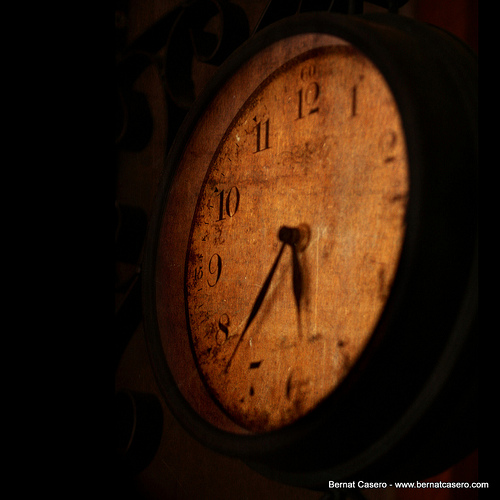
photo by Bernat Casero

Tick, tock, putting it off… (photo by Bernat Casero)

Set an incredibly short amount of time

Ten or fifteen minutes should do it. Push yourself for just that amount of time and see how you feel. You may be happy to continue after that set time.

Switch off notifications

A beep or a screen notification will stop you from what you’re doing, whether you like it or not. No matter how much you tell yourself to ignore it, you’ve already been alerted to it. The temptation is there, itching away at you at exactly the wrong time. Switch those messages off!

Mindmap

Starting is easier when you have a better overview of what you want to achieve. A mindmap will let you consider ideas and links with ease. It may be what you need to conquer your procrastination. I recently gave mindmapping software, Mindmaple Lite a whirl. It’s free and it’s easy to use, so you can concentrate more on the mindmap than the software.

Outline

If mindmapping isn’t your thing, how about a brief outline of what you want to achieve? Build up your sections and sub-sections to break down your research and writing into smaller tasks. I recently discovered Quicklyst as an online way to create outlines.

Act like it’s a blog post

The pressure of writing an academic essay can lead to procrastination. So treat the writing more casually. A recent post on Lifehack explained that 1,000 words doesn’t have to take a lot of time when you work in the right order.

Try writing a snappy title or headline if the essay question is getting in the way (making sure that you’re still trying to answer the same question!). Then, see if you can rattle off a quick introduction and conclusion to help your own mindset (you may wish to rewrite later, so this is just for you right now). Then make a quick outline of the major points you want to cover throughout the essay. After this, fill in the gaps. Do this with a timer if you prefer, so you challenge yourself to get the bulk written quickly, rather than worrying over every last word and detail. Edit and re-draft later.

Go somewhere different

Location makes a huge difference to your productivity, your attitude, and your outlook. Find places you’ve not been to before and explore where it takes your mind, not just your body.

Watch an inspiring talk or presentation

Find a TED talk and watch it. You’ll be procrastinating (win), and you’ll feed yourself some brain-food that’ll get you more psyched up for work (win).

Well, so long as you don’t just keep watching more TED talks…

Understand what’s stopping you

Okay, so you want to put this off. But why? What is the real reason for your procrastination? Be honest. Are you not interested in the topic itself? Do you have difficulty understanding the subject (time to fire up Wikipedia for the basics)? Have you got loads of friends tempting you away for fun?

If you don’t work out why you’re putting the work off, you’ll keep on putting it off!

Stop expecting perfect

Perfectionism is a recipe for procrastination. When you picture the most amazing coursework to have ever graced this earth, everything you do will be a disappointment. After a while, you’ll feel inadequate and start putting off the work instead of cracking on.

Nothing is perfect. And your first drafts are certainly not meant to be anything other than, well, first drafts. Successful writers almost never finish on their first attempt. They redraft, they edit, they get opinions from others. If established writers need to do this, you can stop beating yourself up over flaws. Even a First Class essay has flaws!

 Believe that you can keep learning

As a child, I was told that I was ‘good at maths’. Children tend to believe what they are told. So I went through school believing I had a good grasp of maths. That was fine for a while, but when new concepts arrived that I didn’t understand, I started to think I wasn’t good at maths any more. I guessed I wasn’t as smart as some people had made out.

The concept of ‘smart’ and ‘clever’ is flawed. Turn the perspective around. We all have to learn. Nobody is born with great wisdom and knowledge. What matters is a willingness to keep learning new things and stop worrying that you’re not ‘smart’ enough.

Don’t discount the future

According to one paper about procrastination:

“…the value of socializing in the present is weighed heavily while the value of getting good grades in the future is discounted. This quirk leads to delays in studying for tests, writing term papers and getting prepared for weekly assignments. As can be expected, students who procrastinate generally discounted future values greater than students who don’t procrastinate.”

The future seems a long way away. No wonder it feels easy to put tomorrow to one side. But the future soon becomes the present and it’ll bite you on the bum if you don’t deal with it in good time.

Forgive yourself

We all fall down from time to time. The occasional lapse is allowed. It’s not uncommon to put something off for ten minutes and then find you’ve put it off for ten days.

So long as this doesn’t happen all the time, you can let yourself off the hook. You’ll probably procrastinate less on the next task if you forgive yourself.

Procrastination can happen when you suffer a delay beyond your control, like when you’re waiting on a crucial library book to be available. Even then, you can find ways to move beyond the initial setback. Sometimes you do just have to wait. That gives you time to spend on other stuff anyway! 😉

How will you keep the procrastination beast at bay today?

On Writing

Today I welcome Rod Pitcher to TheUniversityBlog. Rod has written a piece on the writing process.

Rod is a PhD student in Education at The Centre for Educational Development and Academic Methods at the Australian National University, Canberra, Australia. The focus of his study is the metaphors that doctoral students use when describing their research and other matters related to their studies. He uses metaphor analysis to arrive at an understanding the students’ conceptions.
Rod Pitcher’s profile is at http://cedam.anu.edu.au/people/rod-pitcher and you can contact Rod at Rod.Pitcher@anu.edu.au

photo by chic.geek

photo by chic.geek

On Writing

Writing is not a simple process. It depends on a number of factors, three important ones of which are knowledge, incentive and the ability to write. I have never had any problems with the last one. I enjoy writing and do it well according to my supervisors. The others are not so easy.

Knowledge
It seems a truism to say that good writing depends on knowledge, but it is true, none the less. If you don’t know what you are going to write about it will be difficult if not impossible to produce anything sensible. You need knowledge to frame the paper, give an account of what it is intended to illustrate and to provide information to the potential reader. A knowledge of others’ work on your topic is necessary to provide the references that put your work into its context.

If you don’t know what you are writing about, how can you expect to make sense? Whether the paper is factual, biographical or speculative you need to know the background to it. You must be familiar with the topic, the background and anything previously written on the topic so that you can place your work in the context of other’s work on similar topics.

Incentive
Having gained the knowledge about your topic you must then have an incentive to write. Common incentives include finishing your thesis to gain your PhD, writing a journal paper to improve your publication list, or writing an application for a job that you would like after completing your doctorate. Note that the reward for doing the writing should be important to you, personally. The personal incentives are by far the best. Working to someone else’s incentive is a recipe for disaster.

It is sometimes difficult to find an incentive to write, but it is important that you do so. The more important the incentive is to you the more incentive you have to write. Writing without a good incentive can be soul-destroying as you try to imbue some interest you do not have into the work.

Ability
Lastly, you need the ability to write. If you have that ability without being taught then you are lucky. If not, you can be taught to at least produce good quality prose. Your university probably runs courses on it. Take all the courses you can. They can’t do you any harm and you might find the spark that brings out the creative writer in you. Join a writers’ group to get feedback on your work – and LISTEN to the comments, don’t just let them pass you by. Take advantage of other writers’ experience. Finally, practice writing. The more you write the better you will get.

Writing is not easy for most of us. We need help to produce our best. Even the best writers can use constructive feedback and comments about their writing. Use all the resources available to you to develop your writing skills. You will gain from it in your writing – and so will your audience.