EduLinks

EduLinks: Creativity, Politics, Nutrition, Happiness & Warmth

As promised, it’s EduLinks time.  Tuck in!

EduLinkz

From NUS Westminster Update:

“53% of all English domiciled full-time undergraduate students undertook paid work at some time during the academic year-either during term-time, during the short vacations or both. For those undertaking such work, earnings over the academic year were on average £4 005 (after tax).”

World Affairs – The Universality of English

Around 6,000 languages are in use around the world today.  It has been suggested that only 600 languages will remain in use in a hundred years’ time.  The author asks whether that matters.

Procrastination [YouTube Video]

Found this video via Academic Productivity.  Hurrah!  Another way of using up more time working out how to stop procrastinating.  😉

MakeUseOf – How To Easily Make An Attractive Cover Page In MS Word 2007

Sometimes you need to provide a front page for a piece of work.  If you have some creative freedom over the front page, but don’t want to go beyond Word, this tutorial has got it…covered!  Get it?  Covered?  …I’ll get my coat.

From The Battlefield of Ideas (New Statesman)

“Politicians, perhaps anachronistically, still look to the universities for ideas. The universities brood on why it is that they are so unloved. Government and the universities are like a warring couple locked together in a loveless marriage. The answer lies in divorce. The more the universities are left alone, the more creative they will become, the better able to resume the role they once had as powerhouses of ideas. Paradoxically, if the universities wish to become more influential in government, they must first become more independent of it.”

Wise Bread – Bioavailability: How to Get More Nutrients From Your Food

You want the most out of your food, don’t you?  Taste may play a huge part in our enjoyment, but nutrition is something you probably think about.  Even if you don’t act on it much, you’ll know it’s best to eat healthily.  Don’t miss a trick; you could eek out more precious nutrients just by drinking orange juice or grinding black pepper on your food.  Wise Bread explains all.

From NUS calls for student loans chief to resign (Guardian)

“You’ve got the appalling situation which has left hundreds of thousands affected by this crisis, tens of thousands without their support, a miserable start to term and on top of that one of the most shameful spin operations from a public body I have ever seen. They have failed to communicate with the public, made broken promise after broken promise. In that context how anyone can expect us to have confidence is beyond me. It’s time for Ralph Seymour-Jackson to do honourable thing and resign – or for ministers to step in and sack him.”

RealSimple – 9 Things You Can Do to Be Happy in the Next 30 Minutes

Simple ideas, designed to give you a boost when you need it.  That is all.

BBC – Road map for universities awaited

The government has been pretty quiet on their plans for Higher Education and fees.  Mike Baker investigates what’s taking them so long.

BPS Research Digest – A warm room makes people feel socially closer

Studies have suggested that when people are warm, they bond more easily.  They actually do get a ‘warm’ feeling.  So next time you want to get cosy with friends, turn up the heat.  You never know, it may be worth remembering when you have a presentation and want the lecturer on your side…

Harvard Business – Forwarding Is the New Networking

Just don’t forward *too* much.  And don’t worry so much about sending over the funnies.

PickTheBrain – 10 Very Common Stupid Tricks That Wreck A Good Life

In a similar vein to my recent post on mistakes to beat before they beat you, here are more issues to nip in the bud.  They may well be ‘common traps’, but that’s no reason to let them cause you grief.

The name’s Links…EduLinks.

You know what?  I made a mistake.

Cat

With all these posts on the subject of ‘Time’, I decided to look at how I use my blogging time to help you, my readers, best.

One big deal arose.  So I’m putting my hands up to the mistake, ready to bring things back to order.

Long-term readers of TheUniversityBlog will remember that I used to post regular EduLinks to the site.  Then I posted EduLinks less regularly.  Then I stopped entirely, in favour of a separate TumbleLog site.  Putting choice links and quotes there, I felt, would be a good thing.

Well it wasn’t. It hasn’t really worked on any level, so I believe that everyone benefits if I put EduLinks back where they belong…right here!  My apologies for messing you about.

I have learned a good thing from using the TumbleLog.  As well as occasional bumper posts of links here, I intend to post up single link posts and quotes of note.  It should be the best way to provide the right amount of goodness here on TheUniversityBlog, and bring everything together in a (hopefully) satisfying mix of woo!

If you’re a recent follower to the site, I hope your experience is about to get that little bit better.  If you’ve been following the highs and lows on here for a while now, I hope you’ll be happy to welcome back an old friend in the EduLinks.  Thank you for your support!

Should recycling be part of your everyday routine?

A quick question for you:

Do you recycle?

photo by spratmackrel

photo by spratmackrel

While checking my Twitter feed, I noticed the following update from Sheffield student @Joe_Oliver:

“Going on a recee to find some recycling bins – before my housemates simply throw my heap of carefully collated recycling away…”

This reminded me of a conversation with a friend earlier this year about recycling when fewer people were doing it on a regular basis.  She said she’d been recycling as much as she could from an early age.  It just came naturally.  But many of her other friends thought it was time consuming and pointless.

This further reminded me of one of my uni house shares.  The council do a recycling collection (as you’d expect), so I put out boxes for paper/card, plastics and metals in the kitchen and asked everyone to use them.  It was a little bit of extra work, but surely something worth doing.

However, not everyone wanted to take part.  I’d see stuff like uncrushed cardboard cereal boxes and plastic milk packaging in the refuse bin.  They pretty much filled up the bin on their own!  Since it was easy enough to do, I’d take the stuff out the bin and put it with the recycling. [I tried not to moan…it’s their choice, after all!]

Then there were bottles.  As ‘typical’ students, we tend to dabble in alcohol on occasion.  With large quantities of empties from the delicious wine, beer, and the like, that’s a lot of glass to be recycled.  Just a short walk away on uni grounds (60, maybe 90 seconds walking distance), there was a bottle bank.  But that short walk was enough to mean bottles were often put in the bin, rather than the bank.

photo by James Cridland

photo by James Cridland

Universities are keen to promote as many environmentally friendly credentials as possible, helping wherever they can to make saving our planet as easy as possible.  Among student-facing measures, many universities have introduced initiatives such as recycling facilities in communal areas on campus and in accommodation, making the process even easier to deal with.  But a uni can’t succeed unless students do their bit too.

Part of the problem is that universities probably have more incentive to ‘go green’ than individual students.  In Monday’s Guardian, there was a piece about the forthcoming book, Superfreakanomics by Steven Levitt and Stephen Dubner (Amazon link).  The article states:

The problem with trying to reduce carbon emissions, [the authors] argue, is that the incentives are all wrong. Too many of the benefits are “externalities”, from which the people making the sacrifices will never benefit – and the whole history of economics demonstrates that such completely unself-interested behaviour is impossible to implement on a large scale, especially when so many people suspect that their sacrifice would not, in fact, make a significant difference to the outcome. “Behaviour change is hopeless,” Levitt says. “It’s just completely pointless to think that you’re going to get six billion people, the poorest people around and the richest people around, to work together, when every individual person has no impact on the problem. That’s a fundamental issue that economists have thought about, and recognised the hopelessness of, for hundreds of years . . . One thing we know is that I’m not going to sacrifice, materially, my own life, to help an anonymous person in Bangladesh who might not even have been born yet, when I know that there will be no help for that person anyway.” Calling on people to reduce their carbon emissions, the authors write, “is a noble invitation. But as incentives go, it’s not a very strong one.”

If this is the case, it’s a real shame.  Though there is hope.  A report in The Economist about the International Energy Agency’s “World Energy Outlook 2009” concluded:

“Green-minded folk have been reminding this correspondent to switch the lights off when leaving a room for years, but it has taken a detailed report on the matter from an international organisation to persuade him of the case.”

At least they were persuaded!

Whatever the case is, I did think recycling was becoming an everyday thing for most of us now.  However, it seems there are still a number of students who haven’t made it part of their lifestyle.  It doesn’t take much to think before chucking everything in a bin.  I hope lack of incentive doesn’t cause all requests to be fruitless.

I mentioned the 10:10 campaign when it launched.  The campaign asks us to reduce our carbon emissions by 10% by 2010.  It’s a big deal, but with an achievable target.  Recycling is one way you can aim toward that 10% target.  For more ways to reduce your emissions, read this 10-point checklist.

There’s a saying that I expect most of you have heard:

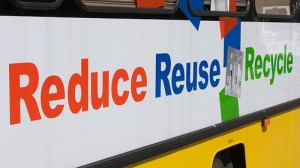
“Reduce, Reuse, Recycle”

photo by Nick Bramhall

photo by Nick Bramhall

The words are in order of importance.  Therefore, if you don’t reduce, then reuse.  If you don’t reuse, then recycle.  If you don’t recycle… 😦

None of us are perfect, but when it comes to simple changes, surely it’s worth the few seconds of hassle to help for the longer term.  Isn’t it?

What’s your experience?  Are you a keen recycler (or not)?  Have you signed up to 10:10?  How do you help protect the environment?

photo by Polska Zielona Siec

photo by Polska Zielona Siec