EduLinks – More debt, fewer exams, just as much fun

Happy Friday. A few more links for you.

Psychology Today – Coffee Vs. Energy Drinks: Caffeine Wars

How much do you know about the caffeine you consume? And what can you do to fix the caffeine fix?

Speak Schmeak – Yes, you are being judged

When you speak and when you’re presenting yourself, it’s common to worry about what people think.  But your audience is not looking for you to slip up.  They are paying attention, but not how you think:

“The audience is trying to determine what their relationship is with you. Can they trust you? Will you listen to them and understand where they’re coming from? Is this relationship worth their time and money?

“Your job on stage is to connect, relate, and deliver. You don’t have to be like your audience to do so, but you do have to be compatible with what your audience expects from a speaker in the general sense, and with what the audience is looking for specific to your topic.”

I think the same can be said when you meet new people.  You may not be up on stage, but people are trying to fit you in to their lives.

From James Dunn – Why a university degree is still worth its weight in debt

“My degree in archaeology from Durham University seems unimpressive on paper, three years with a mountain of debt snowballing out of control and a degree that was not conducive to employment in journalism, a market that is furiously competitive out of recession let alone in it. This, however, is a gross misinterpretation as the common saying ‘Don’t let your degree get in the way of your education’ rings very true in my case.”

Harvard Magazine – Are final exams on the way out?

A lengthy exam at the end of a module?  That may well be falling out of fashion.

Learning by doing, not by listening

A great little piece well worth spending 3 minutes on.  You’ll be respected not for the answers you give, but for the questions you ask…

JP Rangaswami’s life was turned around when a teacher told him that he would be respected not for the answers he gave, but for the questions he asked.  Rangaswami suggests, “An intelligent answer you can give half-asleep. An intelligent question requires at least one eye open”.  He also says that “Words like ‘success’ and ‘failure’ are wasting time”.

More info at JP Rangaswami’s site, Confused of Calcutta [link thanks to @nlafferty]

To Do: Dissertation

Just found this site.  The tagline is: “Motivation and Encouragement for Dissertation Writers Across Disciplines”

In other words, get reading this site when you start working on your dissertation.  You’ll be happier for it!

Awesome Highlighter

Enjoy highlighting in your books and course guides?  Now you can use a highlighter on web pages, make notes, send your annotated pages to classmates, and all sorts.  There’s even a helpful bookmarklet for instant access and a Firefox addon for even more functionality. Hat tip to @jennifermjones for this EduLink.

What is learning?

It doesn’t matter HOW you learn if you ARE learning.

Perhaps an over-simplified point.  Nevertheless, how you learn has to come first.  What you learn comes next.  Without the ‘how’ you can’t have the ‘what’.

photo by Jeezny

photo by Jeezny

But where does ‘how’ end and ‘what’ begin?  Does a person know when they are learning?  At what point do you know you’re learning the right thing?  Does a top grade prove you’ve mastered:

  • The ‘how’;
  • the ‘what’;
  • both;
  • neither;
  • or something else entirely?

Take the person next to you in a seminar.  They may be on the same degree, studying the same modules, but you will both learn different things and you will learn in different ways.

For all the similarities between yourself and a person next to you, your focus is unique, so you must be responsible for what you learn.  You can learn to play the trumpet, but it won’t be worth a thing if you were meant to be researching computational physics.  A stupid example, but it shows that a link must be achieved before you can learn with a particular end goal in mind.

If that’s the case, what exactly is the ‘what’ of learning?  You can learn anything, but the true relevance is in tackling what is appropriate to your situation.

In this regard, you can only take an ‘educated guess’.  That guess may be quite obvious to you and it may be the same guess the vast majority of people make.  However, this doesn’t make it any more objective.  Your job in learning is to develop, to understand, to question, and to explore.

That’s a pretty open remit.

But you’re not alone.  Guidance and motivation are provided along the way.  Tutors help shape your experience and give you a platform to start from.

At this point, learning itself is more important than the tutor or the student.  Tutors cannot be expected to dish out answers and clear the way until a single, specific path is left open.  Many paths are available, none of which are simply ‘right’ or ‘wrong’.

Learning is subjective.  And that’s okay, because higher learning wouldn’t exist without subjectivity, no matter what the topic.  Break things down to their core concepts and it’s still difficult to give a definitive answer to a question such as, “What is learning?”

Such uncertainty sounds negative at first.  But it’s not.  It’s exciting.  The possibilities are endless.  And the power is yours.

You need to do one thing.  It’s the most simple and most difficult thing about study within higher education.  You must take responsibility for your learning.  ‘How’ you learn and ‘what’ you learn will somehow fit in naturally after that.  But you need to want it.

Keep going down the road long enough and you may even find that valid link between trumpet playing and computational physics.

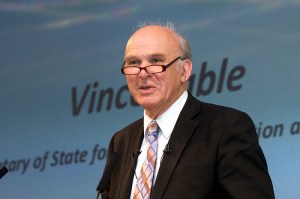
Vince Cable & the future of higher education

Business Secretary, Vince Cable, made a speech this morning about the future of higher education.  He has discussed a graduate tax, 2-year degrees, and various measures that can cut costs, but retain high standards.

Wordle: Vince Cable Universities Speech - 15 July 2010
Click here to see a Wordle of Cable’s speech

Would sweeping changes like 2-year degrees make a big difference?  Maybe.  Can ‘higher education’ as a wide collective term be expected to embrace such ideas without problem?  No.

While some universities are bound to jump at the chance of a two-year degree structure, others will be vehemently against it.  The difference of opinions will be down to this:

“We don’t know what higher education is for any more.” [source]

This comes from the previous President of Dublin City University, Ferdinand von Prondzynski. He makes a sensible point.

Put another way, higher education has been given too much to do.  Too much dilution results in not enough focus.  Two-year degrees can’t be made to work across the board.  Cable said we need to “re-think the case of universities from the beginning”.  The re-think on higher education needs to cover HE as a concept and as an entire sector.

While I am happy to see discussion and new thinking about 2-year degrees, it isn’t simple to wave a magic wand and change the landscape of higher education.  Academics with large research responsibilities are already stretched for time, so where would the extra teaching time come from?  Additionally, 3-year degrees cannot just disappear so the option would need to remain.  It would be entirely unreasonable to see a drop in teaching quality and standards as a result of new degree models.

photo by bisgovuk

Vince Cable (photo by bisgovuk)

Vince Cable hasn’t actually made any policy proposals this morning, but he is pointing toward a future that he would like to see.  He is urging the Browne Review to consider a graduate tax as a feasible alternative to the current fees system.  Cable said his suggestions may sound radical, but are not.  He asks that we continue the debate and make some truly radical moves to help the future of HE.

Radical proposals are fine so long as they have a solid foundation.  A change for the sake of change is no guarantee of a better way.

Is now the time to see universities coming together in collaboration, rather than fighting for scraps in a panic that they might lose what is dear to them?  I would love to see better engagement and participation between institutions.  At the same time, I would like to see those institutions in a position where they can showcase their unique traits with ease.

One way for universities to develop their unique identity is through a powerful mission statement.  Right now, current mission statements could come from any university, as Times Higher Education discussed earlier this year.

With this in mind, I believe the following ideas are also worth pursuing:

  • Give universities more freedom in creating their specific mission, vision and values;
  • Allow universities to develop their specialisms more easily, so long as they are unique, have valid reasoning, stick within their mission aims, and give teaching at least as much priority as research;
  • Promote greater collaborative engagement between institutions;
  • Ensure institutions do not pick only the most profitable degrees and methods of assessment;
  • Acknowledge the wide remit HE has rather than pretend all institutions are the same and/or ignore their major (sometimes uniquely defining) differences.

These ideas would identify what would suit each institution, while also giving students better information on deciding where to study, what will benefit them, and why an institution can deliver that for them.

Many ideas are being touted, leaked and proposed regarding the future of higher education.  From new ways of funding through to different degree models, we may see certain fundamental ‘rules’ rewritten.  I am ready to treat this time with enthusiasm, although it doesn’t stop my fear that some decisions could be rushed.  Indeed, some choices may be made that are based solely on cost and saving money.  These are difficult times as much as they are interesting times.  Everyone needs to tread carefully here.  Not just students, not just staff, not any single group.  HE covers so much ground that most people are (or will be) involved in one way or another.

HE stands for so much that we need a different way of classifying what each institution, or department, or member of staff, or student, is working toward.  More from von Prondzynski:

“It is time for something better. It is time to understand what part of higher education is vocational, and what part is educational in a broader sense. It is time to have a plan about how graduates will develop their careers on leaving education. It is time to state more clearly what we see as the benefits of higher degrees, particularly doctorates. And it is time to engage and motivate those working in higher education so that they can apply energy and skill to their tasks and so that they can lose the instinct to feel nostalgic about whatever went before.”

I am writing this post fresh from hearing Vince Cable’s speech and getting feedback from commentators, blogs, news posts, and my Twitter feed.  There is a lot of excitement, a lot of confusion, a lot of ideas, a lot of backlash…a lot of everything, quite frankly.

Times Higher Education started a #loveHE campaign recently.  The very reason why a mere speech stirs up so many emotions shows just how many people do love higher education.  The conversation — and the love — is starting to move out toward the wider public.  Whether you love or hate what Vince Cable has said and no matter how you will eventually feel about the outcomes of such wide debate, it’s crucial that we keep that love of higher education going.

Are we in this together?

Further links:

Past, Present, Future: Does Change Bring Change?

How ready and engaged are students when they enter higher education? A Professor had this to say about students going to university:

“Speaking generally, during the last thirty years the schools of England have been sending up to the universities a disheartened crowd of young folk, inoculated against any outbreak of intellectual zeal.”

Do you think there’s some truth in this?

What if I told you the Professor, A. N. Whitehead, made this suggestion in the year 1932?

It’s easy to look to the past and believe much of the situation in higher education was different then.  Of course, it WAS different.  But as you imagine a time when going to university was nothing like as widespread and accessible as it is now, it’s hard to picture a lack of ‘intellectual zeal’ among such a small selective grouping.

Perhaps it was just the wrong selective grouping.

Whatever the case, I found the above quote in a book from 1962. Nearly 50 years ago. A different era…or so you would think.

photo by Squirmelia

photo by Squirmelia

The book, ‘Educating the Intelligent’ by Michael Hutchinson and Christopher Young, has a great chapter on university education.  I came across much detail that holds relevance with the current situation for HE.

Take this example:

“It is now clear that we need a massive expansion in the numbers receiving university education in this country, coupled with a re-thinking of the content of university education itself.”

Expansion and widening participation have been a big part of HE over the years.  Now, through decisions being made by the coalition government, we face further change to the content and layout of university education.  How it will play out, nobody really knows.  But it’s clear that 50 years after ‘Educating the Intelligent’ was published, we are still re-thinking the format.  This re-thinking is necessary as the world and our needs change.  But it’s just as much a hindrance as it is a help.

Other issues under discussion suggest we still haven’t found answers to certain problems.  One such problem is that of making students ready for the workplace once they graduate.  Should this be a core purpose or requirement of university education?  Should it at least be on offer to those who want it?  Another excerpt:

“The job which a child will start on today may have ceased to exist when he retires from work in the next century.  The processes and machines with which he will be working at the time of his retirement may not yet have been put on the drawing-board…His training, and in particular his mental attitude to his work, will therefore need to be entirely different from the attitudes which still largely prevail today and which are based upon a previous industrial age when a man, trained in one mechanical skill, would spend a lifetime practising that one skill.  ‘Clearly,’ as the Crowther Report says, ‘the first quality that is needed to cope with such a world is adaptability.'”

Many business leaders and graduates themselves still question abilities to cope with adapting.  Times Higher Education recently reported on a wave of new degrees being created for business and enterprise.  The idea is that universities help students achieve deeper critical and analytical understanding to complement specific skills.  Professor Chris Kemp of Bucks New University explains:

“Most people who come from industry already have the practical skills but what they need is the theoretical skills. This is about education. This isn’t training, it’s an academic underpinning to the experiential learning they already have.”

So, we’re still re-thinking university education and we’re still working out adaptability and the link between education and the workplace.  What else?  Okay, one last thing.

Here’s what ‘Educating the Intelligent’ has to say about getting a place to study at a university without vast quantities of stress and complication:

“The concept of the sixth form will be ruined if the present anxiety about getting a place at the university is not allayed.  If these boys and girls are to arrive at the university full of imaginative intellectual energy, sixth-form education must not take place in an atmosphere of worry and fear about the future.

“The only way to prevent such anxiety is to establish a fair standard of academic achievement and make it quite plain that on reaching this standard a sixth-former will have qualified for a university place.  This is the maximum amount of worry that it is reasonable to impose on the sixth-former.  In plain terms this means that a child of eighteen will know that, provided he reaches the necessary examination standard, he will be guaranteed a place in a university.  His job will be to reach the required standard; it will be our job to arrange for his selection to a particular university.”

There is a very real problem with available places at university.  Anxiety among prospective uni students has not disappeared, especially now.  A surge in applications could lead to 200,000 people left without a place.  With so few places set to be available through the clearing system, even students with high grades and ‘intellectual zeal’ could find no place available to them in the coming academic year.

Despite qualifying in terms of required grades, there will be no guarantee of a place at the end of the road.  There are other options, but this will not take away the sting that some students receive in the next few weeks.

Higher education has changed so much that it is difficult to compare with university in the 1930s and 1960s.  Even the 1980s and 1990s were a long time ago with the amount of change that has taken place.

Despite all the change, plenty of what was said decades ago can still be associated with.

Which makes you wonder…How much change does change really bring?