Reading / Research

How to study a book before you have it

The wait for a crucial book to become available in the library is frustrating.  Even worse when the library doesn’t have the book at all.

Aside from inter-library loans, buying the book yourself, and other costly or time-heavy options, what other options do you have in the meantime?

photo by Newton Free Library

photo by Newton Free Library

To Do: Dissertation has some great tips on what to do while you wait for that book to become available.

But it got me thinking about others ways to the book that may work in your favour.  Here are a few ideas that might land you more access to a book than you think you have:

  • Check publisher’s website for excerpts and sample chapters – Some publishers are great at making PDF samples available to download.  You may get instant access to the Introduction, first chapter, possibly more.  Even a simple table of contents or index is a helpful head start on your research.
  • Check library online databases for books in electronic format – Don’t just check the library shelves.  An increasing number of books are now available online.  Services such as Cambridge Books Online provide a huge range of books at your fingertips.  Find out if your library has access.  If not, ask if they can get a trial.
  • Use Google Books – It’s not just Google Scholar that can help your research.  With Google Books, you can look through the pages of many books as a preview.  And the previews can be extensive.  Combine that with the ability to search for specific terms within each book and you may not even need to track down the physical copy of the book at all!
  • Use Amazon “Look Inside” – An alternative to Google Books, Amazon have their own preview function for a large number of books.  Again, you can search within the book and get busy with the research straight away.  However, it looks like Amazon may start charging for this feature soon.
  • Play Google and Amazon off with each other – Online previews are limited and don’t display all pages.  Rightly so.  You’re not meant to read entire books with the services.  However, when researching, you may find a specific page is excluded.  If both Google and Amazon have a preview available, that missing page on one resource may be there to view on the other.
  • YouTube talks – Why wait to read what the author wants to say when they may have said a lot of it in a talk or lecture?  By searching for the author (and maybe even book title) in YouTube, you may stumble upon directly relevant content for your research.  It’s another worthwhile reference to add to your bibliography too!
  • Read reviews – All sorts of texts get reviewed, not just bestsellers.  Reviews can give a breakdown of a book’s main ideas, flaws and coverage.  A Google search for book title and author and the word ‘review‘ should bring up newspaper reviews.  You can also check Times Higher Education.  It’s worth checking Google Scholar or journal databases for the title and author too, which should point you toward scholarly reviews and even related papers by the same authors.
  • Search for author details – Personal websites, university web pages, Google Scholar, JSTOR, etc…  All these can give further detail on the individual and their background, as well as other literature they have produced.  You may not have the book, but you may uncover key opinions and similar texts to chew on.

Don’t let the wait for a book stop you from getting on with your reading and research.  In the unlikely event that you find absolutely nothing after these searches, you can still go back to those helpful tips from To Do: Dissertation.
Why fiction is necessary

Fiction is as necessary and important as non-fiction.  Just the facts m’am?  Nope.  Step beyond reality and reap the rewards.

photo by kevindooley

photo by kevindooley

Facts without fiction won’t work.  In most instances, fiction has elements of truth in it and non-fiction can still be crammed with stories (and even fabrications!).

Make the most of all angles.  For a few months, I hadn’t been reading any novels or short stories.  Big mistake.  I really missed the ride and I won’t make the same mistake again quickly.  I felt my own imagination flagging.

Imagination was recently discussed in the Chronicle of Higher Education:

“Surely we would be better off pursuing more adaptive activities—eating and drinking and fornicating, establishing relationships, building shelter, and teaching our children. Instead, 2-year-olds pretend to be lions, graduate students stay up all night playing video games, young parents hide from their offspring to read novels, and many men spend more time viewing Internet pornography than interacting with real women. One psychologist gets the puzzle exactly right when she states on her Web site: ‘I am interested in when and why individuals might choose to watch the television show Friends rather than spending time with actual friends.'”

We love stories.  Even when looking for truth or reading a textbook, some of the best lessons come from stories.  As I’ve said before, storytelling is powerful.  Just as we can inspire by telling stories, we’re suckers for the things ourselves!

Hard facts and dry recounting of events are enough to put casual readers off.  This is probably why “many people seek out certain types of fiction (historical novels, for example) because they want a painless way of learning about reality”.

Yet it goes further than learning.  Amazing philosophical thoughts and questions come out in fiction.  Your life can change for the better when you’re inspired by a character that doesn’t even exist.  A fictional success may be an advantage in the real world…In your world:

“Often we experience ourselves as the agent, the main character, of an imaginary event. To use a term favored by psychologists who work in this area, we get transported. This is how daydreams and fantasies typically work; you imagine winning the prize, not watching yourself winning the prize.”

The drama and the condensed nature of fictional situations give us a more intense excitement.  No wonder we revel in the activities of imaginary characters and put ourselves in their place.  The fiction is necessary to inspire, to open our eyes, to discover heroes to aspire to.

We all need heroes in order to get our own chance at saving the world.  Who says our heroes have to be physical beings?

Bigger picture thinking: Why it helps to go back to basics

I’m a big fan of seeing the ‘bigger picture’.  I prefer to get a rounded view of what’s going on before getting too bogged down with the detail.

Once I have the basics in place, I’m all set to engage with the specifics, because I have built a foundation from which to explore.

This approach isn’t tough and should save time in the long run.  However, far more often you’ll find people working in the opposite direction.  First they take on the specifics, only to discover what’s surrounding them afterwards.

I fully understand the need to specialise.  If nobody dug deep, we wouldn’t advance in the spectacular ways we do.

But you can’t specialise convincingly until you’ve taken account of the bigger picture in the first place.  There’s nothing wrong with getting back to basics.  It’s so much easier to achieve a clear, focused attitude once you see the big concepts that are flying around you.

photo by dvs

photo by dvs

You’re likely deep in exams and revision hell right now.  Either way, think about your revision technique and how you best take information in.  At degree level and beyond, a bunch of specialist facts without a grounding or any basic connections won’t get you far.  You can memorise all sorts of detail, but putting it all into place is practically impossible.

At any time you feel uncertain, whether it’s in your study or an everyday situation, don’t be afraid to look outward at the basic information until you reach a point of understanding.

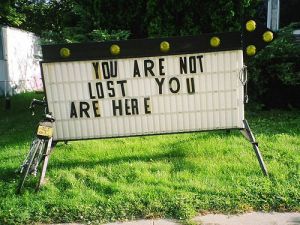
Imagine getting lost when you’re out.  The first thing you want to do is find a familiar landmark or a sign for a place you can get your bearings from.

Next time you don’t fully understand something, try stepping back a little and take into account the basics.  Search for that familiar landmark.  Keep stepping back, revisiting more basic concepts each time until you reach a point of understanding.  From here, look again at what seems to be getting in the way of your grasp of the topic.  Quite often it’s not a specific detail you’re missing, but a more general overview.

The importance of ideas

What you read and retain has a potential bearing on what you read and retain after that.  The ongoing, holistic process is what gives each of us a unique viewpoint.  No wonder we have such varied opinions.  With a general election campaign in full swing, you can’t avoid opinions.  Personal views, official lines, big picture analysis, minor point evaluation…

Opinions are important because they help shape our ideas.  Reading is also important because we learn about other opinions and ideas in the process.  We can’t form our own conclusions if we don’t read about other ideas out there.

Ideas are important too.  Without ideas, progress isn’t made, change doesn’t happen, much of human development stops.

original photo by farleyj

original photo by farleyj

But ideas can’t go anywhere unless they are realised and actioned.  And you can’t action anything without the initial idea:

“Ideas make the world, for they are the guide to future practice.  Even the flimsiest ideas rooted in prejudice and ignorance make history and form public culture…Ideas, when mobilised, become the templates of thought and practice.” [Ash Amin & Michael O’Neill in Thinking About Almost Everything]

When you put your mind to work — whatever the focus — don’t be afraid of what you think.  You may stumble upon something brilliant.  Your education is an opportunity to discover and let your mind wander.  Will your ideas fit in with what has already been, with what is to come, or with nothing at all?

You’ll probably discard the majority of your ideas.  That’s no bad thing.  The more ideas you have, the more you should expect to pass by.  Luckily, you should hold on to more ideas too.

Don’t worry about what you’re doing.  You can’t please everyone.  Many successful ideas look unworkable or unpopular until they go beyond the idea.  As they get a life of their own, what once sounded ridiculous can end up changing the world.

Whether you’re studying in the humanities, the sciences or something entirely different, ideas are crucial.  As Ash Amin and Michael O’Neill explain, university is the home of ideas:

“The very ethos of what defines a university is currently a matter of debate.  It is critical that scholarship, education, and thinking about better ways of living and doing things are all central to what a university should be.  We should not confuse ‘teaching’ – repackaging and dissemination of existing ideas – with education and scholarship, which generate new ideas and open the minds of leaders of the future.  It is no accident that one of the first targets of any extremist regime is the university.  The ideas it generates are central to the future of our civilisation and society.” [From Thinking About Almost Everything]

More now than ever, life carries us along so quickly.  With instant updates and so much on offer, many of us have a fear of missing out.

Every now and then you should stop and think in your own time.  You don’t need to reel off amazing ideas that will change the world, but isn’t it good just to step off the world for a few minutes?

When you get back on, enjoy seeing things differently.

WikipediaWictionaryChambers (UK)Google imagesGoogle defineThe Free DictionaryJoin exampleWordNetGoogleUrban DictionaryAnswers.comrhymezone.comMerriam-Webster