Policy

What will be the future of education?

Lord Browne’s Independent Review of HE Funding and Student Finance is due tomorrow.  If reports on the content of the review are to be believed, students are not going to be happy.

As students across the country prepare to march in London on 10 November 2010, I’d like to share some quotations with you that I spotted recently.

First up, on what education has become:

“There is no denying that education is an essential preparation for life and work in an advanced economy.  Modern economies require skilled and motivated workers, who can only profit from the opportunities they afford if they are equipped to respond to their demands.  So much is now received wisdom.

“But a large part of the problem with education is that this connection has become too direct.  Aristotle said that we educated ourselves so that we can make noble use of our leisure; this is a view directly opposed to the contemporary belief that we educated ourselves in order to get a job.  To that extent the contemporary view distorts the purpose of schooling, by aiming not at the development of individuals as ends in themselves, but as instruments in the economic process.”

A.C. Grayling, The Meaning of Things (2001)

The connection between education and economy comes even closer, showing no signs of stopping:

“…universities in need of funds had little choice but to accept corporate money.  As social status and career success correlated ever more closely with service to profit-making entities, many academics were willing to play along.  A Labour Education Secretary, Charles Clarke, channelled the spirit of the age when he claimed that the idea of education for its own sake was ‘a little bit dodgy’; students, he insisted, needed ‘a relationship with the workplace’.  This insistence that market values can be applied to education continues to inform both policy and rhetoric.  In November 2009 the irrepressible Peter Mandelson was promising a ‘consumer revolution’ in higher education.”

Dan Hind, The Return of the Public (2010)

The Browne Review is expected to recommend a continuation of this ‘consumer revolution’ by suggesting higher fees, a real rate of interest on loans, and the possible lifting of the fee cap altogether.  Universities must, therefore, ask (and answer) crucial questions on student matters:

“What is the value we add for each and every student above the basic cost of paying the staff who teach them and providing the core facilities that they have to have? We should be able to answer this question anyway, irrespective of whether the substitution of private for public funding of teaching goes through, and whether or not the cap on student fees is set at £5,000, £7,000 or more than £10,000. Being able to account for our premium will be essential both to setting the prices of our qualifications in the future, and to remaining competitive in a rather different world.”

Prof. Martin Hall (Vice Chancellor at Salford)

The BBC has a load of links with information on the future of universities and fees, but that detail and speculation cannot answer the question as posed by Professor Hall.  Each university will need to have an individual response based on their own position and qualities.

While this rolls along, the ‘student as consumer’ problem looms.  The Quality Assurance Agency (QAA) published a series of documents on “Rethinking the values of higher education” in 2009, looking beyond the simplistic and misleading ‘consumer’ tag:

  1. Students as change agents?
  2. Consumption, partnership, community?
  3. The student as collaborator and producer?

Whatever the Browne Review concludes, and however students are perceived, we still have to see whether the coalition government will be in a position to feasibly implement the recommendations.  If the key recommendations are as expected, I’m not sure they can.

Why fees don’t act as a deterrent to uni

Would higher tuition fees put you off university?  A study by the University of Leicester suggests demand for places will be strong even if fees went up by triple their current amount.

730 university applicants were asked if they would be put off by higher fees.  The majority said they would still apply.  Slightly more than 10% would be put off by a £10,000 yearly fee.

photo by subcircle

Prospective students don't feel locked out over fees (photo by subcircle)

This is surprisingly low in contrast to the recent NUS & HSBC survey that asked a similar question to current university students.  Asked if they would have been deterred by higher fees, a whopping 78% said they would have been put off by fees of £10,000. [Click for full survey report in Word (doc) format]

So why the difference?  The NUS survey asked students already in HE.  Those students are more than aware of the fees burden, so it’s clear they would be alarmed by an even higher cost.

The Leicester study went the opposite way and asked sixth formers; those not yet in the higher education system.  With so many people applying to universities, I’m sure most students don’t feel they have much choice but to accept whatever price they have to pay.

At a time when university is considered the only route to career success by many, the focus on applying won’t rest on fees.  Suggest everyone had to pay £50,000 a year under these circumstances and I doubt even then you’d have a majority turning away from uni.

Bursaries and scholarships are available to cover some, if not all, costs.  These schemes would have to grow if fees were to rise.  Sadly, students most in need of this financial assistance are not sufficiently aware of such schemes.

The Office for Fair Access (Offa) reports that bursaries are not attracting poorer students.  The “chaotic patchwork” of bursaries are not doing the job of supporting students most in need.  Those at a financial disadvantage are far more likely to attend a university with lower bursaries.  The links are clearly not joining up.

Nik Darlington recently complained that he found the NUS/HSBC survey to be unrealistic.  He argued that by asking current or former students about fees, “This will not give you a realistic market opinion – these respondents are biased having already paid less than half of that amount for their current or former studies.  You have to be putting the question to future students for satisfactory realism”.

While the Leicester survey did put the question to future students, I don’t believe that survey can paint a full picture either.  The answers aren’t surprising.  So long as prospective students deem university to be the usual route forward after school, most students won’t appear to be put off by fees.

Darlington says Leicester have offered “vastly more robust research“.  Nevertheless, the results may be missing the wider point.  Put both sets of answers together to see why.  Before university, any fee is just a price that needs paying.  During university, that fee doesn’t seem quite so obligatory.  The change of opinion is important.

And how about after graduation?  Are current fees worthwhile and, if so, would higher fees still be acceptable?  I am skeptical about the £100,000 graduate premium in these changing times.  Would a graduate-only survey highlight resentment over fees even at their current levels?

How important is opinion in these matters anyway?  It seems that views vary, even amongst students.  And as Ferdinand von Prondzynski suggests, “the electoral impact of fees may be much less predictable than one might think”.

The future is going to be tough, whatever happens.  We have an ever increasing number of questions and very few answers.  Even if the Browne Review recommends higher fees, as is expected, the coalition government have to work a reasonable solution.  Under the circumstances, finding that solution will prove difficult.

And that last sentence is a contender for understatement of the year…

Making student places available and how to fund them

Channel 4 News last night provided a debate on the number of students going in to higher education and whether more places should be provided to meet demand.

Many young people are finding it difficult to find a place at uni, despite outstanding grades.  Rejections may come down solely to a flawed personal statement, or some minor issue that’s become a major block.  In all this uncertainty, it’s clear that the current system of allocating places at university is not supporting all those who would benefit from higher education.

photo by id-iom

photo by id-iom

Wendy Piatt, Director General of the Russell Group of universities, was first to speak on the Channel 4 debate.  She said huge increase in applications forces the question of whether the economy needs this many graduates and, if so, how can we afford them?  Due to world competition, Piatt argued that quality should be maintained.  Why short change students by spreading a limited pot of money too thinly?

Piatt went on to say that the current system does not support greater numbers of students.  Rather than have everybody pay the same amount of money, Piatt said there should be variation, especially as some people earn much more than others.

Strangely, this last point reminded me of an argument for graduate tax, which the Russell Group opposes.  They would rather see the cap on fees raised, if not abolished altogether.

It’s no surprise that the Russell Group want higher fees. They would be able to charge much more, yet maintain a full quota of students.  If any set of universities can stay strong based on their history and prestige, it is this set.

photo by TheAlieness GiselaGiardino

photo by TheAlieness GiselaGiardino

Professor Leslie Davies, vice chair of the Association of Colleges (AoC), said that HE currently caters for different purposes, needs and lifestyles. However, there needs to be further diversification to meet learner’s needs.  For instance, not all students want to move away from home for three years now.  A big shift is happening with better informed students looking more closely at career prospects.

Davies explained that employers are looking for a wide range of qualifications and skills from the workforce, with many companies recognising A-levels as a way in, as well as Diplomas and vocational routes.  A “one size fits all” approach is no longer helpful, so young people require better advice and guidance to suit their personal situation.

NUS President, Aaron Porter, warned of greater costs for the government unless more places were created for students.  The burden on jobseeker’s allowance with many people out of work could be huge, he argued, with the number of jobs drying up and fierce competition for apprenticeships.

In terms of debt, Porter disagreed with Piatt that degree costs should be variable based on course studied.  Some people choose to study law & economics and want to be a teacher.  Why should they be saddled with more debt if they go on to that totally different vocation?

Porter said that both individuals and the state will lose out if the state continues to set an artificial cap on places.  Students should be able to attend university if they wish and demonstrate the ability and grades.  Compared with OECD countries, the UK is slipping down the tables fast.  More people are entering higher education in other countries compared with here, which could severely limit the UK workforce.

photo by garlandcannon

photo by garlandcannon

How did the students see all this?  Also in the studio was a mix of young people either going to university this year or who had missed out on a place at uni despite good grades.

A selection of comments:

  • Students are a burden, but they are also the next workforce who need the right skills and training;
  • University may not be the only choice, but why stop people who DO want to attend and who have made the grade?
  • Looks like re-stratification. Fine if you can afford Cambridge, otherwise forced to do something else like get a diploma from a ‘random college’;
  • Graduate tax is a good idea. However, differential rates do pose a difficulty and it’s not easy to argue the best solution;
  • If you want to go to uni and have your mind set on it, you should have that right.  University is not the only way to kickstart a career.
  • Social perception needs changing before we can better engage public on benefits of HE.  Students are still seen as a lazy bunch who do precious little, but it’s a misconception;
  • Student debt is a growing issue for those looking at future options.  More potential students being turned off now there’s a greater chance of debt skyrocketing further.

The debate made clear that everyone agreed on certain points:

  1. University isn’t the only valid option available to further career prospects;
  2. Better advice and guidance is required to help people make better choices;
  3. Current numbers of students are not sustainable unless some form of change is introduced.

The third point is where much of the agreement breaks down.  The debate rests on where change should be made.  Should diversity naturally lower the number of people filing in to universities?  Should fees be raised and students/graduates shoulder the burden?  Should the artificial cap on places be lifted and funding be sourced from other savings?

I feel the first two points are crucial in assisting the change required in the third point.  Luckily, there is so much agreement on those two points.

Student numbers and funding provision are still the big issues for the government.  In the process, individual choices and the widening of opportunity falls deeper to the background.  What if the way forward was actually moving further away from view?  This is even more pertinent after Nick Clegg’s recent speech on social mobility:

“This is a complex and contested area of both research and policy. And action to improve social mobility will take many years to take effect. In policy terms, it is like turning the wheel on an oil tanker.

“Promoting social mobility is a long-term business. And it is precisely for that reason that it is vital to establish now, at the beginning of our time in office, that promoting social mobility is at the top of our social agenda.”

Social mobility involves more than money and affordability.  This is just the same for universities. Funding may be the problem, but that doesn’t mean it’s also the solution.

Vince Cable & the future of higher education

Business Secretary, Vince Cable, made a speech this morning about the future of higher education.  He has discussed a graduate tax, 2-year degrees, and various measures that can cut costs, but retain high standards.

Wordle: Vince Cable Universities Speech - 15 July 2010
Click here to see a Wordle of Cable’s speech

Would sweeping changes like 2-year degrees make a big difference?  Maybe.  Can ‘higher education’ as a wide collective term be expected to embrace such ideas without problem?  No.

While some universities are bound to jump at the chance of a two-year degree structure, others will be vehemently against it.  The difference of opinions will be down to this:

“We don’t know what higher education is for any more.” [source]

This comes from the previous President of Dublin City University, Ferdinand von Prondzynski. He makes a sensible point.

Put another way, higher education has been given too much to do.  Too much dilution results in not enough focus.  Two-year degrees can’t be made to work across the board.  Cable said we need to “re-think the case of universities from the beginning”.  The re-think on higher education needs to cover HE as a concept and as an entire sector.

While I am happy to see discussion and new thinking about 2-year degrees, it isn’t simple to wave a magic wand and change the landscape of higher education.  Academics with large research responsibilities are already stretched for time, so where would the extra teaching time come from?  Additionally, 3-year degrees cannot just disappear so the option would need to remain.  It would be entirely unreasonable to see a drop in teaching quality and standards as a result of new degree models.

photo by bisgovuk

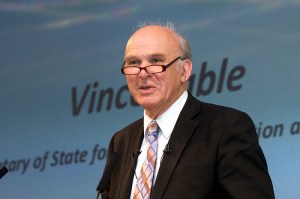
Vince Cable (photo by bisgovuk)

Vince Cable hasn’t actually made any policy proposals this morning, but he is pointing toward a future that he would like to see.  He is urging the Browne Review to consider a graduate tax as a feasible alternative to the current fees system.  Cable said his suggestions may sound radical, but are not.  He asks that we continue the debate and make some truly radical moves to help the future of HE.

Radical proposals are fine so long as they have a solid foundation.  A change for the sake of change is no guarantee of a better way.

Is now the time to see universities coming together in collaboration, rather than fighting for scraps in a panic that they might lose what is dear to them?  I would love to see better engagement and participation between institutions.  At the same time, I would like to see those institutions in a position where they can showcase their unique traits with ease.

One way for universities to develop their unique identity is through a powerful mission statement.  Right now, current mission statements could come from any university, as Times Higher Education discussed earlier this year.

With this in mind, I believe the following ideas are also worth pursuing:

  • Give universities more freedom in creating their specific mission, vision and values;
  • Allow universities to develop their specialisms more easily, so long as they are unique, have valid reasoning, stick within their mission aims, and give teaching at least as much priority as research;
  • Promote greater collaborative engagement between institutions;
  • Ensure institutions do not pick only the most profitable degrees and methods of assessment;
  • Acknowledge the wide remit HE has rather than pretend all institutions are the same and/or ignore their major (sometimes uniquely defining) differences.

These ideas would identify what would suit each institution, while also giving students better information on deciding where to study, what will benefit them, and why an institution can deliver that for them.

Many ideas are being touted, leaked and proposed regarding the future of higher education.  From new ways of funding through to different degree models, we may see certain fundamental ‘rules’ rewritten.  I am ready to treat this time with enthusiasm, although it doesn’t stop my fear that some decisions could be rushed.  Indeed, some choices may be made that are based solely on cost and saving money.  These are difficult times as much as they are interesting times.  Everyone needs to tread carefully here.  Not just students, not just staff, not any single group.  HE covers so much ground that most people are (or will be) involved in one way or another.

HE stands for so much that we need a different way of classifying what each institution, or department, or member of staff, or student, is working toward.  More from von Prondzynski:

“It is time for something better. It is time to understand what part of higher education is vocational, and what part is educational in a broader sense. It is time to have a plan about how graduates will develop their careers on leaving education. It is time to state more clearly what we see as the benefits of higher degrees, particularly doctorates. And it is time to engage and motivate those working in higher education so that they can apply energy and skill to their tasks and so that they can lose the instinct to feel nostalgic about whatever went before.”

I am writing this post fresh from hearing Vince Cable’s speech and getting feedback from commentators, blogs, news posts, and my Twitter feed.  There is a lot of excitement, a lot of confusion, a lot of ideas, a lot of backlash…a lot of everything, quite frankly.

Times Higher Education started a #loveHE campaign recently.  The very reason why a mere speech stirs up so many emotions shows just how many people do love higher education.  The conversation — and the love — is starting to move out toward the wider public.  Whether you love or hate what Vince Cable has said and no matter how you will eventually feel about the outcomes of such wide debate, it’s crucial that we keep that love of higher education going.

Are we in this together?

Further links: