Policy

David Willetts: Student burdens and imaginative thinking

Universities are topping the news agenda again this morning. Lucky us.

Or maybe not.

David Willetts, the universities minister, has said that students should see tuition fees “as an obligation to pay higher income tax”.

Oh dear. Then again, we shouldn’t be such a “burden on the taxpayer”, should we?
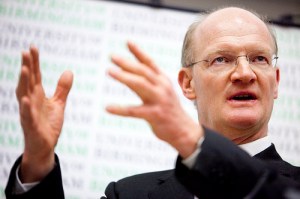
photo by bisgovuk

photo by bisgovuk

Education, like health, like defense, like transport…like most things, is a taxpayer burden. We know taxes must be paid, even if we don’t like it, but we want them to be reasonable and to work.

The welcome expansion of higher education means we cannot expect all funding to come from the public purse. The system has changed too much to expect that.

But one thing about HE hasn’t changed over the years. That is the amount universities help the country achieve through both teaching and research. Based on this alone, public funding must still be the main way to help fund the system. It is reasonable to think that graduates should also contribute toward the future of higher education. But how much?

Willetts asks what can be done to ensure students can get more out of higher education. He asks for clarification on what we are getting in return for our investment:

“The system doesn’t contain strong incentives for universities to focus on teaching and the student experience, as opposed to research.”

This is a fair point in itself. Graduate repayments take 9% of your earnings above £15,000. This is too much of an ‘income tax’ when there is no specific and identified benefit.

One way of tackling the funding issue and that of student benefit is, according to Willetts, to look at systems of education provided by London University and Open University, providing more affordable teaching in HE. Methods like distance learning and local learning would certainly benefit some, but there’s already a lot of this going on, especially within further education. HE in FE is not a new concept. The format is welcome and useful, but it isn’t enough to transform the education system, especially if sufficient funding from the right sources is not forthcoming.

If the coalition government – whether through Vince Cable or collectively – is keen on reducing university places in coming years, a lot needs to change before it can work for students in general. Access needs to be guaranteed to all those who would benefit from HE. Additionally, those students need to be easily identified and given the help to understand what HE can do for them.

I’m not saying it’s an easy task, far from it. We need to tackle widening access as a priority before we start reducing the number of available spaces at universities. The system is already failing students with good grades who cannot get in to university. Widening participation doesn’t stand a chance when even already engaged and achieving students are unable to fulfil their potential.

I noticed that Newcastle University has been taking on local applicants with lower A-level grades for the past 10 years. Success stories such as Newcastle’s highlight mechanisms in place that allow access to all who would benefit. Even those who don’t achieve so well earlier on in life can go into HE and improve their chances considerably.

David Blanchflower suggests we look to Dartmouth College in the US for a way to combine widening participation with successful funding models. This would mean lifting the cap on tuition fees. But would that matter if half the students would receive scholarships and financial aid when it is needed? Would all this financial aid be possible anyway? I’m not sure, but the method is worth exploring in a time of big changes.

Graduates in the US are also far more likely to donate to their place of study. In the UK, graduate donations are nothing like as forthcoming, although they seem to be rising.

It is expected that Lord Browne’s review into higher education funding will list higher fees amongst its recommendations. Time will tell what comes out, but it seems we are being readied for this outcome. Willetts has said that people need to see the difference between a credit card debt and a graduate debt that is more akin to paying higher income tax.

I know the difference and it doesn’t have me sighing with relief.

If the fees cap is lifted – or removed altogether – the burden on the government and on students will increase hugely. Higher fees still won’t benefit the government due to the drain that loans have on the economy in the first place.

Willetts has, therefore, set out the need to “think much more imaginatively” regarding fees. He suggests that graduates may have to pay more for their education in the future, but they will be more accepting if they recognise the worth. That worth, he argues, can only come about through an improved teaching focus.

As far as students are concerned, imaginative thinking will certainly need to go beyond this.

#voteforstudents – More than just a hashtag

Earlier today from 12.00, the Twitter hashtag #voteforstudents started trending worldwide.

#voteforstudents became the second most popular topic tweeted in the UK  within minutes. And for good reason too.

The Vote For Students website, set up by NUS (National Union of  Students) asks students to vote in the forthcoming general  election to support candidates who won’t support an increase in student fees.

The purpose of today’s Twitter event was to make the cause known and help spur students on to vote.  The student population is  huge.  Students represent 15% of the voting population, but many do not vote.  By coming together on a cause like this, students can make a big difference through their united voice.

In addition to this, the Vote For Students campaign puts pressure on political parties to speak up about the future of funding in  Higher Education.

Among the great Tweets were:

#voteforstudents  now at number two in UK trending topics, but it will be the number one thing on students minds on polling day – @estellehart

You don’t have to be a student, pledge your vote now to honest candidates at www.voteforstudents.co.uk #voteforstudents – @andrewhenrynus

We don’t want a country where poor institutions teaching poor students get poorer and vice versa #voteforstudents – @jim_dickinson

#voteforstudents  is about mobilising the student vote with the  immediate aim of stopping any increase in uni fees. – @johnpeart

#voteforstudents  isn’t just for students you can sign up today  too if you care about the future of education in the UK – @marktweets

Because if fees rise then most of us are screwed for the housing  ladder and pensions #voteforstudents – @AliceBouquet

The student vote could change the result of the next election.  Make sure our voices are heard. #voteforstudents – @uclansu

We could swing the general election…there’s 7 million in @nusuk  ‘s membership! #voteforstudents – @DannieGruff

great that #voteforstudents is trending. But it’s vital students sign up http://www.voteforstudents.co.uk & vote! – @AaronPorter

I did notice a couple of criticisms along the way too:

#voteforstudents  campaign and NUS should focus on getting students to vote, since 50% say they wont, rather than promoting their own agenda – @owenlmeredith

Impressed with the successful effort to get #voteforstudents to trend globally. Though a short tweetable manifesto would be useful. – @technicalfault

Today’s campaign to create a Twitter trending topic is one way in many that interested parties (not just NUS) are reaching out to  students to ask for their vote…and for their vote to actually count.

As for a tweetable manifesto, many Tweets were going out with the Vote For Students website linked, but @technicalfault does make a  fair point.  I’m sure if NUS were to set up a similar event, they’d consider something like this.

And I can well imagine NUS will do this again.  The outcome of the event wasn’t certain, but to trend so successfully in the UK and  around the world is a big deal given Twitter’s 40 million Tweets per day! [Update: Just a few days later, let’s make that 50 million Tweets!]

Congratulations to all who helped make #voteforstudents a top trending topic.

Now do we all go back to normal? NO. It’s time to make a difference. That’s what today was all about.  We all need to use our vote wisely.

Earlier today from 12.00, the Twitter hashtag #voteforstudents

started trending worldwide.

#voteforstudents became the second most popular topic in the UK

within minutes. And for good reason too.

The Vote For Students website, set up by NUS (National Union of

Students) asks students to vote in the forthcoming general

election to support candidates who won’t support an increase in

student fees.

The purpose of today’s Twitter event was to make the cause known

and help spur students on to vote.  The student population is

huge.  Students represent 15% of the voting population, but many

do not vote.  By coming together on a cause like this, students

can make a big difference through their united voice.

In addition to this, the Vote For Students campaign put pressure

on political parties to speak up about the future of funding in

Higher Education.

Among the Tweets were these:
#voteforstudents  now at number two in UK trending topics, but it

will the number one thing on students minds on polling day –

@estellehart http://twitter.com/estellehart/status/9281341191

You don’t have to be a student, pledge your vote now to honest

candidates at http://www.voteforstudents.co.uk #voteforstudents –

@andrewhenrynus

http://twitter.com/andrewhenrynus/status/9280856974

We don’t want a country where poor institutions teaching poor

students get poorer and vice versa #voteforstudents

http://www.voteforstudents.co.uk – @jim_dickinson

#voteforstudents  is about mobilising the student vote with the

immediate aim of stopping any increase in uni fees.

http://www.voteforstudents.co.uk – @johnpeart

http://twitter.com/johnpeart/status/9281040139

#voteforstudents  isn’t just for students you can sign up today

too if you care about the future of education in the UK

voteforstudents.co.uk – @marktweets

Because if fees rise then most of us are screwed for the housing

ladder and pensions #voteforstudents – @AliceBouquet

The student vote could change the result of the next election.

Make sure our voices are heard: http://www.voteforstudents.co.uk

#voteforstudents – @uclansu

We could swing the general election…there’s 7 million in @nusuk

‘s membership! #voteforstudents – @DannieGruff

I did notice a couple of criticisms along the way too:
#voteforstudents  campaign and NUS should focus on getting

students to vote, since 50% say they wont, rather than promoting

their own agenda – @owenlmeredith

Impressed with the successful effort to get #voteforstudents  to

trend globally. Though a short tweetable manifesto would be

useful. – @technicalfault

http://twitter.com/technicalfault/status/9282485567

Today’s campaign to create a Twitter trending topic is one way in

many that interested parties (not just NUS) are reaching out to

students to ask for their vote…and for their vote to actually

count.

As for a tweetable manifesto, many Tweets were going out with the

Vote For Students website linked, but @technicalfault does make a

fair point.  I’m sure if NUS were to set up a similar event,

they’d consider something like this.

And I can well imagine NUS will do this again.  The outcome of the

event wasn’t certain, but to trend so successfully in the UK and

around the world is a big deal given Twitter’s 40 million Tweets

per day!

http://royal.pingdom.com/2010/02/10/twitter-now-more-than-1-billio

n-tweets-per-month/

Congratulations to all who helped make #voteforstudents a top

trending topic.

Now do we all go back to normal? NO. It’s time to make a

difference. That’s what today was all about.  Let’s use our vote

wisely!

Students as consumers…but even more so!

I’m going to have a brief rant here. If that’s not your thing, feel free to bypass this post!

Peter Mandelson says that students should be more demanding and take a more consumer approach to their education.

If students weren’t already forced to act as consumers, Mandelson’s suggestions highlight just how much students are expected to deal with the issues surrounding their education themselves.

photo by m.a.r.c.

photo by m.a.r.c.

It sounds to me as if the onus is falling ever more on the individual.  If something isn’t working, it’s the internal system, not the wider policy…

I can’t help seeing ‘students as consumers’ as a way of brushing many wide-ranging issues of higher education under the carpet.  I’m concerned the empowerment issue is an attempt to justify the case for fees and, quite possibly, higher ones.  Then variable fees, perhaps?  Then what?

Mandelson believes institutions should compete more in order to improve courses, but what motivation do universities have at the moment in order to take this seriously?  Money is tight already, so until the future of funding is given the time of day it needs, universities are stuck between a rock and a hard place.  Nobody is able to shine as things currently stand.

Universities are strangely public and private.  They have various sources of funding, which only confuses the matter.  There are no answers, no guaranteed solutions, and no way of telling what’s around the corner.  Yes, all businesses suffer from a lack of guaranteed solutions, but universities often have it a lot worse, and may also suffer with a poor level of autonomy.  Many businesses know why they’re trying to make money and provide the best quality, even if they don’t know where they’re headed or if they’ll succeed with their ventures.

Higher Education rarely even has that luxury.  Is it about teaching, learning, vocational training, researching, money-making, something else, all these things…?  And with such a varied mix of personalities, opinions and cultures on campus, how can a collective strategy or focus be achieved through anything other than luck?

Let’s get this funding review underway soon.  We all understand that HE has to be paid for somehow, so what’s the point in stalling?  For one thing, we need to find a way of seeing students as learners and developers, far more importantly than as consumers.  The review won’t be properly concluded until that happens.

Okay, rant over.  I’ll resume normal service now! 🙂

Graduate Tax – A better alternative to tuition fees?

The National Union of Students (NUS) has published a blueprint that suggests setting up a People’s Trust for Higher Education.  It is, they say, “A fund built mainly on contributions by former undergraduate students and their employers, and the employers of current students”.

NUS Blueprint

Rather than ramp up fees, lift caps and get universities charging different fees, the NUS blueprint asks for a form of graduate tax that would be paid over a fixed period of 20 years, based on your earnings.  The more you earn, the more you pay back.  This has been suggested as a reasonable alternative to implementing higher and variable fees.  In fact, it’s designed to abolish fees completely.

This blueprint has been written to stimulate public debate, rather than answer every question, rather than prove a solution to every problem, rather than explain a perfect system.

That said, it is still a clear set of proposals aimed at creating a fair system for all and encouraging widening participation.

The NUS state:

“Our proposals would end the very notion of a course fee or price, and shut the door on a market in fees. Graduates should contribute to the future costs of higher education according to their actual future earnings, so that those who benefit the most from university by earning more will contribute more, in order to give future students access to higher education.”

However, Nick Taylor brings up a valid point that the NUS suggestions could be “Funding Our Failures”.  He asks us on his blog to “think of an alternative that doesn’t persecute successful students and reward idiots”.

Taylor’s blog post asks a reasonable question, especially as the NUS blueprint specifically states, “Those who leave higher education and, for whatever reason, have only a very low income for the rest of their working lives, may pay nothing at all, and will have relatively little debt compared to today.”

Problem areas like this do need to be addressed, otherwise the system is open to abuse.  It is, therefore, up to us to contribute further to help introduce a system that works for all.  The NUS brings us closer to a way of funding HE using methods other than charging sky-high fees.  So now we have a more detailed, greater supported and generally talked about platform to work from and mould into shape.

Although an open statement, the NUS blueprint also starts to talk about the future of HE given the likely boost in revenue that’s been calculated.  They call for the funding to:

“be conditional on new measures to monitor and improve the quality of the student experience and the impact of higher expenditure in the higher education sector. We believe this should be focused on the outcomes of higher education and the extent to which it actually changes people’s lives.”

If widening participation is truly being taken seriously by the government, it should be made clear to all that HE can change people’s lives for the better and that it’s worth being a part of.  There will always be the ‘Wasters’ that Nick Taylor refers to, but I believe more can be done to persuade these individuals that they can achieve more to the benefit of themselves and others.  It won’t work for everyone, but this new blueprint should go beyond the debate of graduate tax versus student fees and look to the way in which individuals can be encouraged to make the most of their time within HE.  University looks like a laugh because it really can be a laugh.  That doesn’t stop it from being a positive and rewarding move in life at the same time.

Finally, the blueprint opens the way for better support of lifelong learning (which is something I’m all for).  The graduate tax would be related to the number of credits that people have studied.  That allows people to move in and out of HE in different ways and benefit without being hit with huge fees, just for trying to gain more education.  A graduate tax would still need to be paid, but in such a way to allow greater access and better participation.

I am pleased to see today’s blueprint and hope for a wider debate within HE because of it.  While we may not have all the answers right now, we’re certainly a lot closer to finding an effective and fair system of funding higher education.  Now it’s up to us to get working on filling in the cracks and building a system that works for as many people as possible.

The more of us who get involved, the easier that should be.  Let’s do it!

Related Links:
The Guardian – Wes Streeting (President, NUS) on the blueprint

The Guardian’s own take on the graduate tax

BBC News

24dash

Compass Online

Metro

Times Online

University and College Union (UCU) response to the blueprint

Million+ response to the blueprint

The Guardian has put up a voting and commenting page about “Graduate Tax vs Tuition Fees“.  Be sure to watch the comments both for and against!