Job / Career

To work or not to work?

I was reading an essay entitled “Students’ perceptions of the effects of term-time paid employment” and it got me wondering how university life in the UK has changed in recent years with a greater number of students now undertaking part-time work of around 15 hours per week.

I didn’t take a job when I was at uni.  It meant I had to budget hard and consider purchases carefully at every step, but it left me with the time to do whatever I wanted.  It was never my intention to work and I did everything to keep out of the employment game throughout my degree.

That said, I did get paid to be a Senior Student on campus.  In the process, the uni paid for about 75% of my accommodation, so I guess you could call that a type of employment.

It pays the bills... (£20, photo by woodsy)

The essay got me thinking, to what extent is someone better or worse off if they have a job, comapred to one who doesn’t?

(more…)

From university to dream job: Succeed like Radio 1’s Greg James

Greg James (photo used with permission)

I enjoyed reading about Greg James in the Independent on Monday.  From a student at the University of East Anglia, he’s been given a DJing job at Radio 1.  You couldn’t get a much quicker move from uni to national radio!

Greg studied Drama at UEA and has this to say about his time there:

“I had a brilliant time at UEA, I loved every minute of my course and my time at the student radio station in particular was fantastic and set me up so well for my chosen career path. It is a great place to discover your talents and develop your skills.” – from UEA website

After devouring the Indy’s article, I looked for clues to highlight what he had to do to get him where he is now.  Here are 8 winning ways to fulfilling your dreams like Greg James has (with a bit of Ricky Gervais thrown in for good measure…):

(more…)

Recruiting in Other Worlds: Are You Prepared For Virtual Interviews?

Earlier today, I received a comment on a previous post about jobs and CVs.  LJ asked an interesting question:

“I wonder what advice you would give someone facing a virtual interview?”

Virtual interviews are a recent development to recruitment.  They’ve been used more as a taste of the future, but the results have resulted in possible job offers.  Some people are already out there, developing their virtual interview skills.  After you graduate, who’s to say you will be more likely to undergo interviews over the Internet?

And should you treat these virtual interviews any different to a phone interview or a face-to-face one?

In some ways you’ll have to.  In other ways it’s much like any other interview.  You certainly shouldn’t take it less seriously.
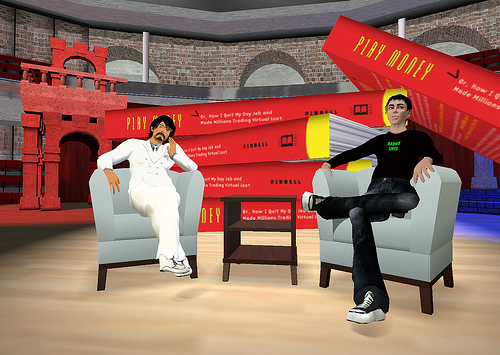
photo by pathfinderlinden

Here are 10 tips to help give you a fighting chance at a virtual interview…because you won’t get a Second Life at this one:

1. Remember it’s an interview – Chances are you’re applying for a job in the real world, so be yourself.  You’ll be meeting face-to-face soon if they like you here.  No point playing some big shot if you hate that kind of exposure in real life…

2. Concentrate on the facts – This is a virtual interview.  Interviewers are unlikely to be checking out your personality.  They want to know what you’ve achieved.  They want to hear stories about what has brought you here today.  They’re looking for a demonstrable ability to perform well, write succinctly, and give clear examples.

3. Don’t try and show off – You might know some impressive tricks in the virtual world.  They won’t be impressive halfway through an interview.  Leave the tricks for your friends unless it’s part of the interview process.

4. Remain courteous – You wouldn’t rush away from an interview the moment the final question had been answered, so be sure to make an impression from the moment you’re visible to the moment you’re shaking virtual hands after a successful meeting.  If the interviewer can still see you, make sure your behaviour is impeccable.

5. Keep the interviewer informed – If you aren’t sure about an answer, ask the virtual interviewer for a little time to compose yourself.  If you need clarification on a question, don’t be afraid to ask for it.  If your virtual self is just sitting there doing nothing for a couple of minutes without explanation, it won’t look too good.

6. If you’d feel stupid doing it in the real world, it’ll be stupid to do in a virtual interview – It might seem clever while looking at the screen, but always ask yourself, “Would I dare to do this if I was sitting in the interview myself?”

7. Prepare yourself in the real world – Performing a virtual interview at your computer, in your pajamas, 30 minutes after crawling out of bed, is a bad idea.  Just because you can do it, doesn’t mean you should.  Get yourself dressed and looking smart.  It will boost your positivity and help you play your virtual part a lot better.

8. Do your homework – A virtual interview will be no less difficult than a face-to-face interview.  You still need to prepare and be ready for any questions thrown at you.  If an interviewer asks you, “Is a Jaffa Cake a cake or a biscuit?” it’s no good ignoring the question, or simply laughing.  By all means, react to the general atmosphere if it’s light hearted, but don’t overdo it.  Oh, and a Jaffa Cake is definitely a biscuit, because I’d feel very greedy if I was eating 12 cakes in 10 minutes…

9. Showcase your online talent, if applicable to the job – In a normal interview, you can give the recruiter your web address.  In a virtual interview, you can send the link over at the right time and all view it within an interactive discussion.

10. Tell the truth – Both recruiters and interviewees have championed previous virtual interviews because of the honesty involved.  There’s a tendency to get to the point and give a more confident reply to a question.  So if you think a virtual interview gives more chance to fib, you might be doing yourself out of a job.

——-

It might be early days, but have any of you already taken part in a virtual interview?  Would you give any other advice regarding interviews (real world, or otherwise!)?

Pushing Toward Employment Nirvana – Part 4: It’s Never Too Early to Start a CV

Don’t be late (photo by raena)

There are some things we spend too little time on. Things that have a great bearing on our lives. Buying a house, for instance. The average time spent looking around what’s probably the most important purchase of your life is about 17 minutes. That almost inconsequential amount of time can make such a profound difference to your future that all the experts shout that more time should be invested in making sure you’re doing the right thing.

Those experts shout until they’re blue in the face. The advice only gets through to a few people. Those people can, therefore, spend a little more time and use it to their advantage.

I say the same thing is true for writing a CV.

It’s woeful how little time we spend on such a potentially life altering document. Okay, so a CV is never the sole basis for employing someone and some companies don’t even accept CVs, only their own applications. But there are so many advantages to a good CV that it’s madness to ignore its importance. You see, a CV is your entry to an interview in many cases and the chance to give a positive first impression. And if a company won’t accept CVs, at least you have your positive qualities, work and education dates, awards, and key skills written down (up to date!) and ready to transfer to the format the application requires. Then all you need to do really is complete a personal statement. I aim to write about these at a later date.

I’m not going to explain HOW to write a CV, because there is a multitude of books, websites, blogs, forums, advice centres, yadda yadda yadda, that can do that. There are some tips on getting the basics right below, however.

Anyway, what I want to shout until I’m blue in the face is:

“Write your CV while you don’t need it!”

…or at least make a convincing start.

Since 17 minutes isn’t a long time (unless you’re waiting for the bloody kettle to boil…sorry!), why not spend about 15-20 minutes A WEEK during TERM TIME ONLY and see how much you can get written in the same time it takes to listen to 3 or 4 songs on your MP3 player? Not even while you’re on holidays and semester breaks. Just when you’re at uni itself.

Using short bursts of time to achieve a goal is not a new concept. Just look HERE and HERE. So your CV is one important document that deserves a flash of energy over about 30 weeks. Just 15 minutes a week would give you an amazing 7 and a half hours on developing your CV. That’s like one whole working day for a lot of people, so you should have a pretty solid standing by that time.

Of course, there’s no reason to do it this way if you’d rather get it out of the way. If you do, even better! But don’t rush it. Maybe one hour a day over a week would be just as good…

The point is that ignoring your CV is tantamount to ignoring your future and hoping for the best, even though you’re not putting your best in. As I said in Wednesday’s post, if you don’t put your points across, or even if you do a poor job of it, your skills and experiences will count for nothing.

All CVs are different and depend on a lot of factors, but they all should feature:

  • your personal details (name, address, etc.)
  • dates of education and the grades you achieved
  • any work experience and prior employment
  • key skills

There are many other possible entries on a CV (such as awards, memberships, personal statement/motto, professional qualifications, etc.), but I won’t go further into those as you’re more likely to have a better idea when you’re trying to give your CV a more purposeful or targetted focus. For now, it’s more important to get the basics organised as carefully as possible.

And here are 7 tips on getting those basics right:

  1. Make it punchy, with hard hitting sentences and short explanations. An essay on each job is not required here.
  2. Get your CV to fit about 2 pages – This is old advice and given out often, but it doesn’t stop people sending off CVs with 4 or 5 pages. There’s no need for it. If you really must, make it 3 pages, but I’m sure you’ve got it in you to rework it into less (yet make it even harder hitting…).
  3. Space your CV out – Present the CV so there is plenty of margin space and room to write around your text. You never know when employers want to write notes so they can remember the positive information you’re communicating to them!
  4. Set out bold headings so people know where they are looking and what to expect.
  5. Don’t be lazy about mistakes – A CV is one of the worst possible places to make mistakes. It still happens quite often. Check, check again, check with someone else, then check again. Then check again!
  6. Make it concise, yet relevant – Never forget this document needs to be punchy. Nevertheless, you still need to give relevant examples. It’s not good enough to say you are trustworthy and a teamworker, explain why and how you managed it.
  7. Think ’employer’, think ‘recruiter’ – Look at your CV. Would you give yourself a job? Do you think it would be hard to find a better CV than yours? Does the CV feel personal? Do you believe in the CV as much as you believe in yourself? Would you be happy to show this to someone and say ‘this is me in a nutshell’? If not, keep trying until you do.

Monday’s and Wednesday’s posts gave tips on forming a career plan and understanding your abilities, skills and experiences. With that in mind, you will hopefully see what kind of detail would look good to a prospective employer.

Get this out of the way now and you can quit worrying when you actually NEED a quality CV.

This article is part of the Pushing Toward Employment Nirvana Series.  The full content links are: