General Study Advice

Stuff You Need To Know For University – Review

The people at Zidane Press have sent me a copy of their book, Stuff You Need To Know For University for review. I expected a book much like Lucy Tobin’s A Guide To Uni Life and other books preparing students for their study.

Stuff You Need To Know For University isn’t quite like that. It takes its own place.

Many books in this vein either prepare students for university life, or look at study skills. While the authors cover this at the start of the text, the main bulk takes a different approach. First things first, though, the book begins with a summary for everything required to enjoy university and excel in your essays. It’s almost worryingly brief.

But ‘brief’ isn’t the right word and doesn’t do it justice. Think more ‘to the point’. You’re expected to put the work in. What this book doesn’t offer is a magic pill. And I like that. The purpose of this book is to expand your horizons and get you thinking clearly about your degree AND beyond your degree.

Commandments

The first three pages contain the ’10 Commandments’ for how to do well at uni, starting with “Treat it like a job” and ending with “Enjoy yourself”. There is no mystery. The process isn’t complex. It assumes you will take responsibility for your learning. Some of the opinions within the commandments are a bit sarcastic, but that doesn’t mean the advice is a joke.

Beginnings

Next up, you’re given a short overview of health issues, Freshers’ Week, writing and grades. Just enough to take into account and not too much to make you bored or overwhelmed. You may want to explore in more detail at a later point, but when you’re given so much to take in as a Fresher, this type of overview is useful.

And if you’re looking for more detail on what happens when you first hit campus, take a read of my free ebooks on Fresher Success and Studying Hard.

The Stuff

Past the summary, the rest of Stuff You Need To Know… is part Bluffer’s Guide and part introduction to the wealth of information and scholarly output you’re due to encounter on your academic journeys. Not all of it is relevant to your course, but don’t let that stop you exploring. This book is an easy-going introduction to many ideas and it is up to you to take things further. You can pick and choose what interests you, as well as pick up the book from time to time when you need some inspiration.

The authors even suggest that “you can just take the ‘how to write essays’ bit and disperse of the rest”. Yet, in many ways, that would be missing the point and you wouldn’t be making the most of the book.

The authors cover the humanities, literature, drama, history, politics, economics, science, globalization, art, and music. And tucked away between the art and music chapters (I don’t know why it’s specifically placed there) is a selection of ‘Top Ten’ lists. From safety to theories, from food to films, the authors suggest what they think is best.

What’s refreshing about Stuff You Need To Know… is how it brings you the basics to allow you to step off from and take further in any way you fancy.

Some readers may consider its open-ended nature to be its flaw, but it’s a personal decision. If you’re interested in grabbing the fundamental points and grounding yourself, this book does that job just fine.

Decisions

The bottom line is this: buy the book if you want a useful place to dip your toes in and get the basics covered. Then explore!

If you’re more interested in a thousand different suggestions on preparing research, exam techniques, and the finer details of essay construction, look elsewhere.

I’ve never seen a uni book quite like this before. I enjoyed its quirky layout and concise nature. Stuff You Need To Know For University is a worthwhile and undemanding read.

And because the book won’t take you long to consume, you’ll have plenty time to follow those ten commandments set for you!

[Stuff You Need To Know For University by Richard Osborne, John and Mary Reid, is available now. Retail Price: £9.99]
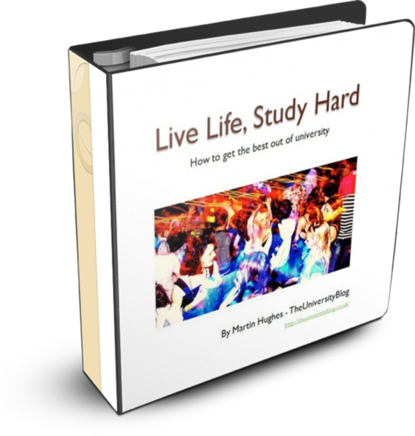
Live Life, Study Hard – Free Book

Today, I’m happy to give you my free ebook on how to get the best out of your time at university.  Live Life, Study Hard [744Kb PDF]:

Would you like to enjoy your experience at uni because of your degree work, not despite of it?  Life shouldn’t stop when you study.  If you want to enjoy the best of both worlds, then “Live Life, Study Hard” is a good starting point.

Working toward a degree needn’t be a chore.  But it’s hard to know where to start.  The first year of uni gives you plenty to think about.  And not much of that thought is necessarily on your study…

Before you know it, you’ve got a small forest of books to read, lectures to comprehend, tutorials to attend, deadlines on the horizon, and all manner of practical work to complete.

Live Life, Study Hard” is a guide to prepare you for this work and get into the right mindset without breaking into a sweat.  Part 1 helps you gear up for what’s happening and what’s ahead.  Part 2 forms the beginnings of study, giving the lowdown on lectures, writing without worrying, and getting to grips with essays.

Here’s the contents:

PART ONE – GEARING UP

  • Your first year DOES count
  • Get serious about university
  • The downside to benefits of uni life
  • Five ways you don’t get the most from your degree
  • Make your own decision exactly that!
  • Achieving balance
  • The importance of paying attention
  • 20 ways to cut down & free up time
  • Study traps you need to know

PART TWO – GETTING DOWN

  • Perfectly prepared for lectures
  • How seminars & tutorials take you beyond the lecture
  • Shifting states: Make writing work for you
  • From “Essay Hell” to “Essay Hello”
  • Escape from Essay Writer’s Block
  • Wonders of the weekend
  • Mental necessities of timetabling
  • More pushes to get you working
  • What next? Getting through your degree

The book is absolutely free to download and you’re free to share it with others.

Hope that has whet your appetite.  If you do only one thing toward your degree this weekend, do the work you need for the following week, no arguments.

If you do only two things toward your degree this weekend, make the second thing a thorough read-through of this book. 🙂

How to study a book before you have it

The wait for a crucial book to become available in the library is frustrating.  Even worse when the library doesn’t have the book at all.

Aside from inter-library loans, buying the book yourself, and other costly or time-heavy options, what other options do you have in the meantime?

photo by Newton Free Library

photo by Newton Free Library

To Do: Dissertation has some great tips on what to do while you wait for that book to become available.

But it got me thinking about others ways to the book that may work in your favour.  Here are a few ideas that might land you more access to a book than you think you have:

  • Check publisher’s website for excerpts and sample chapters – Some publishers are great at making PDF samples available to download.  You may get instant access to the Introduction, first chapter, possibly more.  Even a simple table of contents or index is a helpful head start on your research.
  • Check library online databases for books in electronic format – Don’t just check the library shelves.  An increasing number of books are now available online.  Services such as Cambridge Books Online provide a huge range of books at your fingertips.  Find out if your library has access.  If not, ask if they can get a trial.
  • Use Google Books – It’s not just Google Scholar that can help your research.  With Google Books, you can look through the pages of many books as a preview.  And the previews can be extensive.  Combine that with the ability to search for specific terms within each book and you may not even need to track down the physical copy of the book at all!
  • Use Amazon “Look Inside” – An alternative to Google Books, Amazon have their own preview function for a large number of books.  Again, you can search within the book and get busy with the research straight away.  However, it looks like Amazon may start charging for this feature soon.
  • Play Google and Amazon off with each other – Online previews are limited and don’t display all pages.  Rightly so.  You’re not meant to read entire books with the services.  However, when researching, you may find a specific page is excluded.  If both Google and Amazon have a preview available, that missing page on one resource may be there to view on the other.
  • YouTube talks – Why wait to read what the author wants to say when they may have said a lot of it in a talk or lecture?  By searching for the author (and maybe even book title) in YouTube, you may stumble upon directly relevant content for your research.  It’s another worthwhile reference to add to your bibliography too!
  • Read reviews – All sorts of texts get reviewed, not just bestsellers.  Reviews can give a breakdown of a book’s main ideas, flaws and coverage.  A Google search for book title and author and the word ‘review‘ should bring up newspaper reviews.  You can also check Times Higher Education.  It’s worth checking Google Scholar or journal databases for the title and author too, which should point you toward scholarly reviews and even related papers by the same authors.
  • Search for author details – Personal websites, university web pages, Google Scholar, JSTOR, etc…  All these can give further detail on the individual and their background, as well as other literature they have produced.  You may not have the book, but you may uncover key opinions and similar texts to chew on.

Don’t let the wait for a book stop you from getting on with your reading and research.  In the unlikely event that you find absolutely nothing after these searches, you can still go back to those helpful tips from To Do: Dissertation.

Don’t Plagiarise it. Remix it!

Academics have been remixing since forever.

You cannot move forward without taking from what is already behind you.

Yet remixing is different from plagiarising.  Academics reference the work they’re using and explain how they reached the detail they’re presenting.

photo by Thomas Hawk

photo by Thomas Hawk

There is a common misconception amongst students that you shouldn’t reference too much, because it looks like you haven’t done any thinking yourself.  But the more you refer to, the broader your research has been. Your scope widens as you read more, leading to more citations.

A high number of references is a healthy sign.  Those references have to be relevant, mind!

As you bring all these works together, you are creating a brand new work.  Remix. Mashup. Collaborate. From all this comes your own unique work.  You rely on others to make your own mark.

Coursework is a continuation of other people’s work, full of quotations, and full of ideas.  Even a groundbreaking, brand new finding/viewpoint must interact with previous research.  And each interaction requires an explanation of where it came from.

Additionally, if you have an opinion and want to back it up, it’s acceptable to find similar arguments elsewhere.  I spoke to one student who said they kept having to change their conclusions because they were the same as someone else’s view.  But there’s no harm in holding a similar view.  It’s just as natural to agree with others as it is to disagree with them.  Agreements in academia are helpful, because it’s material to back up your arguments.  It would be more difficult to back something up if everyone else disagreed with you!

Look at enough journal articles and you’ll start to see exactly how much academics manage to reference throughout their writing.  They don’t leave references out through fear of looking unoriginal.  When they discuss what has gone before and refer to previous findings, they are still creating a brand new work.

Your essays aren’t always unique research projects or a demonstration of new findings.  You may simply be discussing the merits of a statement or exploring a particular concept.  In doing so, your job is to cover as much ground as possible through primary resources and secondary material.  Should you find opinions that go against what you want to argue, bring that up too.  Explain why you don’t agree and back up with even more references on top of your own findings.

Next time you see an academic paper where the bibliography takes up the same number of pages as the article itself, hopefully you’ll understand why this happens!

It’s bad to plagiarise.  It’s great to remix!