Freshers

Essential Study Skills – Reviewed

[The people at Sage have sent me a copy of the latest edition of “Essential Study Skills: The Complete Guide to Success at University” by Tom Burns and Sandra Sinfield. This is my personal review of the book.]

Sometimes you need a place to start in order to start organising your thoughts. Sometimes you need a place that’ll give you some thoughts to start off with. “Essential Study Skills” attempts to do that.
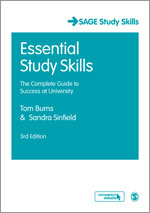
The authors are keen to make their book as easy to digest as possible. The first chapter guides you through the layout of the book and how to use it effectively.

With more than 450 pages, Essential Study Skills —which they call ESS3 for short— is not designed as a fast read to be digested in one go. Rather, the book covers many aspects of your learning and also advises on various other aspects of uni life that you’re likely to encounter.

Each chapter starts with aims and learning outcomes, then ends with review points. Within each chapter are many additional tips to help you on your way. Even at a glance, you can see this is a feature-packed book.

ESS3 is written with a focus on students who are the first in their family to go to university, so it doesn’t assume you have any prior knowledge or guidance. And there is still plenty to chew on, no matter how many generations of your family have attended uni.

With so much information at your fingertips, you may even feel overwhelmed. Must you *really* know all this in order to study effectively? Well, no. The point of the book is to help you ease into your work and pick up important tips and techniques as you go along. It’s the type of book you would be glad to have around throughout your degree, not the day before your essay is due in.

There are times when the advice goes so far that I can’t see many students following the whole way. For instance, the chapter on working in groups has so much detail on making the team work that it ends with a group building exercise to bring everyone closer. There’s nothing wrong with the idea, but it’s an idea of how the authors clearly did not want to leave any stone unturned. If this is going to benefit one group of students, then the authors have succeeded. This type of overkill is great, unless you’re overwhelmed by so much detail, as I mentioned earlier.

But I urge that you take a deep breath and let the book work over time, as it’s designed. Here are two reasons:

  1. We are all different – One person’s potion is another person’s poison. The book gives you various alternatives and lets you explore what works best for you. ESS3 isn’t a ‘this is how to…’ book, it’s a ‘this is how you…’ book.
  2. You will find things you wouldn’t have expected – As I looked through the book, I found a list of 10 sites for creating outlines. There were sites I hadn’t heard of. Sites that I was glad to discover, such as Quicklyst.

And going back to the first point, you’re bound to find at least one outlining tool from the list of ten that works for you. That’s the beauty of having alternatives to try. If the first doesn’t suit, you’ve got nine more to try!

You will probably find yourself devouring some sections of Essential Study Skills, while merely glancing through others. You may or may not return to those chapters later. I would have spent little time on the chapter about making notes, while you may think that the most useful chapter in the book.

The book covers more than the “Essential Study Skills” that the title suggests. The book’s subtitle is “The Complete Guide to Success at University”. That’s why you’re treated to information about being a fresher, using university services, dealing with emotions, and working on your Personal Development Planning (PDP).

The final chapter on what to do once you’ve finished university is strangely brief. The authors are aware of this and explain that many of the necessary skills required to be a successful graduate are similar to those skills required to be a successful student. Precisely what the whole book is about!

While this is true enough, any student about to graduate should look for more information elsewhere for a fuller picture. In particular, only one paragraph discusses the possibility of postgraduate study and the main advice is to prepare like you would for “an especially tricky assignment”.

However, if you have bought this book in your first year (or even before you start), it will easily take you through several years of study. The brevity of the final chapter is not exactly a major issue. Think of it more as a surprise when you’re used to chapter after chapter of detailed advice on mastering your academic technique.

Essential Study Skills is a great book to keep close to you while you develop during your degree. You’re not expected to be perfect after years of practice, let alone after a single term in your fresher year. This book helps you to understand that, yet at the same time helps you strive to bring out your best at all times.

The book is available now in paperback (RRP £14.99) and hardback (RRP £56.00) editions.

HE Marketing: Time to Stand Out, Not Fit In

Marketing is nothing new to universities. Decades ago, before fees and loans were on the table, money was being spent on how an institution looked to potential students and stakeholders.

Whether or not students consider themselves as consumers, the higher education sector is aware that appearance is important. Marketing will remain and will likely grow in terms of both use and cost. At the Warwick Higher Education Summit on 28 Jan 2012, Professor Bernard Longdon described how American for-profit institutions spend around 25% of their budget on marketing, yet only 10% on teaching. It appears that marketing pays.

photo by Angela Rutherford

Dressed to impress long-term or is it just window dressing? (photo by Angela Rutherford)

Brand realities must trump brand appearance.

The UK isn’t in the same place right now with such high marketing budgets, but I was left wondering about the best way universities can make an impression on applicants. In my eyes, we are in a time when identifying brand realities could help universities stand out far better than merely promoting a glossy and beautiful — and potentially misleading — appearance.

How did you imagine your university to be before you were a student there? Did that image change after you’d started?

We get it. Every university is brilliant. They’re all in the top 10% of universities… Students are happy and smiling, the buildings are marvellous, the surrounding area is beautiful, the atmosphere is delightful, and so on. And so on.

But where are the brand realities? It’s all too easy for brand appearances to take on generic views of excellence, quality and beauty rather than highlighting how one size certainly does not fit all.

Sauntson and Morrish suggest the lack of diverse voice resides even in mission statements, which appear “to be an indefinable kind of ‘branding’ in which concrete purposes and achievements are replaced by a symbolic avowal of the values of business and industry” (p.83). While mission statements are rarely viewed as important from the perspective of applicants, it is a concern that the search for a unique brand may be faltering on a wider scale.

The UK HE sector may require some institutions to specialise more than they currently do. This, in turn, would force a need to point out unique selling points even more urgently. But even if every institution stayed the same, there is already great diversity within the sector. At the Warwick HE Summit, both Sir Richard Lambert and Pam Tatlow agreed that HE doesn’t reside in a single size system. To emphasise the point, Lambert and Tatlow had plenty to disagree over, but not this. Tatlow explained that there is not one model to answer all questions and provide all solutions. In short, there is more than enough room to show true colours without looking out of place.

photo by maistora

Which solution fits you best? (photo by maistora)

Diverse or generic?

The Higher Education Policy Institute (HEPI) recently reported that while the sector appears less diverse than ten or fifteen years ago, any change is relatively minor. As for the future, the HEPI report on institutional diversity warns of major changes “as growing market pressures come to bear on institutions”. In coming years, it will pay to stand out rather than fit in.

How useful, then, is it to be all things to all people?

Institutions have long been in a strangely favourable situation where applicants and those involved in guiding student choices will generally look to official literature as the first port of call. In some cases, the prospectus is left alone in favour of a university’s website or mobile app. Whatever gets chosen, this official marketing and information is consulted a great deal and won’t be ignored any time soon.

Given this, it pays to communicate where each institution is different.

I advise applicants to look beyond the marketing. Students cannot make a fully informed choice on this alone. But while universities continue to hold the attention of applicants at an early stage through their marketing and promotional material, it must help the individual as well as the institution. Pointing out brand realities is a great start. Upon this scaffold, universities can outline their purposes with conviction and everyone should benefit in the process.

University marketing must highlight unique traits and core focuses over a general approach. This will still allow enough room for a diverse set of wants and needs, which is far better than attempting to be an ‘everyman’ figure. Allowing for diversity is not the same as promoting universal appeal.

Stuff You Need To Know For University – Review

The people at Zidane Press have sent me a copy of their book, Stuff You Need To Know For University for review. I expected a book much like Lucy Tobin’s A Guide To Uni Life and other books preparing students for their study.

Stuff You Need To Know For University isn’t quite like that. It takes its own place.

Many books in this vein either prepare students for university life, or look at study skills. While the authors cover this at the start of the text, the main bulk takes a different approach. First things first, though, the book begins with a summary for everything required to enjoy university and excel in your essays. It’s almost worryingly brief.

But ‘brief’ isn’t the right word and doesn’t do it justice. Think more ‘to the point’. You’re expected to put the work in. What this book doesn’t offer is a magic pill. And I like that. The purpose of this book is to expand your horizons and get you thinking clearly about your degree AND beyond your degree.

Commandments

The first three pages contain the ’10 Commandments’ for how to do well at uni, starting with “Treat it like a job” and ending with “Enjoy yourself”. There is no mystery. The process isn’t complex. It assumes you will take responsibility for your learning. Some of the opinions within the commandments are a bit sarcastic, but that doesn’t mean the advice is a joke.

Beginnings

Next up, you’re given a short overview of health issues, Freshers’ Week, writing and grades. Just enough to take into account and not too much to make you bored or overwhelmed. You may want to explore in more detail at a later point, but when you’re given so much to take in as a Fresher, this type of overview is useful.

And if you’re looking for more detail on what happens when you first hit campus, take a read of my free ebooks on Fresher Success and Studying Hard.

The Stuff

Past the summary, the rest of Stuff You Need To Know… is part Bluffer’s Guide and part introduction to the wealth of information and scholarly output you’re due to encounter on your academic journeys. Not all of it is relevant to your course, but don’t let that stop you exploring. This book is an easy-going introduction to many ideas and it is up to you to take things further. You can pick and choose what interests you, as well as pick up the book from time to time when you need some inspiration.

The authors even suggest that “you can just take the ‘how to write essays’ bit and disperse of the rest”. Yet, in many ways, that would be missing the point and you wouldn’t be making the most of the book.

The authors cover the humanities, literature, drama, history, politics, economics, science, globalization, art, and music. And tucked away between the art and music chapters (I don’t know why it’s specifically placed there) is a selection of ‘Top Ten’ lists. From safety to theories, from food to films, the authors suggest what they think is best.

What’s refreshing about Stuff You Need To Know… is how it brings you the basics to allow you to step off from and take further in any way you fancy.

Some readers may consider its open-ended nature to be its flaw, but it’s a personal decision. If you’re interested in grabbing the fundamental points and grounding yourself, this book does that job just fine.

Decisions

The bottom line is this: buy the book if you want a useful place to dip your toes in and get the basics covered. Then explore!

If you’re more interested in a thousand different suggestions on preparing research, exam techniques, and the finer details of essay construction, look elsewhere.

I’ve never seen a uni book quite like this before. I enjoyed its quirky layout and concise nature. Stuff You Need To Know For University is a worthwhile and undemanding read.

And because the book won’t take you long to consume, you’ll have plenty time to follow those ten commandments set for you!

[Stuff You Need To Know For University by Richard Osborne, John and Mary Reid, is available now. Retail Price: £9.99]

“If You’re a Fresher…Calm It!”

A student at Oxford Brookes has started a YouTube vlog called “University JibberJabber“.

Maxine Agyemang got in touch with me to say that she’s put together a load of tips on applying to uni, getting to know uni, studying, and making the most of your student life.

As a Fresher, Maxine has only just got to experience this herself, so these tips are fresh in her mind.

What’s university like really? “It’s pretty damn normal”, says Maxine. She doesn’t mean it’s not awesome, but the initial fun will quickly move away as you settle in.

And that’s fine. If you’re happy with things, the sense of ‘normal’ may not be normal to anyone but yourself, but it’s a sign that you’re comfortable with where you are.

So be comfortable, just don’t sit in your comfort zone. They’re different things. The solution? Strive to do amazing things comfortably!

Maxine says that she wanted to make the video she wishes she had before she started at university. It would have helped her feel less stressed for a start. Maxine says, “If you’re a Fresher…Calm it! They’re expecting you to get things wrong“.

They really are. Tutors, staff, everyone involved knows you’ve got a lot to get used to and a lot to learn when you first step foot on campus. Three years (or more) is a long time. If you think you’ve got it sussed from day one, you’re either missing out on sooooo much, or you’re doing something wrong!

So grab a drink and — if you’re anything like me — lots of snacks, and watch Maxine share with you what’s worked for her in her first few months at university.