essays

Make Your Work Compelling

The difference between compulsory and compelling is huge.

Compulsory sounds negative. You must do something, whether you like it or not.

That’s enough to put you off most compulsory stuff. The psychology is all wrong.

Compelling sounds great. You must do something, because you’re excited to keep going. You’d hate to stop.

Zen at work

University involves a lot of work, so it helps when you want to do it. But when you have deadlines to fulfill and the need to submit thousands of words, it’s easy to switch your attention to what’s compulsory.

Do yourself a favour and concentrate on the reasons why you’re interested in your work. The more compelling you make it, the easier you’ll find the less savoury points.

Terry Anderson sees possibility in this through self-paced learning, especially through “sophisticated social networking contexts” that let students discover each other and interact in realtime as well as through past comments and artifacts from previous students on a course.

You may not have this luxury on your degree for most, if not all of your assignments. But there are other ways to turn your attitude from plodding to probing.

Regain Your Enthusiasm

  • Start with an interesting question – What makes you tick? What would you like to know? Where do you want to explore today?
    Thinking about word counts and submission dates will only fill your mind with stress points. Bring your focus to the assignment itself, not the logistics.
  • Don’t overthink it – Once you’ve asked interesting questions, keep working on them until you start to grow tired of it. When you feel things dragging, stop right there. Pack up. Do something else. Even the most fun activities get boring when you don’t stop. So learn to let go.
  • Team up with others – Deconstruct, discuss, debate. Five minutes may be all it takes to uncover talking points that get you enthused about the task at hand. Whether or not you like to work in a group, an academic chat can get the creative juices flowing. If you’d prefer to do the actual work on your own, that’s fine. Once the urge is there, your mission is to stay in the mood to work with a spring in your step.
  • Space things out – The nearer you get to the deadlines, the more you focus on the compulsory aspect of your work. You avoid this by starting early and doing the work bit by bit. Not too much in one go, and certainly not all at once at the last minute.
  • Make it a habit – The longer you procrastinate, the more likely you’ll see the compulsory over the compelling. As well as spacing things out, as I mention above, find ways to develop habits to ease into the work. Habits can be different for everyone and is enough to be the subject of many texts, including Charles Duhigg’s recent book, The Power of Habit.
    Duhigg says that you should identify current routines for habits you would like to change. What is the cue that leads to your habit taking over? Next, choose different outcomes (it doesn’t really matter what they are) to work out what cravings are truly driving the routine. Then isolate the cue. Are you reacting to your location, the time of day, how you feel, what happened just beforehand? In time, you’ll find a pattern will emerge. Finally, have a plan. Commit to a new habit that you feel is better placed for what you want to change. From first-hand experience, Duhigg found embedding a new habit to be a challenge, but it was worth persevering.

Let the subject excite you and stop the admin from getting you down. So much of the change from compulsory to compelling is in the attitude. Set things up for an activity you don’t want to stop doing. And when you do stop, you’ll miss it.

That will make a change from never wanting to see it again, eh?
Press Save

Many moons ago, I sat down to reply to an email. A really long email.

I poured my heart out. Not literally, of course. That would have been weird.

But it was a masterpiece of personal writing. I was confident that the recipient would have a life-changing moment as soon as they saw my delightful prose upon their screen.

The end was in sight as I started the final paragraph, wrapping up the loose ends and signing off with a “Broom Broom for now”. Don’t ask.

As I sat there, half typing, half grinning smugly at my genius, something rather annoying happened.

A power cut.

photo by Jacob Haas

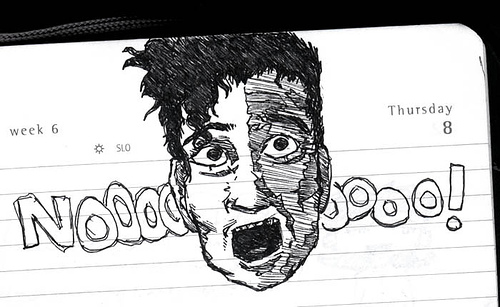
NOOOOOOOO! (photo by Jacob Haas – CC BY-ND 2.0)

I lost everything. Over an hour of writing gone. Around two-thousand words never to be seen again. Yes, this was an era before auto-saving drafts were the norm. That type of thing was reserved for Microsoft Word. Ah, the memories!

Let’s say I was unhappy and leave it at that. In the end, my re-written reply was two short paragraphs and a mumbled annoyance that lamented the lack of a witty and wonderful response after the power went out. It probably made no sense to the person at the other end of the message. No matter; I didn’t care any more.

I write this as a warning to you when you’re tapping away in a state of flow. You’re in the zone and on top of the world. Piffling stuff like saving the document doesn’t occur to you when everything’s going so well.

And despite the auto-saving beauty of so much we do these days, I’m sure the one time you encounter disaster will be the one time that automatic life-saver isn’t there to help you.

For me, it was just an email. That hurt enough.

Imagine the horror if it was, say, one of your essays.

On an allnighter the day before it’s due in.

And you’ve already had an extension.

Please. Press save. Back it up. Do it now.

And breathe.

Everyone Needs To Stop Doing This

Plashing Vole tweeted:

“As the Dissertation God for one of my subjects, the words ‘everyone’ and ‘everything’ are now banned due to unthinking abuse.” [Source]

Apparently, some dissertations that had been submitted for marking contained this type of saying:

  • “Everyone is on Twitter.”
  • “Everyone knows X.”

It’s best to leave these sayings behind. Here’s why:

Crowd (photo by Redfishingboat (Mick O))

“It was amazing. Everyone was there.” – No. Not everyone. (photo by redfishingboat (Mick O))

Everyone is on Twitter

No. Not everyone. You know that really. It’s just a way of saying how popular Twitter seems to be. Surely everyone is using Twitter? But academia needs to be pedantic. Your coursework is not the time for casual remarks.

This isn’t the same as stating information that is generally regarded to be the case without need to explain further. More on that below.

To make a point, you need a reference. Twitter statistics are hard to come by in any up to date and accurate measure, especially in academic papers and textbooks. However, go to the source and you can make a good start.

Twitter’s own Twitter account posted on 18 December 2012 that there are more than 200 million active users per month. They give no further evidence, so it isn’t definitive (even if they say so themselves), but it is a good start if you want to talk about how many people use the service.

Similarly, if Twitter announced that everyone was using Twitter, you could reference that and find examples of people who do not use the service. That’s what research is all about…Although I’m pretty sure Twitter aren’t about to say that the entire human population on earth is now using Twitter.

Everyone knows X

Some information can be referred to and used without referencing. Usually when there is wide agreement, nothing controversial, and generally understood far beyond academic circles.

In these rare cases, I’m pretty sure the information won’t involve ‘everyone’ or ‘everything’. That’s another clue not to use those words.

If the detail is genuinely accepted and requires no further referencing, you can get rid of “everyone knows” anyway. First, because it’s not literally true (it’s unlikely to be stored in a knowledge bank in the brain at birth), and second, because they are pointless words. If everyone accepts it, why do you need to tell us? After all, you’re telling us what we already know.

But why am I telling you about this? I thought everyone knew not to do it… 😉

There are variations on this. When you start writing things like, “People say…” and “Many researchers note…“, remember that you need to be specific. Give examples. Refer to the researchers. Don’t call them ‘people’ or ‘researchers’ at all. Name them outright and give them pride of place.

Every time you find yourself writing along these lines, you have a way forward. Take the offending remarks and look for a way to reference the information instead. You’ll get a useful footnote in and you’ll show that you’ve looked for the detail. What first looked like a throwaway comment has suddenly become potential for a better mark. Not a bad incentive for dropping ‘everyone’ from the writing.

Use Wikipedia by going beyond Wikipedia

Adam Coomer asks on The Guardian, “Should university students use Wikipedia?

No, if you want to cite directly from it or get all your sources from the article’s references and nowhere else.

Yes, if you want a starting point or if you want to familiarise yourself with general concepts.

Of course, there is a proviso: always expect mistakes, controversy, and vandalism. Just in case.

The subject matter may look like a boring source to add jokes, false information, and opinion, but it happens all over the place. Take everything with a pinch of salt.

By the time you’re at the stage of writing essays and completing coursework, Wikipedia shouldn’t be top of your list. But it’s a great place to start when you’re researching and gathering notes.

libri8 (photo by rezdora70)

Here are three major reasons Wikipedia will work for you:

  1. Off to a Great Start – A wiki entry isn’t good enough for gathering references, because it only skirts the surface. Even an in-depth article won’t cover everything to the extent you’re expected to dive into. You are expected to look at academic articles and books from many sources. But Wikipedia is great to use at the beginning. Get stuck in when you start out, not when you finish up.
  2. Convenience – A quick look online is easier than taking out the textbooks. You may even want a simple outline of a topic. Enter Simple Wikipedia. Brief explanations when even the original Wikipedia article is too much hassle. A great way to remind you of the core information.
  3. Jumping Off Point – Don’t think of the Wiki footnotes as a set of articles to add to your own references. Go further and read the references within those referenced articles. Also, find key words that the Wikipedia piece makes a big deal of and look them up in recent scholarly articles. That way, you get the important older papers, plus a look at more up to date stuff. And all off the back of a Wikipedia page.

Talking of jumping off points, there are others close to home. Use your textbooks in the same way. Yes, Wikipedia is convenient, but you probably have your textbooks close to hand much of the time. You don’t have to do much to get the treasure. Grab the books, find the topic you’re researching, and look at the references given in the book (usually at the end of the chapter, or at the back of the book). Voila! More books and academic papers for you to dig out to study and reference. And not the same ones that everyone else looking at Wikipedia will dish out either. Win!

The point of all this is that Wikipedia has a place. As the Guardian piece states, “the default response of academics to simply advise against using the site is unlikely to have much effect”. After all, why not use the site?

I say go ahead and use it. But use it wisely. The key is to use Wikipedia to your advantage and not merely for shortcuts. Make the site part of your wider scholarly plan and there shouldn’t be a problem. It’s when you rely on it as your major go-to that you’ll end up with issues.

Wikipedia is your friend, even at uni, so long as you treat it right. How much do you use it?