essays

5 Ways to Get Around Essays Without An All-Nighter

Essays. They’re all about the numbers, right? Get that wordcount and you’re free.

writing essay

What would you do to get rid of an all-nighter, just before the assignment is due in?

Perhaps I can interest you in a few other methods…

Even paced

Deadlines are all different. You may have a week, a fortnight, a month, even the entire term before a piece of work is due in. Let’s say you have a couple of weeks from start to finish for a 2,000 word essay. You would need to write fewer than 150 words a day in order to get to the 2k mark.

Okay, you’ll need to leave time to edit and add more when you need to delete some of the less convincing stuff, but you only need to up your game to 200 words a day and you’ll have several days left to play with.

Quick first draft

This method isn’t given anything like the amount of love it should. When you’re set an assignment, it’s worth writing down what you can from the outset. You may get stuck at 100 words or you may cruise toward the limit. Whatever happens, you’ve started. Work from that place and it’s suddenly less daunting.

Outline in advance

It’s easy to lose track of all your amazing ideas. Start with a plan of what you want to say and the important points you need to get down in your essay.

Your plan can change later. The main reason for the outline is to give you a clear structure to work with. You won’t be left flapping about at the last minute, desperate to remember all the thoughts you had buzzing around your head when you were first given the assignment.

When it seems clear in your head, get those ideas down on paper so you don’t forget later.

Dictate

Gone are the days when you needed a dedicated dictaphone for a quick voice note. Now your phone will record stuff admirably (unless you’re producing broadcast stuff, of course).

Do you express yourself better when spoken out loud? Then start recording your voice! Speak your essay’s first draft and jot it down later. Even better, dictate it to a voice recognition tool that can print the text up on screen for you.

Whatever you can manage, chatter away about the topic and get that essay going now.

Quote first

I’ve never been a big fan of this one, but it might help you. When you’re stuck for ideas, grab some books on the subject you’re writing about and find some juicy quotations to work around. Let the work of others inspire you.

I’m not that keen on this approach because it may set you down a false trail or lead you to take on someone else’s ideas, rather than allowing you to form your own conclusions. There are dangers associated with this method.

Nevertheless, finding some great leads to use in an essay can be a step closer than simply doing some research before you get started. The very fact that you have some choice quotes typed up can form as a way to get words on the screen, stopping the scary blank white page. You may also stumble upon a theme or outline emerging from what you’ve found.

How do you get started on essays? Which approaches work for you?

Why Your Essay Feedback Isn’t For Your Essay At All

Alan Cann calls this one ‘a bit depressing‘.

A new study found that:

“…a replacement of manually generated feedback with automatically generated feedback improves students’ perception of the constructiveness of the provided feedback substantially (undergraduate) or significantly (postgraduate).”

I don’t know why more respondents preferred automated feedback. Could it be because students aren’t frequently told that feedback is best used in order to improve on future assignments?

How clearly are students made aware of the need for ongoing assessment? If you don’t fully appreciate the way detailed and specific feedback can help you, the auto-generated feedback may seem a great idea. Get the grade and some general advice and walk away with all the info you think you need.

(photo by jepoirrier) (CC BY-SA 2.0)

(photo by jepoirrier) (CC BY-SA 2.0)

On the face of it, an automatic report makes sense. Anything beyond that seems like a time commitment with little gain. There may seem no point poring over the details when the essay has already been submitted.

But feedback isn’t for the past, it’s for your future work. General advice and rough guidelines won’t do more than weakly nudge you in the right direction. For the best hope of improvement, you need to respond to detailed information that is tailored to your specific circumstances.

Detailed feedback may be hard to swallow when you have a lot to improve. That may also explain why some people would prefer automatically generated reports. They feel one step removed, so you almost have an excuse not to listen. It wasn’t aimed exclusively at you, so there’s wriggle room and you don’t need to take the advice so seriously.

Whatever flavour your feedback comes in, consider these points:

  • Have an open mind – You may not like to hear that you’re not perfect, but the more you put your head in the sand, the less likely you are to even get close to perfection. Make the opportunity to action problem areas rather than defend yourself.
  • Think of the future – Work out what you would have done to improve the essay and remember that so you can make a similar effort in your next piece of coursework.
  • Ask more questions – When you’re not sure what the feedback means, speak to your tutor for more information. The key is to get a detailed understanding of how you can improve, so keep searching until you have a plan on which steps to take.

Automatic feedback isn’t useless, but it needs context and it should never be the only type of feedback given. It’s not enough when the aim of higher education is to dig deep and explore the possibilities.

There are loads of things you can do with your assignments when you get them back. The grade is just one part of it. Check out these links from the TUB archives for more tips on using your essay feedback:

Outlines Are Not All Equal

A short essay is not the same as a long essay. A presentation is different too. So is a dissertation.

That means your preparations need to vary. How you approach each assignment is important.

Outlines are a great way to build an idea of what you want to produce. Here are some brief notes on how your outlines could differ, depending on which type of coursework you are working on.

(photo by anselm23)

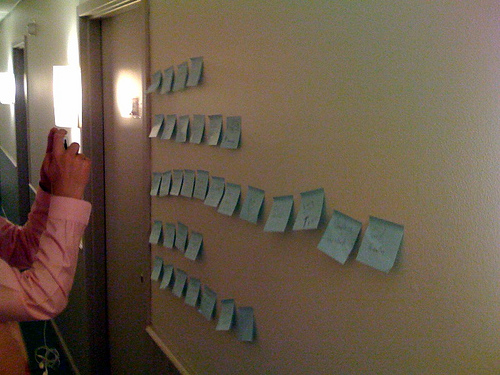
Post-It Outline. One way to prepare that essay. (photo by anselm23)

Short essay

Start with bullet points of the major arguments you wish to make. If you have too many ideas, either condense them into themes or brutally remove all but the very best. Your main tasks are a clear focus and awareness of key points.

Be aware of brevity needed in such a short space and plan accordingly. There’s no need to outline with the aim to cover every possible base. Highlight your most important areas with one or two clear examples.

Work from there and continue working concisely and to the point. When you’re getting too detailed, it’s time to scale back.

Long essay

This essay contains more room to explore. Most essays tend to come under the ‘long’ description, so stay focused. It’s easy to ramble and move away from the question under discussion.

An outline allows you to stay on track and on message.

Ensure each bullet point you make is related to addressing the question. At each stage of the outlining, refer back to the question.

For every major argument you wish to tackle, give sub-headings that relate to proof, examples, counter-arguments (and how you’re dealing with them), quotations and references, and key descriptions of topics and themes.

Presentation

You’re dealing with more than text here. You’ve got your voice, use of technology and slides, interacting with an audience, and so on.

In terms of outline, you need to prepare for all these things. That means a sharp eye on admin and peripheral issues. Your initial outline must cover use of equipment, size and layout of room, handouts, software use, Internet availability, and so on. While none of this is about your actual subject, it’s all relevant to the way you’re conducting yourself. Best assess the situation early, rather than five minutes before you’re due on stage!

As for content, think like you should a short essay. Your main aim is usually to highlight major arguments and workings as effectively as possible. Alternatively, you might be discussing an experiment or some findings you’ve made. All these examples require bold points and clear detail.

If you need a vague outline to play with, pick a start, middle and ending. In other words, introduce, elaborate (tell stories), and conclude. You may also like to quote something in keeping with your presentation at the beginning in order to set the scene.

Dissertation

Assuming you have agreed a dissertation topic, the most important initial outline is the structure. In what order will you present the themes and arguments? Work out the flow of the dissertation before anything else. Each part should follow on from what has come beforehand.

Spend considerable time outlining for your dissertation. It’s worthy of a post in itself, because a dissertation outline is far more detailed than that of a single essay.

Thankfully, in finding a topic, you should have developed some form of basic outline as part of the process.

Practical work & experiments

First off, develop a plan of action and a rough order of play. What needs doing, how should you prepare, and why are you doing this?

Next, explain what comes afterwards and what you’re going to do with your results and outcomes. If you are being assessed for a written element of this work, make another outline plan for that subsequent assignment.

Seminars & weekly reading

Advance outlines work for some students. Think of it like a timetable without rigid times. The timetabling aspect can come later. What matters in your outline is getting to grips with what you want to know at the end of your week, the books and papers you have earmarked, the questions you want to cover before, during and after seminar sessions, and any problems you may encounter.

You may have a better way to prepare for your regular work. If so, great. If not, see if an outline helps get you closer to the work at hand.

For some, a list is enough. For others, a strict timetable is required. Whatever the case, you can outline anything, so give it a go no matter how small your project is.

Are you a keen outliner? Share your outlining tips in the comments below.

Who? That.

You should read Plashing Vole’s post on using ‘that’ and ‘who’ when talking and writing about literature. Does a literary character get lumbered with being a ‘that’ or can they break through to new depths and become a ‘who’?

Plashing Vole explains:

“A Whovian treats characters as real people, a Thaterite analyses them linguistically and celebrates the separation of art and what some people still refer to as ‘real life’.”

Do you have a preference? Plashing Vole prefers ‘who’ and–after brief consideration–I agree it sounds better. I also agree that it’s easier to call a wild animal ‘it’, although I do it for sake of ease and not because it’s a ‘dumb beast’. Unless I went around sexing each creature I wanted to refer to, I’d feel unhappy about giving a 50/50 chance to getting a guess of ‘he’ or ‘she’ correct.

In general English usage, here is what is printed in the Oxford A-Z of English Usage:

“It is sometimes argued that, in defining relative clauses, that should be used for non-human references, while who should be used for human references: a house that overlooks the park but the woman who lives next door. In practice, while it is true to say that who is restricted to human references, the function of that is flexible. It has been used for human and non-human references since at least the 11th century. In standard English it is interchangeable with who in this context.” – p.154 (1st ed.)

Animals are non-human, so ‘it’ seems the way to go. But for literary use? A fictitious character is not human, but does masquerade as one in the mind of the author and reader. At least, that’s the hope.

Perhaps ‘that’ is the easy way out. But when enough people are frustrated by its use, it’s not an easy way out at all. Interchangeable or not, a character that/who is real in terms of what you’re studying is operating in a complicated place.

Given all the potential trouble here, surely we could grace them as a ‘who’…