Nobody knows precisely what they want and exactly how to get it.
If you’re lucky, you can get close. But life isn’t exact. Things change. You change.
And we learn. University allows you to discover new things, find out more about your subject, and find out more about yourself. At least, that’s a big part of what it should bring.
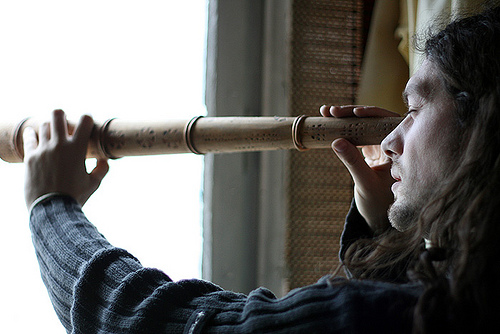
Looking to the future (photo by ckaroli)
From this perspective, you may have a good idea about what you would like to experience and what is necessary to move you forward in the ways you wish. But how that can be achieved and whether everything will fit into place perfectly isn’t a given. There is no exact science, however much you prepare.
Earlier this week, I attended the launch of a new book about the future of higher education, “Blue Skies”. I wrote a chapter for it, about the wonder of contradiction in HE. Yay!
Something that struck me at the launch event was just how much students were at the centre of the discussion. A good thing, since they are a huge part of higher education…
Rod Bristow, President of Pearson UK, said that the National Student Survey is being featured more highly and being used more prominently throughout the HE sector. Universities Minister, David Willetts, agreed and suggested that students are being put in a better position to control where money will go. By voting with their feet, students will make the calls.
Willetts further cements this point in Times Higher Education:
“The critics may dismiss this as mere consumerism. I call it harnessing the power of the student to put the classic values of excellent teaching centre stage once again.”
As a soundbite, this is impressive. As a reality, it is more complicated. Nevertheless, the power of the student can still be harnessed.
You can, and should, form a huge part of what goes on in terms of teaching, learning, research, and the future. In my chapter of the book, I champion the work of “Student as Producer” at the University of Lincoln, which tackles effective student action head-on.
There is no doubt, therefore, that students do have power to make effective change. Anybody has that power given the right circumstances.
Yet surely this power isn’t best actioned by voting with feet and calling a consumer revolution based on fees and a general sense of entitlement, even if the two issues require great consideration.
Frank Furedi puts this far better than I could:
“From a Socratic perspective the very term ‘student satisfaction’ is an irrational one. Why? Because students need to be placed under intellectual pressure, challenged to experience the intensity of problem solving. Such an engagement does not always promote customer satisfaction. Not a few individuals at the receiving end of a Socratic dialogue felt provoked and angry. Today, this old philosopher would not rank very high in a student satisfaction survey. So the question worth asking is ‘ought the satisfaction of the student customer be one of the central objectives of the university?’ From the perspective of the development of a stimulating and creative academic life, the answer must be a resounding NO! The moment that students begin to regard themselves as customers of academic education, their intellectual development is likely to be compromised. Degrees can be bought; an understanding of a discipline cannot.” [Source]
Conflict exists. But does it have to be this way?
Imagine if we lived in an age where fees didn’t exist. A time in which HE was fully funded by the state.
[I know that might be difficult, even hurtful, to consider, but hopefully you’ll get over it…]
If you didn’t have to pay fees, I’m guessing you’d still expect a certain amount of satisfaction from your course. It’s probably reasonable to assume you would not appreciate poorly communicated lectures, a lack of good learning resources, and a run-down atmosphere.
Undergraduate education can still be student centred. But it can be done in ways we have not yet imagined.
David Willetts wants better information given to prospective students. That’s great news. Obviously.
Now we need to carefully consider what information is best placed to help an increasingly diverse set of people choose courses that will work for their individual circumstances.
Nothing can be perfect, but that’s no reason to stop thinking about it altogether.
The chapter following mine in the new book is by former FT columnist, Stefan Stern. He makes a great point that may have been lost over the years:
“…what I shall tell my children in due course is that university is there for them to deepen their love of a subject and to develop as individuals. Job prospects, employability skills and building networks of ‘contacts’, must be a secondary or even tertiary concern. Study something that fascinates you, and worry about the future later on.” [Source]
Is now the right time to get back to learning for the sake of learning? Take pride in your work. Enjoy what you do. Get excited by education in the same way you treat your social life. We won’t be able to irradicate ‘Essay Hell’, but I firmly believe in the possibility that we can easily increase a genuine ‘Care for Coursework’.
What say you? Is this possible? What role should students play for the future of HE?




 TheUniversityBlog