Coursework

Why Your Essay Feedback Isn’t For Your Essay At All

Alan Cann calls this one ‘a bit depressing‘.

A new study found that:

“…a replacement of manually generated feedback with automatically generated feedback improves students’ perception of the constructiveness of the provided feedback substantially (undergraduate) or significantly (postgraduate).”

I don’t know why more respondents preferred automated feedback. Could it be because students aren’t frequently told that feedback is best used in order to improve on future assignments?

How clearly are students made aware of the need for ongoing assessment? If you don’t fully appreciate the way detailed and specific feedback can help you, the auto-generated feedback may seem a great idea. Get the grade and some general advice and walk away with all the info you think you need.

(photo by jepoirrier) (CC BY-SA 2.0)

(photo by jepoirrier) (CC BY-SA 2.0)

On the face of it, an automatic report makes sense. Anything beyond that seems like a time commitment with little gain. There may seem no point poring over the details when the essay has already been submitted.

But feedback isn’t for the past, it’s for your future work. General advice and rough guidelines won’t do more than weakly nudge you in the right direction. For the best hope of improvement, you need to respond to detailed information that is tailored to your specific circumstances.

Detailed feedback may be hard to swallow when you have a lot to improve. That may also explain why some people would prefer automatically generated reports. They feel one step removed, so you almost have an excuse not to listen. It wasn’t aimed exclusively at you, so there’s wriggle room and you don’t need to take the advice so seriously.

Whatever flavour your feedback comes in, consider these points:

  • Have an open mind – You may not like to hear that you’re not perfect, but the more you put your head in the sand, the less likely you are to even get close to perfection. Make the opportunity to action problem areas rather than defend yourself.
  • Think of the future – Work out what you would have done to improve the essay and remember that so you can make a similar effort in your next piece of coursework.
  • Ask more questions – When you’re not sure what the feedback means, speak to your tutor for more information. The key is to get a detailed understanding of how you can improve, so keep searching until you have a plan on which steps to take.

Automatic feedback isn’t useless, but it needs context and it should never be the only type of feedback given. It’s not enough when the aim of higher education is to dig deep and explore the possibilities.

There are loads of things you can do with your assignments when you get them back. The grade is just one part of it. Check out these links from the TUB archives for more tips on using your essay feedback:

Outlines Are Not All Equal

A short essay is not the same as a long essay. A presentation is different too. So is a dissertation.

That means your preparations need to vary. How you approach each assignment is important.

Outlines are a great way to build an idea of what you want to produce. Here are some brief notes on how your outlines could differ, depending on which type of coursework you are working on.

(photo by anselm23)

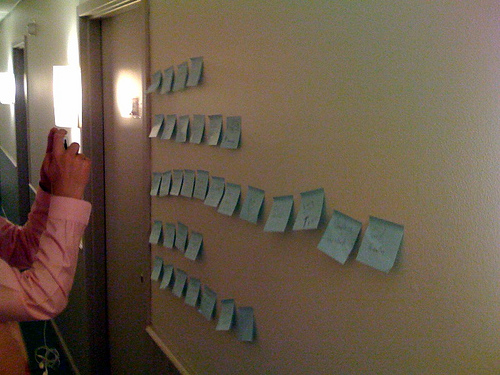
Post-It Outline. One way to prepare that essay. (photo by anselm23)

Short essay

Start with bullet points of the major arguments you wish to make. If you have too many ideas, either condense them into themes or brutally remove all but the very best. Your main tasks are a clear focus and awareness of key points.

Be aware of brevity needed in such a short space and plan accordingly. There’s no need to outline with the aim to cover every possible base. Highlight your most important areas with one or two clear examples.

Work from there and continue working concisely and to the point. When you’re getting too detailed, it’s time to scale back.

Long essay

This essay contains more room to explore. Most essays tend to come under the ‘long’ description, so stay focused. It’s easy to ramble and move away from the question under discussion.

An outline allows you to stay on track and on message.

Ensure each bullet point you make is related to addressing the question. At each stage of the outlining, refer back to the question.

For every major argument you wish to tackle, give sub-headings that relate to proof, examples, counter-arguments (and how you’re dealing with them), quotations and references, and key descriptions of topics and themes.

Presentation

You’re dealing with more than text here. You’ve got your voice, use of technology and slides, interacting with an audience, and so on.

In terms of outline, you need to prepare for all these things. That means a sharp eye on admin and peripheral issues. Your initial outline must cover use of equipment, size and layout of room, handouts, software use, Internet availability, and so on. While none of this is about your actual subject, it’s all relevant to the way you’re conducting yourself. Best assess the situation early, rather than five minutes before you’re due on stage!

As for content, think like you should a short essay. Your main aim is usually to highlight major arguments and workings as effectively as possible. Alternatively, you might be discussing an experiment or some findings you’ve made. All these examples require bold points and clear detail.

If you need a vague outline to play with, pick a start, middle and ending. In other words, introduce, elaborate (tell stories), and conclude. You may also like to quote something in keeping with your presentation at the beginning in order to set the scene.

Dissertation

Assuming you have agreed a dissertation topic, the most important initial outline is the structure. In what order will you present the themes and arguments? Work out the flow of the dissertation before anything else. Each part should follow on from what has come beforehand.

Spend considerable time outlining for your dissertation. It’s worthy of a post in itself, because a dissertation outline is far more detailed than that of a single essay.

Thankfully, in finding a topic, you should have developed some form of basic outline as part of the process.

Practical work & experiments

First off, develop a plan of action and a rough order of play. What needs doing, how should you prepare, and why are you doing this?

Next, explain what comes afterwards and what you’re going to do with your results and outcomes. If you are being assessed for a written element of this work, make another outline plan for that subsequent assignment.

Seminars & weekly reading

Advance outlines work for some students. Think of it like a timetable without rigid times. The timetabling aspect can come later. What matters in your outline is getting to grips with what you want to know at the end of your week, the books and papers you have earmarked, the questions you want to cover before, during and after seminar sessions, and any problems you may encounter.

You may have a better way to prepare for your regular work. If so, great. If not, see if an outline helps get you closer to the work at hand.

For some, a list is enough. For others, a strict timetable is required. Whatever the case, you can outline anything, so give it a go no matter how small your project is.

Are you a keen outliner? Share your outlining tips in the comments below.

Make Your Work Compelling

The difference between compulsory and compelling is huge.

Compulsory sounds negative. You must do something, whether you like it or not.

That’s enough to put you off most compulsory stuff. The psychology is all wrong.

Compelling sounds great. You must do something, because you’re excited to keep going. You’d hate to stop.

Zen at work

University involves a lot of work, so it helps when you want to do it. But when you have deadlines to fulfill and the need to submit thousands of words, it’s easy to switch your attention to what’s compulsory.

Do yourself a favour and concentrate on the reasons why you’re interested in your work. The more compelling you make it, the easier you’ll find the less savoury points.

Terry Anderson sees possibility in this through self-paced learning, especially through “sophisticated social networking contexts” that let students discover each other and interact in realtime as well as through past comments and artifacts from previous students on a course.

You may not have this luxury on your degree for most, if not all of your assignments. But there are other ways to turn your attitude from plodding to probing.

Regain Your Enthusiasm

  • Start with an interesting question – What makes you tick? What would you like to know? Where do you want to explore today?
    Thinking about word counts and submission dates will only fill your mind with stress points. Bring your focus to the assignment itself, not the logistics.
  • Don’t overthink it – Once you’ve asked interesting questions, keep working on them until you start to grow tired of it. When you feel things dragging, stop right there. Pack up. Do something else. Even the most fun activities get boring when you don’t stop. So learn to let go.
  • Team up with others – Deconstruct, discuss, debate. Five minutes may be all it takes to uncover talking points that get you enthused about the task at hand. Whether or not you like to work in a group, an academic chat can get the creative juices flowing. If you’d prefer to do the actual work on your own, that’s fine. Once the urge is there, your mission is to stay in the mood to work with a spring in your step.
  • Space things out – The nearer you get to the deadlines, the more you focus on the compulsory aspect of your work. You avoid this by starting early and doing the work bit by bit. Not too much in one go, and certainly not all at once at the last minute.
  • Make it a habit – The longer you procrastinate, the more likely you’ll see the compulsory over the compelling. As well as spacing things out, as I mention above, find ways to develop habits to ease into the work. Habits can be different for everyone and is enough to be the subject of many texts, including Charles Duhigg’s recent book, The Power of Habit.
    Duhigg says that you should identify current routines for habits you would like to change. What is the cue that leads to your habit taking over? Next, choose different outcomes (it doesn’t really matter what they are) to work out what cravings are truly driving the routine. Then isolate the cue. Are you reacting to your location, the time of day, how you feel, what happened just beforehand? In time, you’ll find a pattern will emerge. Finally, have a plan. Commit to a new habit that you feel is better placed for what you want to change. From first-hand experience, Duhigg found embedding a new habit to be a challenge, but it was worth persevering.

Let the subject excite you and stop the admin from getting you down. So much of the change from compulsory to compelling is in the attitude. Set things up for an activity you don’t want to stop doing. And when you do stop, you’ll miss it.

That will make a change from never wanting to see it again, eh?

Press Save

Many moons ago, I sat down to reply to an email. A really long email.

I poured my heart out. Not literally, of course. That would have been weird.

But it was a masterpiece of personal writing. I was confident that the recipient would have a life-changing moment as soon as they saw my delightful prose upon their screen.

The end was in sight as I started the final paragraph, wrapping up the loose ends and signing off with a “Broom Broom for now”. Don’t ask.

As I sat there, half typing, half grinning smugly at my genius, something rather annoying happened.

A power cut.

photo by Jacob Haas

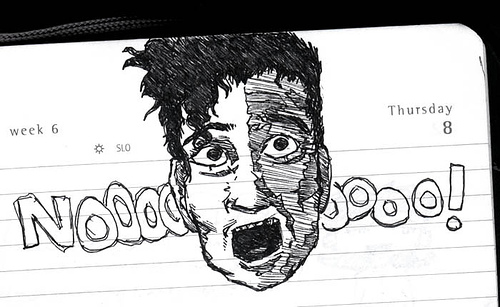
NOOOOOOOO! (photo by Jacob Haas – CC BY-ND 2.0)

I lost everything. Over an hour of writing gone. Around two-thousand words never to be seen again. Yes, this was an era before auto-saving drafts were the norm. That type of thing was reserved for Microsoft Word. Ah, the memories!

Let’s say I was unhappy and leave it at that. In the end, my re-written reply was two short paragraphs and a mumbled annoyance that lamented the lack of a witty and wonderful response after the power went out. It probably made no sense to the person at the other end of the message. No matter; I didn’t care any more.

I write this as a warning to you when you’re tapping away in a state of flow. You’re in the zone and on top of the world. Piffling stuff like saving the document doesn’t occur to you when everything’s going so well.

And despite the auto-saving beauty of so much we do these days, I’m sure the one time you encounter disaster will be the one time that automatic life-saver isn’t there to help you.

For me, it was just an email. That hurt enough.

Imagine the horror if it was, say, one of your essays.

On an allnighter the day before it’s due in.

And you’ve already had an extension.

Please. Press save. Back it up. Do it now.

And breathe.