Author: Martin

Celebrating university life in all its diversity. Helping to achieve a full, entertaining, productive, and successful experience.

January: Month of the ‘Best of…’ Posts [EduLinks]

Now that TheUniversityBlog is back, how about a load of links? Lots of ‘best of’ features for you to grab loads of goodies from last year’s haul of great online content.

First up, the Guardian has predictions for the 2014 graduate jobs market. What does your future hold?

Leo at Zen Habits presents great content on reaching your best potential and leaving pointless actions behind. Here are his favourite posts from 2013.

Becoming Minimalist shares a highlights post. Don’t worry, you don’t have to be a minimalist to get value from the posts. You may start becoming one soon though!

Tyler Tervooren at Riskology.co starts his version of the 2013 ‘Best of’ post with a bang. “11 Lame-Ass Excuses You Make Every Day That Are Ruining Your Life”. Can you handle it?

Jane Hart links to the 50 best articles she read in 2013. Education-wise, there’s something for everyone.

With a postgrad vibe, Patter has her top 10 posts from 2013.

Tony Bates looks beyond 2014 and thinks about online learning in 2020.

Paul Greatrix (aka @registrarism on Twitter) brings together his collection of 2013 (and 2012) posts on The Imperfect University. Well worth a read if university admin and policy is your thing.

As for beefy study tips, I’ve got a heavy, but valuable read. A journal article that breaks down the very best ways to learn and study. Sadly, the usual techniques are generally the least effective. It’s heavy, but important stuff. Set aside a bit of time for reading so you can work more efficiently in the future.

That’ll keep you going for a while. What did you read in 2013 that inspired you to do awesome things? Share the wealth!

Winner (photo by kreg.steppe) (CC BY-SA 2.0)

(photo by kreg.steppe) (CC BY-SA 2.0)

TUB Reboot – TheUniversityBlog in 2014

Here comes a lot more from TheUniversityBlog, or as I affectionately call it, TUB! More great stuff on the site and a newsletter too.

I spent an extended time away and had a great time. Of course, I missed all of you too. Moving away from the social pulse is strange.

It felt a bit like Doug Belshaw’s BlackOps, where he takes a month (or two) off from social networks and email. Last week I did a lot of catching up and participated in Martin Couzins’ great new course on how to be an effective digital curator. The course is a great way to get lots of people together who are interested in collecting and shaping content, so it was a good way to get back in the swing of things online.

Updates

Now we’re very much in 2014, I wanted to make a few changes. For a start, I’ve updated the site. What do you think about the new look? If you read via email or a feed, come and take a peek. I plan to increase the post numbers again, with a selection of shorter pieces alongside the lengthy posts.

But I need your input for the most relevant stuff. Do you need more exam tips? Want to sort out your work/life balance (or don’t even think it exists)? Interested in higher education in the news? Have something on your mind that you wish was covered here? Get in touch and let me know which aspects of uni life you want the lowdown on.

Newsletter

I’m also about to start a newsletter, ‘TUB Thump‘. Eagle-eyed readers will have noticed a signup link on the sidebar. Many, many thanks for those of you who have already subscribed. The first edition of the Thump will be out soon.

You want in? For exclusive content, competitions, quick tips and great links, sign up to TUB Thump here. Only the best from TUB Towers.

Let’s make 2014 shine!

(photo by Neal) (CC BY 2.0)

(photo by Neal) (CC BY 2.0)

UCAS Statistics and Looking Cautiously Ahead

UCAS has released statistics for the number of university applicants so far this year. The numbers for the November comparison point show a 4% drop in UK applicants compared to last year. Applicant totals so far are closer to 2010 figures.

However, the 2010 figures for UK applicants increased by 340% between the November comparison point and the January deadline. Compare that with a 300% increase in 2011, 250% in 2012, and 300% in 2013. As we are regularly reminded, information provided in the interim should not suggest any specific course of events. Early figures of this type rarely provide an idea of the final outcome.

We can't see the future, but that doesn't mean we should wait until it's happened.

We can’t see the future, but that doesn’t mean we should wait until it’s happened.

Chief executive of Universities UK, Nicola Dandridge, explained that direct comparisons cannot be made as this year’s figures have been taken on a different date. Dandridge also recognised that applicants are increasingly using the whole time available up to the January deadline, rather than applying straight away.

So while nothing is set in stone, these statistics offer us a guide to possible scenarios that could play out.

Is this year’s drop partially down to potential applicants (and their parents, carers, etc.) giving greater consideration to their decisions from the outset? And will their caution result in a big surge toward the end or a clear dip?

Much of this depends not so much on tuition fee worries, but on viable and comparable alternatives to higher education. I don’t feel we have yet reached a point where large numbers of school leavers are realistically considering many different routes. New ideas are brewing, but university is still a big driver and still seen by many as ‘what you do’. How long will this attitude last?

The 2011 White Paper said it was time for students to vote with their feet:

We want a diverse, competitive system that can offer different types of higher education so that students can choose freely between a wide range of providers.” – p.47, Students at the Heart of the System, 2011.

It assumes that people will choose the best university for them. But what if people instead choose no university at all?

The thing about feet is that there’s more than one way to vote with them.

[Update: Nick Entwistle pointed out that the 4% drop is roughly in line with population figures for 18 year olds. As numbers in that demographic are currently on a decline, that makes sense. It’s another important factor to consider and I forgot to mention that, so thanks Nick!]

Beauty and the Beastly Spend

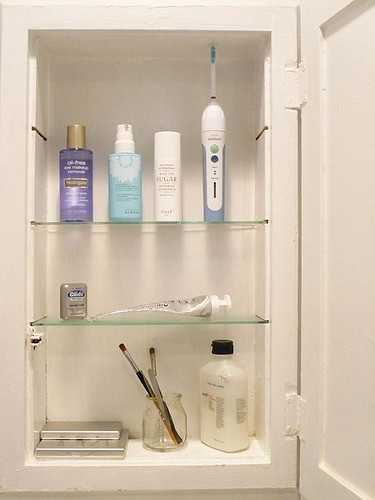
After I read how students are spending hundreds of pounds on beauty products, I quickly worked out how much I spend each year.

Lancaster students are apparently the biggest spenders, with an average of £1,109 a year going on beauty products.

(photo by sparklerawk) (CC BY-NC-ND 2.0)

Looking good. But are you a beauty super-spender? (photo by sparklerawk) (CC BY-NC-ND 2.0)

I don’t know what qualifies as a ‘beauty product’, but I’ve included soap and deodorant in my list of products. Do they count? I’d label them more ‘necessary’ than ‘beauty’.

Even if they do count, let’s just say I’m definitely not in the same league as the average students questioned in the survey. From the results, you may be horrified to meet me as ‘beauty’ appears not to be my middle name…

Because I don’t spend £1,109. Lancaster have certainly beaten me here.

I don’t spend £500.

Not even £100.

I seem to be insanely cheap. My total spend on ‘beauty’ products (including soap and deodorant, remember…) is a paltry:

Twenty-two pounds a year.

£22. That’s it.

It’s down to my eco-living attempts and a tendency to ignore products with a worrying ingredient list. Back on campus, I probably spent more like £150 a year. A very rough guess, but clearly a lot more than I do now. Still nowhere near the figures compiled in this latest survey.

Next year I’ll be spending over £30, because I have to buy a new post-shave moisturiser. How very dare I?

What’s your yearly beauty spend?