Month: May 2010

EduLinks – Lists, Loneliness & Lacking Privacy

Back again with loads of weekend reading and lush links for you.

Ben Casnocha – 50 Ways to Expose Yourself to Randomness

A list of ideas to launch you into new, exciting, interesting things.  You may not want to try any of the 50 suggestions here, but the point is to go and do something different that could open your eyes and take you to wonderful places.

Marc & Angel Hack Life – Top 40 Useful Sites To Learn New Skills

One of those great resource posts to bookmark and (hopefully) not forget.

BBC Magazine – What’s the difference between being lonely and a loner?

It’s okay to have loner moments.  It’s not the same as being lonely.  When you’re lonely you want company, when you’re being a loner you’re happy without it.

Politicrit – I #loveHE, so why don’t you?

Newell tells me this post felt like a great big rant.  But I like it and it reads well.

“I don’t work within the HE sector-although I like to think I work partly for it-but I regularly meet lecturers, Vice Chancellors, activists and student representatives. Every time I leave these meetings I leave in awe of the person that I’ve met. So why is it that this sector, which I will unashamedly admit I love with an ever growing passion, is constantly met with criticism, cuts and public apathy?”

BookBoon

BookBoon offers academic textbooks on its site for free.  With a growing collection on numerous topics, you should give them a visit to see what books may be of use to your study.

Smashing Mag – Bizarre Websites On Which You Can Kill Time With Style

Finished your exams now?  No?  You’re still busy?  Ah, then I don’t recommend you clicking the link above.  It’s too dangerous…

Compare My Radio

Tracking what gets played on UK radio stations, this site shows you what’s popular on the playlists.  Most interesting is the ‘variety gauge’, which lets you see how much a station repeats the same songs over and over again.  Compare BBC 6 Music’s 62% variety with Capital FM’s 3% variety.  Capital played only 240 unique tracks in the last month, while 6 Music played 3,603 unique tracks.  So when you say some radio stations seem to play the same tracks all the time, you wouldn’t be far wrong.

Search Engine Land – Facebook’s New “Simple” Privacy Settings Still Pretty Complex

Due to a huge backlash from users and critics over privacy settings, Facebook are responding by making the settings simple again.  Well, simple-ish.  What difference it makes, we’ll soon find out.  In the meantime, with so many users pumping out status updates and personal information to the world, you’re free to search what’s being said via services such as Booshaka and Openbook.  Tut tut.

Universities Week: What’s the Big Idea?

Universities Week is on 14-20 June 2010, hoping to engage the public with positive stories about the great role universities play in society.  Sad thing, as someone pointed out to me on Twitter, is that most universities won’t exactly be full of students in the middle of June…

Times Higher Education – Pulling Power

Why choose a particular uni?  What makes some institutions more exciting than others?  And just how does the London School of Economics get so many applicants (nearly 16 applications per place)?

Constructively Productive – 36 Secrets the Productivity Gurus Won’t Tell You (But Our Heretics Will)

Thursday Bram and Ali Hale have set up a new site that tries to bring “perspective to productivity”.  The above link brings all manner of people together to discuss unusual ways that they stay productive.  Because what works for one person won’t necessarily work for another.  The answer to what works best for you can only come from you.

Do you act on ideas, or encourage them to fade away?

Have you ever been in a situation where you felt so hyped up about something that your brain was buzzing with ideas?  So many great plans rush around your head and you can’t wait to start actioning all this great stuff.

And then?

And then nothing.

The initial excitement seemed enough to enthuse you to work on all sorts of projects.  The reality is different.  The rush disappears pretty quickly.

I’m not just talking about world-changing ideas and genius inventions.  Anything that inspires you is liable to disappear if you forget how it made you feel.

As a student, I had difficulty with this.  A LOT of stuff was exciting.  Every five minutes I’d feel involved in a big idea and I needed to drop everything.  Yeah, drop everything until the next big thing came along in another five minutes.

I still get this and I think it’s impossible to do anything different.  But I don’t let go of ideas that give me a huge buzz until I’m sure it’s not worth my time.

Why is it so easy f0r ideas to fade away and how can you give them more chance of moving beyond an initial idea?  Let’s explore some of the issues:

original photo by Isa's Photography

original photo by Isa's Photography

You have too many ideas

Classic problem.  Everyone thinks about stuff all the time.  You have more big ideas than you realise.  But you’ve got to drop some. A handful of big projects is manageable.  A forever increasing supply may feel safe, but it stops you working on any of the projects.  Go with your priorities and biggest ideas.  Unless it’s time sensitive, everything else can wait.  If it is time sensitive, but not a big deal, is it really worth your time?  Be brutal.

Forgot what you wanted to do (i.e. you didn’t write it down)

Slap yourself on the wrist and learn for future brainstorms.  The whizz of ideas in your head is nothing compared to those ideas written down.  Once you’ve noted the idea you can delve further without fear of forgetting what went before.

Idealised more than realised

You were excited, but it feels more like a pleasant dream of what could be.  “One day,” you think, not committing to anything.  If you’re happy not to go further, so be it.  But regrets come easy if you brush too many great ideas aside. Don’t forget that.

You ignored so many gaps/flaws, the plan now looks unworkable in reality

Fair enough, you went too far in a ‘perfect world’.  But before you scrap it all as a big joke, take another look.  How could you fill some of the gaps without going crazy (or doing something illegal!)?  It may not be as ridiculous as you think.

photo by Joel Bedford

photo by Joel Bedford

Following up the initial idea seems too much work (or you don’t have enough time)

Are you still interested, despite the lack of time?  If so, what activities can you afford to remove from your busy schedule to make way for time on your big idea?  You have just the same 24 hours in each day as anyone else.  What once seemed important may not be as important as your new plans.  So long as you don’t jump around aimlessly from plan and plan, a change in priorities can give you a fresh view.

Excitement has gone. Not the big deal you thought it was

These things happen.  You haven’t lost anything.  The next great idea is around the corner. You know it! 🙂

Fear of failure

Tried and failed? At least you tried.  Didn’t try at all?  Then you’re stepping in to “what if” territory and the possibility of regrets further down the line.  You owe it to yourself to push past the fear.  Many situations fail without complicated or embarrassing consequences.  When you do 100 things and succeed once or twice, it’s bound to be better than doing nothing at all.

Lack of others championing the idea now

Ideas can come from groups.  It’s easy to get swept away with the emotion and the passion shared with those around you. When they’re gone, you need self-belief and a personal drive toward the end goal.  If you’re lacking in enthusiasm, remember how you felt when you initially embarked upon things and why it felt so important.  Imagine how your efforts could help others or make a difference that counts.  You don’t need constant appreciation to realise your plans, but you do need a constant view in your mind of reaching the end goal.

photo by Janine

photo by Janine

Critics have pushed your ideas down a notch (or three)

I recently said how easily critics can crush you.  But how much better do they know?  Constructive help is fair enough, but random criticism is pointless.  Anyone in the public eye has to deal with loads of criticism, much of it throwaway, basic and opinionated.  They won’t stop doing what they believe in, so why should you?

Seems like too much work for too little gain

Stepping back a bit, you may be right.  What looked simple may not be the blessing you thought it was.  However, do consider if you can make that gain using an alternative method that’s less painful.  There’s often a way.

You need support, but don’t believe you can get it

First, you’d be surprised how much support is out there.  Second, have you considered all the types of support available?  You can get support other than just money and people power.  Third, what makes you so sure the support won’t be forthcoming?  Fourth, if that’s the only thing getting in your way, you’d be crazy not to at least try for some support.  Stopping at this stage would be like giving up at the last hurdle when you’re at your fittest.  My advice is keep going until you’ve tried to clear that hurdle with your best effort.

How easy do you find it to act on your ideas?  Do more fade away than you’d like?  What do you do to stay inspired?

Bigger picture thinking: Why it helps to go back to basics

I’m a big fan of seeing the ‘bigger picture’.  I prefer to get a rounded view of what’s going on before getting too bogged down with the detail.

Once I have the basics in place, I’m all set to engage with the specifics, because I have built a foundation from which to explore.

This approach isn’t tough and should save time in the long run.  However, far more often you’ll find people working in the opposite direction.  First they take on the specifics, only to discover what’s surrounding them afterwards.

I fully understand the need to specialise.  If nobody dug deep, we wouldn’t advance in the spectacular ways we do.

But you can’t specialise convincingly until you’ve taken account of the bigger picture in the first place.  There’s nothing wrong with getting back to basics.  It’s so much easier to achieve a clear, focused attitude once you see the big concepts that are flying around you.

photo by dvs

photo by dvs

You’re likely deep in exams and revision hell right now.  Either way, think about your revision technique and how you best take information in.  At degree level and beyond, a bunch of specialist facts without a grounding or any basic connections won’t get you far.  You can memorise all sorts of detail, but putting it all into place is practically impossible.

At any time you feel uncertain, whether it’s in your study or an everyday situation, don’t be afraid to look outward at the basic information until you reach a point of understanding.

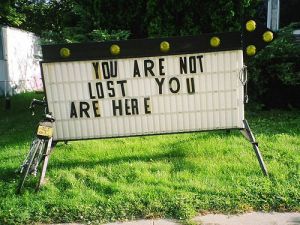
Imagine getting lost when you’re out.  The first thing you want to do is find a familiar landmark or a sign for a place you can get your bearings from.

Next time you don’t fully understand something, try stepping back a little and take into account the basics.  Search for that familiar landmark.  Keep stepping back, revisiting more basic concepts each time until you reach a point of understanding.  From here, look again at what seems to be getting in the way of your grasp of the topic.  Quite often it’s not a specific detail you’re missing, but a more general overview.

Who are you trying to impress? Cast aside the critics!

The creative process is never easy.  I’m not just talking essays.  Even the stuff you want to create is an uphill struggle.

Even a blog post, like this, is liable to bring a person down on their knees.  I want to make something, but I also want it to have meaning, value and purpose.  A lot of thought needs to go into the work.

photo by alicepopkorn

photo by alicepopkorn

How much care and attention should you give to a job before it’s presentable to anyone else?

Notice that I use the word ‘presentable’.  This isn’t about perfectionism.  I’m looking more at the self-conscious concerns that build up as soon as you start writing our own script.  You’re don’t know what direction this will take.  It’s exciting.  It’s interesting.  It frees you up to do what you want.

And that’s scary.

All at once you feel an awareness of a critical public watching your every move, preparing to pounce on every weakness.  All eyes are on you.  The critical public are waiting for you to slip up.

Most of that critical public exists only in the creator’s head.  Unfortunately, that’s the worst place the critics can exist!  It only serves to make the real-world critics seem even more threatening.

Critics, wherever they exist, should be no threat.  You owe it to yourself to push past the critics and get on with living:

“Sure, criticism hurts.
But a life unlived hurts more.” – Jonathan Fields

All too often, criticism is a trap.  Let’s say you’re performing something for 20 people.  19 of those people are satisfied with what you’re doing.  Only one person questions your performance and digs in to what they saw.

How do you react?  Are you happy that 19 people appreciated what you did, or do you focus on the one critic?  Or…or…do you stick to appreciating your own creative process in your own way?  You don’t have to focus on any of the 20 people.

Nevertheless, many people would react to that one critic in the room.  It hurts and the comments may eat away at you for a while.  I’ve fallen into that trap before.  In the hugely connected and public world we now live in, we are acutely aware of our position under the spotlight. Just one comment can lead to doubt.

Whenever you doubt yourself, remember this: you are an individual with faults and failings, just like every individual.  If you can use criticism to improve your future efforts, fantastic!  But mere opinions that goes against your creative plans aren’t worth worrying about.

Artist Grayson Perry has an interesting take on the creative process:

“Being creative is all about being unself-conscious; being prepared to make a bit of a fool of myself. In my experience, embarrassment is not fatal.”

Robert McCrum analysed Perry’s words in The Guardian and makes an interesting point:

“If genuine originality is at stake, the artist will probably be in two minds about what he or she is up to, and unwilling to offer an easy account.”

Is it acceptable for us to make public mistakes or to step back from trying to impress everyone out of fear?  Will there really be any relevant and damaging repercussions if you suffer the odd embarrassment?

Try your best and it’s highly unlikely you’ll suffer any real damage in the process.  Creativity is random and subjective.  If you have a willingness to learn from all that you do, criticism should either be constructively helpful to you or words to ignore.

It’s impossible to know how to impress all the time.  The creative process is about enjoyment and discovery.  Creativity under stress isn’t creative at all.  Have you ever heard of restrictive creativity?  No, me neither.