Study

Why the learning experience is greater than end results

A friend of mine struggled with tests as a child.  Any time an assessment was coming up, his mind would go blank and he’d panic.  The pressure of passing weighed down on him to such an extent that no manner of revision or study took him any further.

original photo by sashamd

original photo by sashamd

A couple of days before another test, the worry became too much and he asked his Dad for help.  His Dad, being a schoolteacher (and his Dad!), was a pretty good person to talk to.

Dad said, “You don’t need to worry about tests if you always try your best.  There’s more to life than getting full marks.”

The father went on to say that an interest in learning is far more important than focusing on a test result.  If you can honestly tell yourself that you worked with a view toward learning and discovery, the results should follow.  Get 0% or 100%, the mark doesn’t matter if you work hard in the process.  The results will come naturally.

My friend continued his preparation for the test.  This time, the learning was more fun.  He felt less stress and more connection with the learning materials.

On the day of the next test, he turned up at school with a totally different perspective.  There was a sense of peace. Terror didn’t pin him down.  Despite feeling nervous, he was confident.

And (surprise, surprise) he passed without difficulty and with high marks.  This success came about from one small change of focus.  Instead of concentrating on the end result, the focus was on the learning experience as a whole.

My friend has taken his Dad’s advice with him ever since and loved his time at university, while getting solid grades along the way.  He teaches other children now and I hope he’s able to pass on what he discovered to his pupils.

Unfortunately, schools are under so much pressure that many teachers are used to talking at their pupils rather than engaging in active conversation.  This doesn’t allow students to “perform at their optimum”.  At a time when pupils should be encouraged the way my friend was, they’re in real danger of being let down.

An Institute of Education (IoE) study on learning recently found that the advice my friend was given is effective in helping students achieve much better grades than those who are focused on results:

“In one study, some teachers were told to help pupils learn while others were told to concentrate on ensuring that their pupils performed well. The students under pressure to perform well obtained lower grades than those who were encouraged to learn.

“Another study showed that when teachers focused on their students’ learning, the students became more analytical than when the teachers concentrated on their pupils’ exam results.

“A further study, of 4,203 students, showed classroom behaviour improved when teachers focused on learning rather than grades.”
[Guardian]

At university, you are far more responsible for your own learning.  Luckily, that means you don’t have quite the same pressures with teachers focusing on your grades in the same way.  However, you need to make decisions over what you’re going to focus on.

So what will it be?  Focus on the result, or focus on the learning?  A focus on the learning allows the end result to develop favourably, whereas a focus on the result clouds the process.

Chris Watkins, the author of the IoE report says, “passing tests is not the goal of education, but a by-product of effective learning”.

Perhaps it’s time to give learning a fresh approach.  Involve yourself in the research.  Get interested in the material on offer and actively seek out more information.

Learning is key.  The focus on a First or 2:1 shouldn’t be necessary when you’re in it for the learning.

What is learning?

It doesn’t matter HOW you learn if you ARE learning.

Perhaps an over-simplified point.  Nevertheless, how you learn has to come first.  What you learn comes next.  Without the ‘how’ you can’t have the ‘what’.

photo by Jeezny

photo by Jeezny

But where does ‘how’ end and ‘what’ begin?  Does a person know when they are learning?  At what point do you know you’re learning the right thing?  Does a top grade prove you’ve mastered:

  • The ‘how’;
  • the ‘what’;
  • both;
  • neither;
  • or something else entirely?

Take the person next to you in a seminar.  They may be on the same degree, studying the same modules, but you will both learn different things and you will learn in different ways.

For all the similarities between yourself and a person next to you, your focus is unique, so you must be responsible for what you learn.  You can learn to play the trumpet, but it won’t be worth a thing if you were meant to be researching computational physics.  A stupid example, but it shows that a link must be achieved before you can learn with a particular end goal in mind.

If that’s the case, what exactly is the ‘what’ of learning?  You can learn anything, but the true relevance is in tackling what is appropriate to your situation.

In this regard, you can only take an ‘educated guess’.  That guess may be quite obvious to you and it may be the same guess the vast majority of people make.  However, this doesn’t make it any more objective.  Your job in learning is to develop, to understand, to question, and to explore.

That’s a pretty open remit.

But you’re not alone.  Guidance and motivation are provided along the way.  Tutors help shape your experience and give you a platform to start from.

At this point, learning itself is more important than the tutor or the student.  Tutors cannot be expected to dish out answers and clear the way until a single, specific path is left open.  Many paths are available, none of which are simply ‘right’ or ‘wrong’.

Learning is subjective.  And that’s okay, because higher learning wouldn’t exist without subjectivity, no matter what the topic.  Break things down to their core concepts and it’s still difficult to give a definitive answer to a question such as, “What is learning?”

Such uncertainty sounds negative at first.  But it’s not.  It’s exciting.  The possibilities are endless.  And the power is yours.

You need to do one thing.  It’s the most simple and most difficult thing about study within higher education.  You must take responsibility for your learning.  ‘How’ you learn and ‘what’ you learn will somehow fit in naturally after that.  But you need to want it.

Keep going down the road long enough and you may even find that valid link between trumpet playing and computational physics.

Why fiction is necessary

Fiction is as necessary and important as non-fiction.  Just the facts m’am?  Nope.  Step beyond reality and reap the rewards.

photo by kevindooley

photo by kevindooley

Facts without fiction won’t work.  In most instances, fiction has elements of truth in it and non-fiction can still be crammed with stories (and even fabrications!).

Make the most of all angles.  For a few months, I hadn’t been reading any novels or short stories.  Big mistake.  I really missed the ride and I won’t make the same mistake again quickly.  I felt my own imagination flagging.

Imagination was recently discussed in the Chronicle of Higher Education:

“Surely we would be better off pursuing more adaptive activities—eating and drinking and fornicating, establishing relationships, building shelter, and teaching our children. Instead, 2-year-olds pretend to be lions, graduate students stay up all night playing video games, young parents hide from their offspring to read novels, and many men spend more time viewing Internet pornography than interacting with real women. One psychologist gets the puzzle exactly right when she states on her Web site: ‘I am interested in when and why individuals might choose to watch the television show Friends rather than spending time with actual friends.'”

We love stories.  Even when looking for truth or reading a textbook, some of the best lessons come from stories.  As I’ve said before, storytelling is powerful.  Just as we can inspire by telling stories, we’re suckers for the things ourselves!

Hard facts and dry recounting of events are enough to put casual readers off.  This is probably why “many people seek out certain types of fiction (historical novels, for example) because they want a painless way of learning about reality”.

Yet it goes further than learning.  Amazing philosophical thoughts and questions come out in fiction.  Your life can change for the better when you’re inspired by a character that doesn’t even exist.  A fictional success may be an advantage in the real world…In your world:

“Often we experience ourselves as the agent, the main character, of an imaginary event. To use a term favored by psychologists who work in this area, we get transported. This is how daydreams and fantasies typically work; you imagine winning the prize, not watching yourself winning the prize.”

The drama and the condensed nature of fictional situations give us a more intense excitement.  No wonder we revel in the activities of imaginary characters and put ourselves in their place.  The fiction is necessary to inspire, to open our eyes, to discover heroes to aspire to.

We all need heroes in order to get our own chance at saving the world.  Who says our heroes have to be physical beings?

Bigger picture thinking: Why it helps to go back to basics

I’m a big fan of seeing the ‘bigger picture’.  I prefer to get a rounded view of what’s going on before getting too bogged down with the detail.

Once I have the basics in place, I’m all set to engage with the specifics, because I have built a foundation from which to explore.

This approach isn’t tough and should save time in the long run.  However, far more often you’ll find people working in the opposite direction.  First they take on the specifics, only to discover what’s surrounding them afterwards.

I fully understand the need to specialise.  If nobody dug deep, we wouldn’t advance in the spectacular ways we do.

But you can’t specialise convincingly until you’ve taken account of the bigger picture in the first place.  There’s nothing wrong with getting back to basics.  It’s so much easier to achieve a clear, focused attitude once you see the big concepts that are flying around you.

photo by dvs

photo by dvs

You’re likely deep in exams and revision hell right now.  Either way, think about your revision technique and how you best take information in.  At degree level and beyond, a bunch of specialist facts without a grounding or any basic connections won’t get you far.  You can memorise all sorts of detail, but putting it all into place is practically impossible.

At any time you feel uncertain, whether it’s in your study or an everyday situation, don’t be afraid to look outward at the basic information until you reach a point of understanding.

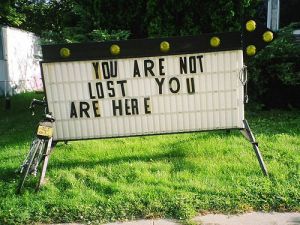
Imagine getting lost when you’re out.  The first thing you want to do is find a familiar landmark or a sign for a place you can get your bearings from.

Next time you don’t fully understand something, try stepping back a little and take into account the basics.  Search for that familiar landmark.  Keep stepping back, revisiting more basic concepts each time until you reach a point of understanding.  From here, look again at what seems to be getting in the way of your grasp of the topic.  Quite often it’s not a specific detail you’re missing, but a more general overview.