Money

The £9k exception norm

Today’s headlines on tuition fees are promising large rises. I’m about to discuss the fees announcement. But don’t be alarmed by the numbers.

MoneySavingExpert has a guide to understanding the new fees and loans system for 2012/13 and it’s worth checking that rather than worry about the figures in isolation.

The figures sound scary, but the reality is different. Whether you agree with it or not is a different matter.

There are underlying issues that could arise due to the government selling off loans in the future, but hopefully it won’t be something we need to cover. If you do want to read more about the sale of student loans, check out Part 3 of Andrew McGettigan’s report, “False Accounting? Why the government’s Higher Education reforms don’t add up” [PDF]. It’s also worth reading McGettigan’s recent post on finances at his blog, Critical Education.

Now on to the fees announcement.

photo by Leo Reynolds

photo by Leo Reynolds

The Office for Fair Access (OFFA) has published details of university fees for 2013/14. The fees are even closer to the £9,000 cap than they already were for 2012/13, when the new fees come into play. FT’s data blog lists the full 2012/13 fees.

After financial support from all areas is taken into consideration, the estimated average fee for 2013/14 is set to be £7,898.

That’s once everything is taken into account. A potential difference of £1,102 between the adjusted average and the absolute maximum fee. Not exactly the suggested ‘market’ that was touted.

A yearly fee above £6,000 was supposed to be the exception. Many HE commentators weren’t convinced. In November 2010, I suggested that we should “expect to see the cap become the price“. It hasn’t taken long.

In March 2011, I acknowledged that finances and access agreements cannot be worked out in any short-term plan:

“It seems that, even without any changes to the proposed fees system in coming years, it’s going to take a couple of runs through the process before we get a true picture of what’s happening.” [Source]

The new fees regime for 2012/13 hasn’t even begun and the next year of fees has been set. Clearing doesn’t start for a couple of weeks, and that’s set to be different to previous years. Salford VC, Martin Hall, says that clearing is “no longer a mopping-up opportunity for those who didn’t get their expected grades to find a spare place”.

This is just the start.

It’s understandable that fees have long been the big talking point surrounding higher education since the changes were announced. Sadly, that’s been to the detriment of other HE discussions. Postgraduates, institutional diversity, student engagement, the loans system and its future, public perceptions and engagement with HE…There is so much to talk about. It’s as if fees talk got in the way of other conversations. Well, unless you were more directly involved or particularly keen on HE policy and wonk-talk!

For applicants, there is still little reason to limit choices based on tuition fees other than the occasional exception. In general, the slight differences are less important than other considerations. The new fees system was billed to give students greater choice. People would vote with their feet and not accept unreasonably high fees as a matter of course.

With fees set so close to the cap, where will those feet tread?

Many considerations are needed when making university choices. It depends on each person and why they wish to attend (including whether or not to attend at all). I’ve got a list of 50 things to think about for uni decisions. It’s not exhaustive, because that’s not possible.

Fees may not be so important in choices right now, but bursaries are still worth researching. Bursaries make an immediate impact, unlike fee waivers, because the money goes directly to the student. Prospective students should make sure they know what bursaries are available to them.

Some institutions may find new reasons to set very different fees once we’re a year or two into the new system. There’s no way to accurately foretell this because there are no direct comparisons. Also, any additional policy changes change the situation once more. And there’s still a lot of room for that to happen.

However, as things currently stand, it’s clear that fees are sitting firmly around that £9k cap. Who’da thunk it?
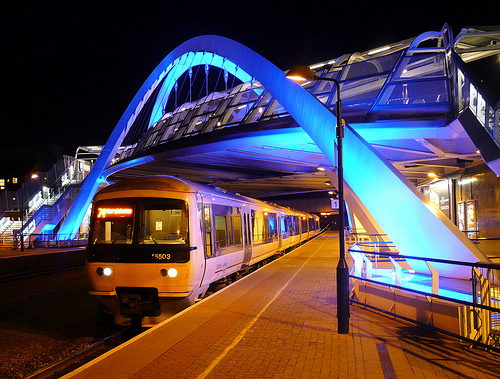

Fare Is Fair – How to get the lowest price for your rail travel

A survey of over 700 university students in the UK found that 99% overestimated the lowest possible price of a single ticket between London Euston and Manchester Piccadilly.*

How often do you see low priced tickets though? I did loads of train travel as a student and the long distance journeys were pretty costly. Not having enough money, I had to seek out the best prices.

photo by R~P~M

photo by R~P~M

The student survey, for thetrainline.com, discovered that 72% were aware that a Young Person’s (16-25) Railcard can save a third off fares, but only a quarter of the respondents knew that more savings could be made by booking ahead.

I was hot on the cheap advance tickets. Even after I found the cheapest fares, I still got another third off the price with my 16-25 Railcard.

You have to be quick to get the very best prices. Tickets for the next long holiday may not be the first thing on your mind the moment you arrive back from the last holiday, but advance legwork may be the best way to save some serious cash.

Ian Hildreth, thetrainline.com’s Marketing Director, says, “The cheapest Advance train tickets for travel in the Easter break go on sale up to twelve weeks in advance”. He advises students to sign up to their Ticket Alert email so you get the lowdown on when the tickets you want go on sale. That way, you’ve got the best chance to grab a great deal.

Another way I search for the cheapest deals is through the National Rail website, where they offer a cheap fares finder. They check the different train operator’s prices for you and they can vary a lot. Be flexible about dates if you can, because you’re more likely to find the best deals that way.

Even if you have to book at the last minute, it’s still worth seeking out a cheaper advance ticket a day or two before the journey. In fact, Martin Lewis says on moneysavingexpert.com, “Always check if advance tickets are still available, even if you’re on the way to the station”. Check out the MoneySavingExpert section on rail travel for more tips, including hardcore tactics such as splitting your tickets for even bigger savings.

*If you’re wondering, the lowest priced fare from London to Manchester is £12. I did check a date in the future to see this for myself. Those prices were available, but they can go fast. And remember, with a Young Person’s Railcard, that price goes down even further to £8. Good times!

Upfront fees, perks for the rich, and the social mobility problem

Got cash? Feeling flush? Pay your money up front and enjoy the university YOU want to attend.

photo by alancleaver_2000

photo by alancleaver_2000

David Willetts, Minister for Universities & Science, is looking at proposals that allow rich students (or rich parents) to pay higher fees up front to attend university. These places would be ‘off quota’, so they would not change numbers going through standard channels of application.

But Willetts’ argument is facing a backlash from the outset. Willetts suggests that social mobility will improve because there will end up being more places available to students who cannot afford to pay straight up.

While the proposals have not yet been agreed and details are yet to be finalised, that hasn’t stopped negative opinion from emerging. Twitter has been awash with it this morning. By example, two major complaints of the idea are:

  1. Rich people will be able to choose the institution they wish to attend, thus making some universities more elitist;
  2. To cite social mobility is upsetting for many who simply see this move as an opportunity for rich people to buy a place while a standard student doesn’t have this guarantee.

Today’s report in The Guardian highlights the complexities and potential problems, but also the possible benefits from the new ideas under discussion.

There is no answer to what’s under discussion, because no detail has been agreed. On top of this, we’re already facing massive changes in terms of fees and funding both for students and for universities. This new proposal is yet another alteration that adds to the confusion. It’s almost impossible to find a solid base to work from to help higher education or students at the moment.

Entry requirements are set to be the same for those looking to pay more, yet there is still much chatter on Twitter of buying places without the grades. Willetts said on Radio 4 that this type of practice is not under proposal.

If entry grades are, therefore, set to be the same as standard places, what benefits would someone paying up front have?

  1. Practically guaranteed place to the institution you choose to pay for (because it’s not a place under quota);
  2. Money paid now means there is no need to think about loans and paying off in the future.

The first point is much more powerful than the second. Rather than worry about an oversubscribed institution, one payment after you get the grades is all you need to go where you want.

Yes, it’s a perk. Yes, entry is based on wealth (after grade requirements have been met). But that doesn’t mean it cannot be used positively. The detail needs to be careful so as not to create an elitist normality. Additionally, much of the cash should be redistributed to help less affluent applicants and the like. In no way should this be seen solely as a money-making exercise for institutions, even if institutions require more cash. Balancing the books this way would set a dangerous precedent.

Unfortunately, discussion has been limited this morning because of the angle given to the new proposals. In mixing advantages for rich people with improving social mobility, any chance of debate and constructive discussion over these proposals has been blown out of the water.

http://twitter.com/wesstreeting/statuses/67867820486180865

If, despite the almost immediate backlash, the government proposals become a reality, I imagine they will ditch the ‘social mobility’ justification. I wouldn’t be surprised if they’re looking to move away from that angle already.

UPDATE: When I mentioned a backlash, I wasn’t exaggerating.

In fact, such opposition meant the government had to rush out a statement on this matter. David Willetts said:

“We will only consider allowing off-quota places where it contributes to the coalition commitment to improve social mobility and increase fair access.

“There is no question of wealthy students being able to buy a place at university. Access to a university must be based on ability to learn not ability to pay.

“We have been discussing the idea of charitable donors and employers endowing additional places on a needs blind basis which will be subject for consultation in the higher education white paper.” [Source]

Wonkhe has also posted on the off-quota places issue and admitted, “May need to update later on as things move”.

It is a fast moving day. And It’s only midday at time of writing this! To put it into perspective, the final (amusing) thought can go to Thomas Graham:

http://twitter.com/thomasgraham/statuses/67908848303878144

What will be the future of education?

Lord Browne’s Independent Review of HE Funding and Student Finance is due tomorrow.  If reports on the content of the review are to be believed, students are not going to be happy.

As students across the country prepare to march in London on 10 November 2010, I’d like to share some quotations with you that I spotted recently.

First up, on what education has become:

“There is no denying that education is an essential preparation for life and work in an advanced economy.  Modern economies require skilled and motivated workers, who can only profit from the opportunities they afford if they are equipped to respond to their demands.  So much is now received wisdom.

“But a large part of the problem with education is that this connection has become too direct.  Aristotle said that we educated ourselves so that we can make noble use of our leisure; this is a view directly opposed to the contemporary belief that we educated ourselves in order to get a job.  To that extent the contemporary view distorts the purpose of schooling, by aiming not at the development of individuals as ends in themselves, but as instruments in the economic process.”

A.C. Grayling, The Meaning of Things (2001)

The connection between education and economy comes even closer, showing no signs of stopping:

“…universities in need of funds had little choice but to accept corporate money.  As social status and career success correlated ever more closely with service to profit-making entities, many academics were willing to play along.  A Labour Education Secretary, Charles Clarke, channelled the spirit of the age when he claimed that the idea of education for its own sake was ‘a little bit dodgy’; students, he insisted, needed ‘a relationship with the workplace’.  This insistence that market values can be applied to education continues to inform both policy and rhetoric.  In November 2009 the irrepressible Peter Mandelson was promising a ‘consumer revolution’ in higher education.”

Dan Hind, The Return of the Public (2010)

The Browne Review is expected to recommend a continuation of this ‘consumer revolution’ by suggesting higher fees, a real rate of interest on loans, and the possible lifting of the fee cap altogether.  Universities must, therefore, ask (and answer) crucial questions on student matters:

“What is the value we add for each and every student above the basic cost of paying the staff who teach them and providing the core facilities that they have to have? We should be able to answer this question anyway, irrespective of whether the substitution of private for public funding of teaching goes through, and whether or not the cap on student fees is set at £5,000, £7,000 or more than £10,000. Being able to account for our premium will be essential both to setting the prices of our qualifications in the future, and to remaining competitive in a rather different world.”

Prof. Martin Hall (Vice Chancellor at Salford)

The BBC has a load of links with information on the future of universities and fees, but that detail and speculation cannot answer the question as posed by Professor Hall.  Each university will need to have an individual response based on their own position and qualities.

While this rolls along, the ‘student as consumer’ problem looms.  The Quality Assurance Agency (QAA) published a series of documents on “Rethinking the values of higher education” in 2009, looking beyond the simplistic and misleading ‘consumer’ tag:

  1. Students as change agents?
  2. Consumption, partnership, community?
  3. The student as collaborator and producer?

Whatever the Browne Review concludes, and however students are perceived, we still have to see whether the coalition government will be in a position to feasibly implement the recommendations.  If the key recommendations are as expected, I’m not sure they can.