Durham University are about to start a module on Harry Potter. Students on an Education Studies degree will get the chance to study Harry Potter in a social, cultural and education context, as well as consider the relevance of Harry Potter to education and how it impacts upon 21st Century education.
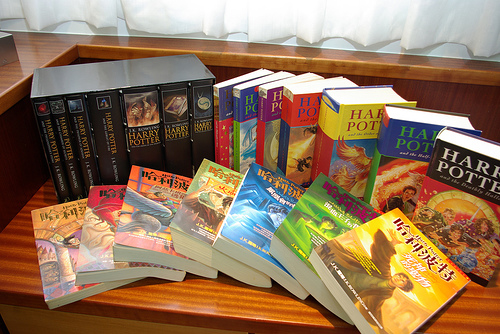
photo by bibicall
The course will not just look at the books, but explore the entire Harry Potter phenomenon.
Unfortunately, as soon as something popular or recent becomes an area of study, sensationalist headlines aren’t far behind.
For instance, the Daily Star ran the headline, “A HARRY POTTER DEGREE“.
A module isn’t a degree. But some people will now think lazy students are going to spend three years doing nothing but reading J. K. Rowling’s books and perhaps writing the odd essay about what they’ve read. If they can be bothered. Bloody students…
The worldwide success and impact of Harry Potter gives it credibility to study further in an academic sense. Serious attention will be given to the way Rowling’s books have changed the world and made a mark. It would be sensible to study the texts, examine the historical perspectives, research the current and future impact, understand the way in which Harry Potter has changed the face of publishing and literature (if at all), and a whole host of other things.
Just look at Durham’s official module description for “Harry Potter and the Age of Illusion” and you’ll see an educational context given to the area of study.
It is entirely sensible for Education Studies students to be offered a module examining the influence of Harry Potter on education. Rowling’s novels are books for children that have sold millions of copies worldwide and gone way beyond the books themselves…if this isn’t a subject worth studying further, what is?
This isn’t the first time Potter has been frowned upon. In 2008, one exam board included “Harry Potter and the Philosopher’s Stone” on their syllabus. As well as accusations of ‘dumbing down’, it was argued that recent works should not be included as they hadn’t stood the test of time.
Even if I believed this mattered, I would still argue that ‘standing the test of time’ doesn’t have much meaning. There is no ruling to argue what should and shouldn’t stand the test of time. The fact a book is placed on a syllabus means that it could remain there for many years. In a decade, will Harry Potter have acceptably stood the test of time simply because it had spent a few years on a syllabus? Forget the popularity and world-changing events surrounding the Potter brand, it’s still on an exam so it’s stood the test of time…
Back to the Daily Star article. They print a comment from Nick Seaton, Chairman of the Campaign for Real Education. Seaton is quoted as saying “It does not merit a course at one of the country’s top universities”.
What makes this module less worthy for study than another module? There are plenty of modules that look at literature from recent decades and they don’t even explore the impact on education and culture in the way this Harry Potter module will. Does that mean all modern and postmodern literature modules should be scrapped?
Or perhaps the problem is because Harry Potter is not a science subject.
Science is, of course, on the cutting edge. It regularly explores the ‘yet to be’. Funnily, I don’t hear anyone complaining that the work is pointless because it hasn’t stood the test of time.
Okay, facetiousness to one side, let’s say we do look at STEM subjects (Science, Technology, Engineering, Maths) as the important areas for academic study. The government certainly do. Should popular culture or emerging literary concepts be dismissed as irrelevant areas of study?
For instance, a decade ago, complaints were raised when Staffordshire University offered a course on ‘David Beckham Studies’. What is the point of awarding a degree in Beckhamology?
But there was no David Beckham degree. In this instance, a ‘Football Culture’ module covering the history of football included a focus on David Beckham’s impact in recent years. The degree itself was Culture, Media and Sport. Put in context, I find no problem with this idea whatsoever.
However, misinformation and sensationalism results in ridicule, making a mockery of higher education. No wonder the public are quick to dismiss students as lazy and complain that there are simply too many graduates entering the workforce based on no proper work at all.
But these are false trails. Any proper argument about graduate numbers, dumbing down, and so on, are left to one side as soon as conversation turns to ‘Mickey Mouse’ degrees and pointless areas of study.
In 2008, The Times talked of academic speeches covering the study of David Beckham. Among them was Momin Rahman’s “Beckham: How ‘Queer’ serves ‘Heterotopia’ in the dialectics of celebrity”.
So what was Rahman actually talking about? He asks, “What purpose does masculinity serve in contemporary society? What does it mean to be a man? Beckham has become a symbol of this whole issue.”
Rahman was looking at culture. David Beckham was a valid route in. The study of Beckham has gone beyond Beckham and asks some searching questions.
There are no easy answers to those questions. Unsurprisingly, this is where academia comes in.
Academics have long explored topics that are foreign to many. Shouldn’t this be a good thing? If the work all made perfect sense and was obvious to all, it wouldn’t be research. No new ground is covered when there’s nothing left to discover.
Why can we not use Harry Potter and David Beckham to find that new ground? As soon as a higher level of study is brought to a topic with great public awareness and engagement, it’s like the world can’t make sense any more. Is it really so difficult for a subject to be popular AND academic?
Press offices at universities must find the process of announcing new modules quite daunting. On one hand, your uni is introducing something:
- brand new;
- exciting;
- popular;
- yet to be covered elsewhere.
On the other hand, the subject could be seen as:
- a publicity gimmick;
- a shameless way to encourage higher student sign-up;
- an exercise in dumbing down;
- a subject with no true academic relevance.
The study of something that has made a significant difference to many people must be a good thing. The Harry Potter set is worthwhile of study because it is not simply a series of books. David Beckham is worthwhile of study because he is not simply a footballer.
I don’t follow football, neither do I care what impact David Beckham has had on wider culture. But I do know his impact has been massive and I do know that enough people care. That, in my view, is more than enough to allow a focus on Beckham within a module on Football Culture, within a course on Culture, Media and Sport.
I would question a whole degree on David Beckham or Harry Potter in the same way I would question a whole degree on Jane Austen novels or atomic structure and bonding. To get that in-depth on an isolated area is postgraduate territory and beyond.
But nobody is offering a degree on Harry Potter books. Or Jane Austen novels. Sensationalist headlines and entertaining news features don’t do higher education any favours when the detail isn’t accurately portrayed or explained.


 TheUniversityBlog