“If there’s a word or phrase you don’t understand in the lecture, write it down and look it up when you get home, and add it to your notes. It reduces that panicky feeling of not understanding anything!”
Yup. It’s that simple.
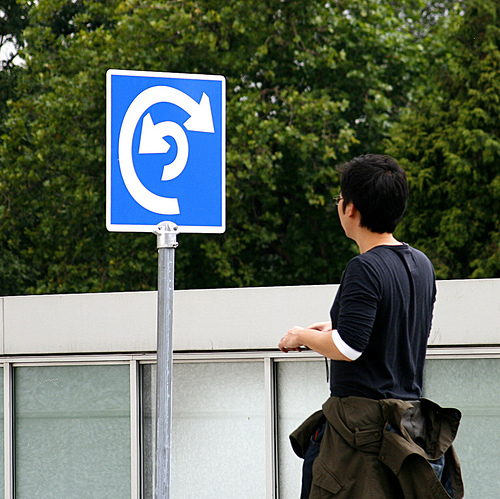
Not everything is obvious straight away (photo by Doug88888)
When you hear a word or a concept that makes no sense, you can do one of two things:
You stop what you’re doing and feel confused. In the end, you miss more of the lecture;
OR
You happily note down what you don’t understand to look up later at your own convenience.
Eliminate the panic and stay focused. Do number 2!
The next time you don’t get something, acknowledge it and deal with it later. It’s the best way to stop your mind from wandering and to keep your confidence intact.
In the book Positive Linking, Paul Ormerod says that the top 3 items on a Google search account for 98% of clicks. The top 1 item, the top result that comes back, accounts for 60% of clicks.
If almost every click occurs in the first three results, Google could go as far as leaving just 4 results on a page and almost nobody would notice. There may even be a slight upward trend in users clicking that fourth link, “just in case”.
Four results to a page may even become a reality. SERoundTable reported that Google are testing that four result option, among other combinations.
One reason why so many clicks are on the first result is because many people search for a site through Google when they know the web address anyway. For instance, a Google search for Facebook is done a lot of the time instead of actually typing facebook.com in a web browser.
When logged in to Google, you have the option to ask for more results per page. Check the preferences page to alter what comes through. I currently have Google set to give me 50 results to a page. If Google took that option away and only allowed four results to a page, I’d be hugely frustrated.
What if Google made every first search a 4-result page and made each subsequent page a 50-result page (or whatever you preferred)? I’d probably still be frustrated, because many of my searches rely on more than the first few results. I’d probably learn to live with it though.
Phil Bradley wonders if Google are looking to get more advertising coverage with fewer results to a page. Whether or not this is the case, this will impact power users than average users.
Keep on searching (photo by gerlos)
As a student, you should be a power user as often as possible. Go beyond the first few results. Be the 2%.
Try out different searches if the first one doesn’t help. I’ve been known to make subtle changes to a search, yet get wildly different results.
When I read the headline that Nick Clegg had apologised over the Liberal Democrat tuition fees pledge, I shrugged. It’s nothing new.
I did wonder “Why now?” and found that the Lib Dem Conference is coming. Clegg’s video apology is a party political broadcast solely dedicated to when they made the pledge to vote against any type of tuition fees rise, under any circumstances.
It didn’t take long for an ‘honest’ subtitled version of the video to emerge. There’s even an auto-tune mix of Clegg’s broadcast.
While much of the Twitter response and online comments have decided not to play along with the apology, there has clearly been some playing along for laughs.
You don’t get to see many MPs saying a very direct ‘sorry’. Nevertheless, it’s unlikely that many policy wonks, student leaders and HE staff will give it time of day.
The video wasn’t made for those of us more involved, though. These things are produced in order to cover a wider public whose interest hasn’t strayed much beyond what’s in the papers and on the news. Helen Lewis in the New Statesman says, “Making the video is a bold move from Clegg”.
Will it be enough to soften up some people and bring a renewed optimism to some of the public? The reaction so far suggests it might not. And while it’s hardly scientific (and probably still not looking at a wide enough cross-section of the public), there are nearly three YouTube dislikes for every one like on Clegg’s apology video (at time of writing, 392 likes, 1027 dislikes).
NUS President, Liam Burns, said that Clegg should apologise for breaking the pledge, not making it. Clegg expressed regret in the past for having made the pledge. Has there been any regret in having broken it?
Clegg’s move is an attempt to draw a line under an issue that already had a line drawn under it many moons ago. This apology doesn’t do anything new. Votes were cast, the choices were made, the game was changed, and the situation is playing out as we speak.
That situation continues to change and we’re bound to see more policy tweaks ongoing. Think of it as the policy equivalent of the credit crunch. If enough people make enough changes and they all impact on each other, the resulting confusion will ensure that nobody knows what’s going on where, how everything is linked any more, or how to get back on track.
Clegg’s apology video is not a change in policy. Neither does it put matters in a new perspective. For a view of Clegg’s position when the tuition fees issue was still fresh, look no further than William Cullerne Bown’s assessment from 2010.
‘Sorry’ seems to be the hardest word…And for many students, ‘Apology accepted’ may be the hardest reply.
The Palgrave offering may not be the cheapest, but the layout and the extras were worth it for most users. One person goes as far as calling the planner “an absolute Godsend”.
Over at Amazon, one user has helpfully added a few shots of what’s inside the planner. It’s all specific to students (as you’d expect!) and laid out nicely.
I’ve never used this planner myself, but with a lot of love over at The Student Room, it’s worth a mention. The 44 five-star reviews and average score of 4.6 stars on Amazon paint a positive picture too!
A diary is a great step for sorting your life out and getting things on track. Timetabling is a mental necessity one way or another. Beyond these plans, you may also want to keep an academic journal about what you’re learning, why you’re learning, the things you want to learn more, and so on.
There are loads of different diaries and planners out there. Do you have a favourite diary that you return to every year? Have you discovered the perfect planner? Or do you have a completely different way to arrange your year ahead? Let us know!


 TheUniversityBlog