Business Secretary, Vince Cable, made a speech this morning about the future of higher education. He has discussed a graduate tax, 2-year degrees, and various measures that can cut costs, but retain high standards.
Click here to see a Wordle of Cable’s speech

Would sweeping changes like 2-year degrees make a big difference? Maybe. Can ‘higher education’ as a wide collective term be expected to embrace such ideas without problem? No.
While some universities are bound to jump at the chance of a two-year degree structure, others will be vehemently against it. The difference of opinions will be down to this:
“We don’t know what higher education is for any more.” [source]
This comes from the previous President of Dublin City University, Ferdinand von Prondzynski. He makes a sensible point.
Put another way, higher education has been given too much to do. Too much dilution results in not enough focus. Two-year degrees can’t be made to work across the board. Cable said we need to “re-think the case of universities from the beginning”. The re-think on higher education needs to cover HE as a concept and as an entire sector.
While I am happy to see discussion and new thinking about 2-year degrees, it isn’t simple to wave a magic wand and change the landscape of higher education. Academics with large research responsibilities are already stretched for time, so where would the extra teaching time come from? Additionally, 3-year degrees cannot just disappear so the option would need to remain. It would be entirely unreasonable to see a drop in teaching quality and standards as a result of new degree models.
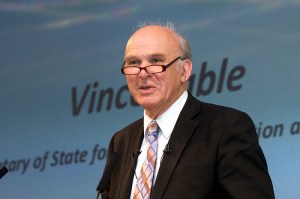
Vince Cable (photo by bisgovuk)
Vince Cable hasn’t actually made any policy proposals this morning, but he is pointing toward a future that he would like to see. He is urging the Browne Review to consider a graduate tax as a feasible alternative to the current fees system. Cable said his suggestions may sound radical, but are not. He asks that we continue the debate and make some truly radical moves to help the future of HE.
Radical proposals are fine so long as they have a solid foundation. A change for the sake of change is no guarantee of a better way.
Is now the time to see universities coming together in collaboration, rather than fighting for scraps in a panic that they might lose what is dear to them? I would love to see better engagement and participation between institutions. At the same time, I would like to see those institutions in a position where they can showcase their unique traits with ease.
One way for universities to develop their unique identity is through a powerful mission statement. Right now, current mission statements could come from any university, as Times Higher Education discussed earlier this year.
With this in mind, I believe the following ideas are also worth pursuing:
- Give universities more freedom in creating their specific mission, vision and values;
- Allow universities to develop their specialisms more easily, so long as they are unique, have valid reasoning, stick within their mission aims, and give teaching at least as much priority as research;
- Promote greater collaborative engagement between institutions;
- Ensure institutions do not pick only the most profitable degrees and methods of assessment;
- Acknowledge the wide remit HE has rather than pretend all institutions are the same and/or ignore their major (sometimes uniquely defining) differences.
These ideas would identify what would suit each institution, while also giving students better information on deciding where to study, what will benefit them, and why an institution can deliver that for them.
Many ideas are being touted, leaked and proposed regarding the future of higher education. From new ways of funding through to different degree models, we may see certain fundamental ‘rules’ rewritten. I am ready to treat this time with enthusiasm, although it doesn’t stop my fear that some decisions could be rushed. Indeed, some choices may be made that are based solely on cost and saving money. These are difficult times as much as they are interesting times. Everyone needs to tread carefully here. Not just students, not just staff, not any single group. HE covers so much ground that most people are (or will be) involved in one way or another.
HE stands for so much that we need a different way of classifying what each institution, or department, or member of staff, or student, is working toward. More from von Prondzynski:
“It is time for something better. It is time to understand what part of higher education is vocational, and what part is educational in a broader sense. It is time to have a plan about how graduates will develop their careers on leaving education. It is time to state more clearly what we see as the benefits of higher degrees, particularly doctorates. And it is time to engage and motivate those working in higher education so that they can apply energy and skill to their tasks and so that they can lose the instinct to feel nostalgic about whatever went before.”
I am writing this post fresh from hearing Vince Cable’s speech and getting feedback from commentators, blogs, news posts, and my Twitter feed. There is a lot of excitement, a lot of confusion, a lot of ideas, a lot of backlash…a lot of everything, quite frankly.
Times Higher Education started a #loveHE campaign recently. The very reason why a mere speech stirs up so many emotions shows just how many people do love higher education. The conversation — and the love — is starting to move out toward the wider public. Whether you love or hate what Vince Cable has said and no matter how you will eventually feel about the outcomes of such wide debate, it’s crucial that we keep that love of higher education going.
Are we in this together?
Further links:
- NUS welcomes graduate tax
- Russell Group against new graduate tax
- Gary Gibbon of Channel 4 News on Vince Cable’s speech
- Nik Darlington – Dr Cable ends cold war over tuition fees
- Times Higher Education – Cable sets out radical plans for academy’s future
- UCU on graduate tax
- Million+ says grad tax must not be an excuse to cut student numbers
- 1994 Group – ‘A bold and progressive vision for the sector’
- Mario Creatura – Two year degrees: opening Pandora’s box
- Guardian – Graduate tax urged to replace tuition fees
- Guardian – Graduate tax will force students to pay more for degrees
- Telegraph on two year degrees
- BBC – Vince Cable proposes graduate tax in funding rethink
- BBC Q&A on university funding



 TheUniversityBlog